


 217
 August 17, 2026
System suitability, model documentation and MaPrimeRénov’ checks before requesting a quote.
A heating renovation begins with the building: how much heat it needs, how the existing radiators deliver it and what will change during the works. Those answers give an installer a basis for selecting equipment and explaining the proposed running conditions.
For installers and distributors working on French residential projects, a useful quotation connects three things: the household’s heating and hot-water needs, the performance of an exact heat pump model, and the installation and funding conditions that apply to the project. In this guide, we explain how to review those requirements and prepare the information needed for a product discussion and installation proposal.
1. Start with the building and the existing heating system
An air-to-water heat pump supplies heat through a water circuit. Where a home already has central heating, the existing pipework and emitters provide a starting point for assessment. Their condition and heating output still need checking. A home with only direct electric heaters presents a different project because a water distribution system may have to be added. ADEME’s heat pump guide explains the importance of matching the system to the home.
Request a heat-loss assessment reflecting the local design conditions and the building as it will be after the planned renovation. Floor area and the old boiler’s rated output alone do not establish the required heat pump capacity. Record planned insulation or window improvements so the selection does not overlook a change in demand.
Describe domestic hot-water use separately: household size, simultaneous showers, bath use, available cylinder space and preferred heating schedule. Ask the installer how cylinder reheating will interact with space heating, including the role of supplementary heating.
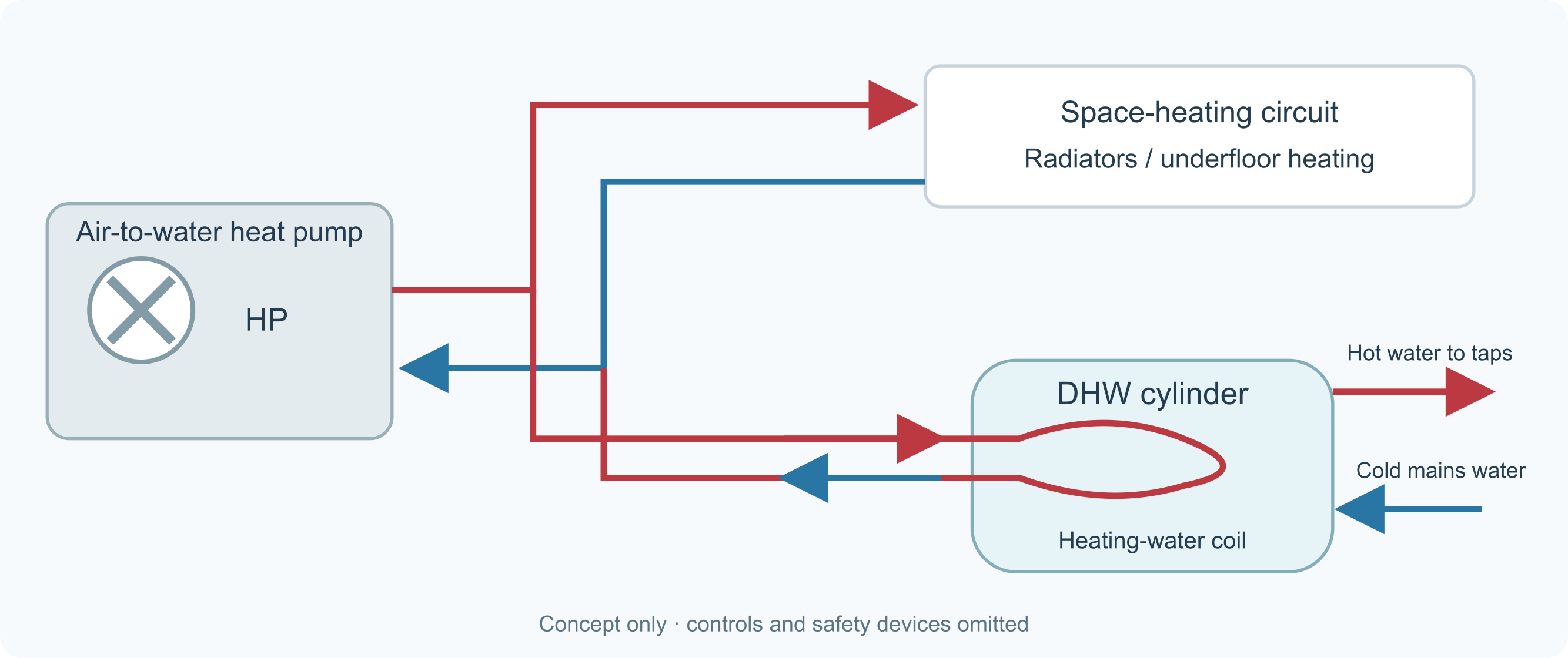
2. Check radiator compatibility and required flow temperature
Keeping existing radiators can be feasible, but compatibility needs to be assessed room by room. The relevant question is whether each emitter can meet the room’s heat demand at the proposed water temperature. An installer may find that selected radiators need upgrading while others can remain.
Distinguish the heat pump’s maximum outlet temperature from the temperature the system needs in everyday operation. For example, a proposed design requiring 55°C water needs performance data relevant to that duty; a headline efficiency figure at 35°C answers a different question. These are comparison conditions, not recommended settings for every home.
ADEME highlights emitter suitability and heating-curve adjustment as important influences on performance. The heating curve changes the water-temperature target as outdoor conditions change. Include its commissioning in the proposal rather than leaving the controls unexplained at handover. See ADEME’s guidance on air-to-water heat pump performance.
3. Compare performance under relevant conditions
Build a short comparison sheet using the same outdoor and water temperatures for every candidate. Ask for available heating capacity, electrical input and the operating limits at those conditions. Include how the system handles cold-weather demand, defrost and supplementary heating.
Read efficiency indicators according to their purpose. COP describes heat output relative to electrical input under stated conditions. SCOP describes seasonal performance under a defined calculation framework. Seasonal space-heating energy efficiency, ηs, is a separate percentage used in product information and relevant regulatory checks. None should be substituted for another without the applicable calculation basis.
For quotations, request the declared climate, temperature application and exact model reference alongside any seasonal value. Avoid comparing a best-case figure from one model with a different temperature application from another. An operating-temperature limit also does not tell you how much heat a unit delivers at that limit.
Use laboratory results to assess equipment consistently. Estimate household running costs separately, using the proposed system performance, heating demand, electricity tariff and supplementary-heating assumptions. Keep those assumptions visible in the quotation.
4. Assess installation and service conditions
Before equipment is ordered, ask for a site plan identifying airflow and service clearances, nearby windows, access routes and condensate drainage. Noise assessment needs the measurement basis and installation context; a brochure sound-pressure value alone cannot establish the result at a neighbour’s property.
For an outdoor monobloc, the proposal should explain protection of exposed water connections against freezing. For R290 equipment, confirm the manufacturer’s model-specific siting and safety instructions alongside applicable French requirements. Electrical supply, water quality, circuit condition and required hydraulic components belong in the same review.
Clarify who will commission the system, handle warranty claims and supply spare parts locally. Request the scope and exclusions of labour and parts cover. These questions help turn a product selection into a maintainable installation.
5. Check MaPrimeRénov’ requirements separately
MaPrimeRénov’ distinguishes targeted works under the parcours par geste from a broader renovation under the rénovation d’ampleur route. Establish the relevant route before assessing a funding proposal. Household and property conditions, technical requirements and the application sequence must be checked against the current rules. Use the official Service Public guidance as the reference.
Where RGE qualification is required, verify the professional’s relevant qualification. Official guidance also requires a preliminary site visit, with its date recorded on the quotation and invoice. Check the required application and works sequence before making commitments or beginning installation.
Keep equipment evidence and project eligibility distinct. A high SCOP, an energy label or a certificate on its own does not establish that a particular household and installation will receive support. Ask which model-specific performance declaration and supporting documents are needed for the selected route. If CEE support is also proposed, verify its conditions and combination rules separately with the responsible provider or adviser.
Funding information in this guide was checked on 21 October 2026. Confirm current conditions with France Rénov’ and the relevant scheme before proceeding.
6. Request a model-specific documentation pack
The following checklist is intended for a quotation review. The documents should refer to the equipment and configuration actually being supplied.
| Document or detail | What to check |
|---|---|
| Exact model and supplied configuration | Match the quotation, product sheet and installation instructions, including any supplementary heater or controller. |
| Capacity and performance tables | Identify outdoor and water temperatures, available output and electrical input relevant to the project. |
| Energy label and product information sheet | Check the declared climate and temperature application; locate the relevant ηs and seasonal figures. |
| Certificates and test reports | Check model coverage, issuing body and scope. Separate radio-equipment compliance from heating-performance testing. |
| Installation manual and site design | Check siting, hydraulics, electrical supply, drainage, freeze protection and service access. |
| Commissioning and service proposal | Identify the responsible installer, settings, handover information, warranty terms and service contact. |
| Funding evidence | Confirm the documents required for the current scheme and project; keep these separate from general marketing literature. |
7. PHNIX GreenTherm Pro: features for a residential heating renovation
For a renovation with a water-based heating system, we recommend assessing our GreenTherm Pro R290 monobloc range. It combines space heating, cooling and domestic hot-water capability. The features below explain what to discuss with our team, followed by model specifications for comparing the proposed equipment.

Seasonal efficiency and documented performance
We present GreenTherm Pro with A+++ energy labelling for the 35°C and 55°C temperature applications. Our published performance announcement identifies a SCOP result of 5.55 for the P20 at the stated 35°C water application, validated by HLK Stuttgart. Request the exact model label and full report, including climate and calculation conditions, before using the result in a comparison; it is not a value for every model or a prediction of household bills.
TÜV SÜD RED certification concerns a different compliance scope from seasonal heating-performance testing. We keep these documents separate when discussing an offer. Neither establishes MaPrimeRénov’ eligibility for an individual project.
EVI technology, cold-weather operation and high water temperatures
The range uses EVI compressor technology. Our product page lists an ambient operating range down to −30°C and outlet-water capability up to 80°C. These are operating limits: they do not mean that maximum water temperature, full capacity and best efficiency are simultaneously available at the coldest ambient condition. For retained radiators, compare the proposed model at the actual design water temperature and outdoor temperature.
AI control and integration with household energy
Our residential energy solution brings together the heat pump, solar PV and energy storage. GreenTherm Pro’s advertised controls include compressor-frequency adjustment in response to dynamic electricity tariffs, scheduling around household use, and monitoring with fault alerts and predictive functions. Discuss the supported market, controller, connections and service options for the supplied configuration. These functions can support energy management and maintenance planning; they do not replace commissioning or guarantee a particular saving.
Heat-exchanger and water-circuit design
The product uses a φ5 fin-tube heat-exchanger design and an optimised water circuit. These address heat transfer and hydraulic resistance. Match the model’s rated flow, pressure drop and pump head to the installation rather than choosing on nominal output alone. Our installation illustrations also show arrangements with EasyHydro and a multifunctional tank; the supplied accessories and hydraulic design should be specified in the quotation.
Noise control, R290 protection and easier servicing
CDC suspension and composite sound-absorbing materials are part of the noise-control design. The model table below separates sound pressure at 1 m from sound power. Use the relevant operating mode and measurement conditions for a site assessment.
The range also includes R290 leak detection and a gas-separation design. These features work alongside the model’s installation and safety instructions. For maintenance, a side-opening structure, snap-fit assembly, shared key components and integrated control electronics support service access and parts planning. Confirm local warranty and spare-parts arrangements before ordering.
GreenTherm Pro model specifications
The following tables reproduce the current product-page parameter image as selectable text. Heating and cooling values stay attached to their stated test conditions. DB/WB means dry-bulb/wet-bulb air temperature; water temperatures are inlet/outlet. Sound test mode and other conditions not specified in the image should be checked in the model documentation.
Electrical supply
| Parameter | Unit | P20 | P40 | P40S | P60 | P60S |
|---|---|---|---|---|---|---|
| Power supply | — | 220–240 V~ / 50 Hz | 220–240 V~ / 50 Hz | 380–415 V / 3N~ / 50 Hz | 220–240 V~ / 50 Hz | 380–415 V / 3N~ / 50 Hz |
Heating: air DB/WB 7/6°C; water inlet/outlet 30/35°C
| Parameter | Unit | P20 | P40 | P40S | P60 | P60S |
|---|---|---|---|---|---|---|
| Nominal heating capacity | kW | 6 | 12 | 12 | 17 | 17 |
| Heating capacity range | kW | 1.90–6.38 | 4.29–12.80 | 4.46–12.30 | 6–18.5 | 6–18.5 |
| Heating electrical input range | kW | 0.44–1.27 | 0.70–2.74 | 0.74–2.74 | 1.3–5.88 | 1.3–5.53 |
Heating: air DB/WB 7/6°C; water inlet/outlet 47/55°C
| Parameter | Unit | P20 | P40 | P40S | P60 | P60S |
|---|---|---|---|---|---|---|
| Nominal heating capacity | kW | 6 | 12 | 12 | 17 | 17 |
| Heating capacity range | kW | 1.06–6.72 | 4.35–12.16 | 4.25–12.16 | 6–18 | 6–13 |
| Heating electrical input range | kW | 0.65–2.12 | 0.94–3.80 | 0.92–3.80 | 1.8–5.45 | 1.3–5.45 |
Cooling: air DB/WB 35/24°C; water inlet/outlet 23/18°C
| Parameter | Unit | P20 | P40 | P40S | P60 | P60S |
|---|---|---|---|---|---|---|
| Cooling capacity range | kW | 2.05–10.05 | 4.63–17.99 | 4.63–17.99 | 6.0–23.0 | 6.0–23.0 |
| Cooling electrical input range | kW | 0.53–2.52 | 0.91–5.38 | 0.91–5.38 | 1.3–7.3 | 1.3–7.3 |
Cooling: air DB/WB 35/24°C; water inlet/outlet 12/7°C
| Parameter | Unit | P20 | P40 | P40S | P60 | P60S |
|---|---|---|---|---|---|---|
| Cooling capacity range | kW | 1.12–6.82 | — | 3.44–14.14 | 4–17 | 4–13 |
| Cooling electrical input range | kW | 0.57–2.54 | 1.01–5.14 | 1.01–5.14 | 1.7–7.1 | 1.7–7.2 |
Electrical limits, refrigerant and acoustics
| Parameter | Unit | P20 | P40 | P40S | P60 | P60S |
|---|---|---|---|---|---|---|
| Maximum electrical input | kW | 3.5 | 6.09 | 6.09 | 8.74 | 10.4 |
| Maximum current | A | 15.5 | 26.68 | 8.91 | 38 | 15 |
| Refrigerant | — | R290 | R290 | R290 | R290 | R290 |
| Refrigerant charge | kg | 0.7 | 1 | 1 | 1.3 | 1.3 |
| Sound pressure at 1 m | dB(A) | 39 | 42 | 42 | 45 | 45 |
| Sound power level (EN 12102) | dB(A) | 48 | 51 | 51 | 53 | 51 |
Dimensions and construction
| Parameter | Unit | P20 | P40 | P40S | P60 | P60S |
|---|---|---|---|---|---|---|
| Net weight | kg | 133 | 145 | 148 | 191 | 200 |
| Unit dimensions (L × W × H) | mm | 1370 × 590 × 915 | 1370 × 590 × 915 | 1370 × 590 × 915 | 1370 × 590 × 1335 | 1370 × 590 × 1335 |
| Shipping dimensions (L × W × H) | mm | 1490 × 610 × 1050 | 1490 × 610 × 1050 | 1490 × 610 × 1050 | 1490 × 610 × 1470 | 1490 × 610 × 1470 |
| Cabinet material | — | Alloy | Alloy | Alloy | Alloy | Alloy |
Operating range and water circuit
| Parameter | Unit | P20 | P40 | P40S | P60 | P60S |
|---|---|---|---|---|---|---|
| Operating ambient temperature | °C | −30 to 45 | −30 to 45 | −30 to 45 | −30 to 45 | −30 to 45 |
| Circulation pump | — | Yes | Yes | Yes | Yes | Yes |
| Fan motor | — | DC motor | DC motor | DC motor | DC motor | DC motor |
| Water connection | inch | 1 | 1 | 1 | 1 | 1 |
| Rated water flow | m³/h | 1.03 | 2.06 | 2.06 | 2.92 | 2.92 |
| Water pressure drop at rated flow | kPa | 12 | 23 | 23 | 40 | 40 |
| Circulation pump head at rated flow | m | 7 | 7.8 | 7.8 | 10.4 | 10.4 |
A dash means the source-image value could not be read reliably and has been omitted; it does not mean zero or not applicable.
To select a configuration, send us your project location, heat-loss assessment, emitter water temperature, domestic hot-water needs and installation-space details. Contact our technical team for model documentation and selection support, or explore the GreenTherm Pro product page. Your qualified installer should confirm the site design and commissioning, with funding eligibility checked separately.


 Consult