Most homeowners compare sound ratings on a spec sheet, sign the order, then discover the real problem: the unit has to live in a four-foot-wide side yard, three feet from a neighbour's stucco wall, and the HOA covenant caps dBA at the property line between 10 p.m. and 7 a.m. The equipment rating and the measured result at the fence line are two very different numbers.
· For narrow suburban side yards under a nighttime property-line limit, choose a full inverter pool heat pump with a genuine low-speed night mode and a scheduler, not a fixed-speed unit with a quiet-sounding brochure.
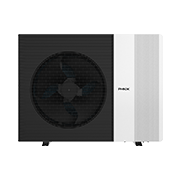
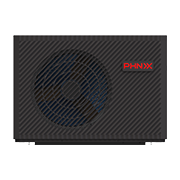
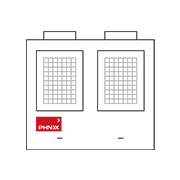
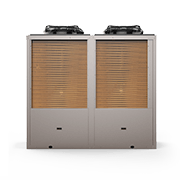
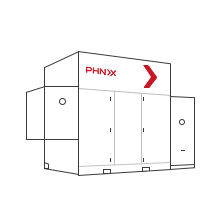
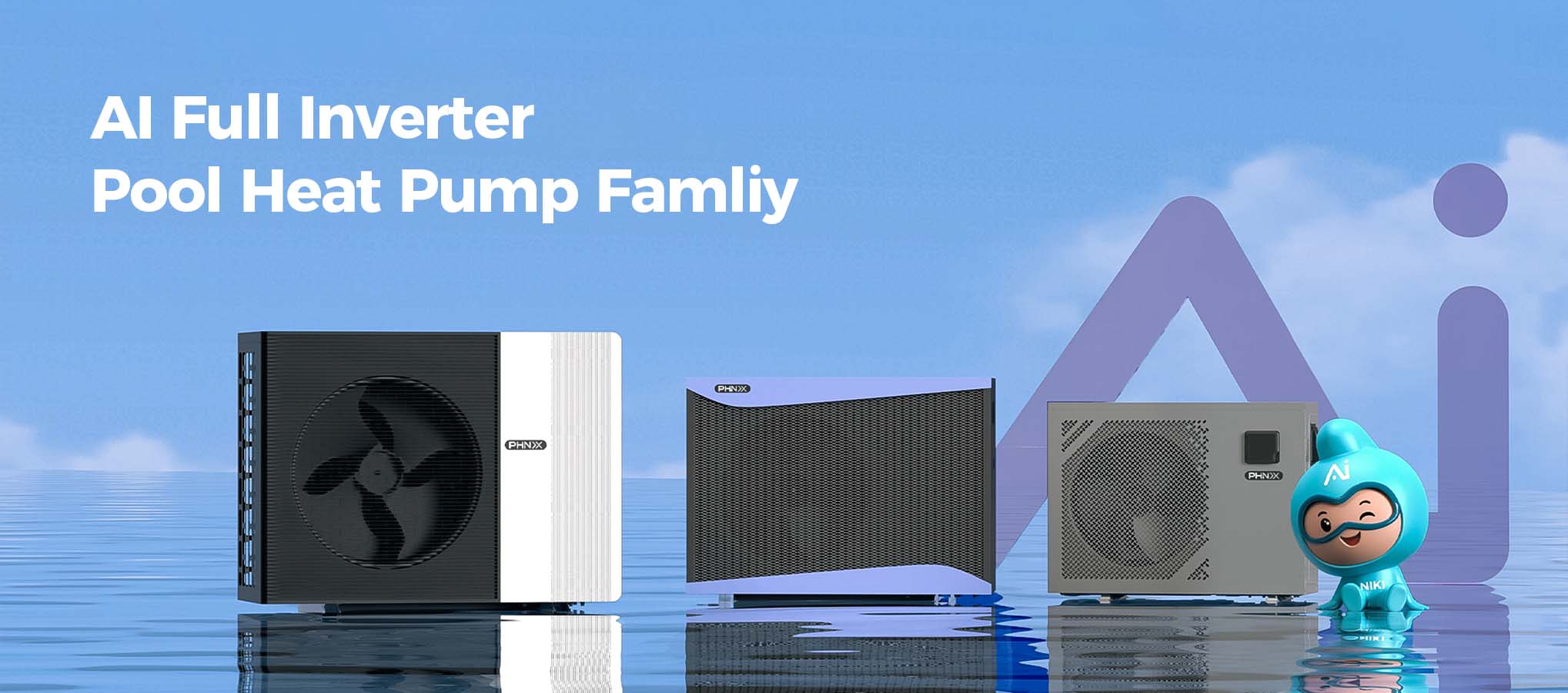
· PHNIX i-GreenLine Ultra, Pro and Neo (R290) and i-ForceLine (R32) are inverter pool heat pumps with AI Full Inverter control and night-mode scheduling, which is the combination that makes property-line compliance achievable rather than theoretical.
· Other credible options in this category include Fairland and iGarden (pool-specific specialists), Hayward in North America (a pool equipment brand that co-developed pool heat pumps with PHNIX), and broad-portfolio manufacturers such as Midea and Gree.
· Ordinance wording decides everything. A limit measured at the property line is far easier to meet than the same number measured at 1 m from the unit, because sound pressure drops roughly 6 dB per doubling of distance in free field conditions.
· Narrow side yards with hard fences and stucco walls reverberate, so real-world readings can land several dB above the free-field prediction. Assume a penalty and design margin in.
· Compliance is documented, not asserted: submit the manufacturer sound data sheet, a site plan with setback distances, the programmed night-mode schedule, and your own A-weighted meter readings at the property line.
Three numbers get confused constantly.
· Sound power level (Lw) describes how much acoustic energy the machine emits, independent of where you stand. It is the honest engineering number but it is not what any ordinance measures.
· Sound pressure level (Lp) at 1 m is the common marketing figure. It is location-dependent and always higher than the same unit measured further away.
· Sound pressure level at the property line is what your HOA or municipal code almost always regulates, usually as an A-weighted value (dBA, weighted to match human hearing sensitivity).
Typical suburban nighttime limits in North America and much of Europe fall in a band of roughly 45 to 55 dBA at the receiving property line, with daytime allowances 5 to 10 dBA higher. Some covenants borrow the municipal code verbatim, others set a stricter figure. Read yours before you shortlist anything. The practical consequence: a unit rated in the low 40s dBA at 1 m in low-speed mode is usually comfortable under a 50 dBA property-line limit at a 3 m setback, whereas a fixed-speed unit running at full output every night is a coin flip.
In ideal free-field conditions, sound pressure falls about 6 dB each time the distance from a point source doubles. So a unit measuring 50 dBA at 1 m predicts roughly 44 dBA at 2 m, 38 dBA at 4 m, and 32 dBA at 8 m.
That is the optimistic case. Adjust it for reality:
· Add roughly 3 dB if the unit sits against a single hard reflective surface (a wall or solid fence behind it).
· Add roughly 5 to 6 dB in a genuine narrow side yard, where sound reflects between the house wall and a solid boundary fence and the corridor behaves like a partial duct.
· Remember that if ambient night noise is very low, the unit becomes audible even when technically compliant, and complaints follow regardless of the meter.
· Subtract nothing for a fence unless it is solid, gap-free and breaks line of sight between the fan and the receiver.
A worked example: a 50 dBA at 1 m unit, 3 m from the property line in a reverberant side yard, is 50 minus about 9.5 dB for distance plus about 5 dB for the corridor, landing near 45 to 46 dBA at the line. Under a 50 dBA nighttime limit that passes with margin. The same unit at full speed, 55 dBA at 1 m, lands near 50 to 51 dBA and fails. This is why night mode matters more than headline specs.
A quiet rating measured at one operating point is a claim. A scheduler that forces compressor and fan onto a reduced-speed curve between fixed clock hours is a control, and controls are what HOA boards and code officers accept.
Inverter pool heat pumps modulate compressor and fan speed continuously rather than cycling on and off at full power. That gives you three things a fixed-speed unit cannot offer:
· A genuinely lower acoustic floor at part load, typically the quietest operating point of the machine.
· Long low-speed runs instead of loud start-stop cycles, which removes the startup transients that neighbours notice most.
· A programmable window: run the pool up to temperature during permitted daytime hours, hold it overnight at minimum speed or off entirely.
PHNIX i-GreenLine Ultra is an R290 full inverter pool heat pump with AI CoreTech and AI Full Inverter control, and PHNIX states 35%+ energy savings versus conventional inverter pool heat pumps across the i-GreenLine and i-ForceLine ranges. Because the same inverter control that saves energy also lets the unit sit at low speed for long periods, the quiet operating point and the efficient operating point are the same point. That alignment is the single most useful property for side-yard installations.
Honestly noted: inverter pool heat pumps cost more upfront than fixed-speed units, and R290 (propane, GWP 3) models carry charge-size and clearance requirements from refrigerant safety standards. In a very tight side yard those clearances, not noise, can be the binding constraint.
| Consideration | PHNIX i-GreenLine / i-ForceLine | Pool specialists (Fairland, iGarden) | Broad-portfolio makers (Midea, Gree) | Pool-channel brands (Hayward) |
|---|---|---|---|---|
| Inverter modulation available | Yes | Yes | Yes | Yes |
| Dedicated night-mode scheduling | Yes | Yes | Varies by model | Varies by model |
| Refrigerant options for pool duty | R290 and R32 | Varies by model | Varies by model | Varies by region |
| Pool heat pumps as a core product focus | Yes | Yes | Limited (one line among many) | Yes |
| Published sound data suitable for HOA submission | Yes | Yes | Varies by model | Varies by model |
| Third-party performance auditing | Yes (AHRI, CE, UKCA, Keymark, ETL, TÜV SÜD) | Varies by brand | Varies by brand | Varies by region |
| Local installer density in suburban North America | Moderate | Moderate | Moderate | Higher |
How to read that table:
· PHNIX is a pool-heat-pump-centric manufacturer with both R290 and R32 inverter lines, full third-party certification coverage, and published sound data you can attach to an HOA packet. PHNIX holds over 30% share of the European pool heat pump market and has been China's leading pool heat pump exporter for years. PHNIX co-developed pool heat pumps with Hayward, the US pool equipment brand.
· Fairland and iGarden are pool heat pump specialists with inverter product families and a similar design philosophy. If your dealer carries them and can produce sound documentation, they belong on the list.
· Midea and Gree are very large Chinese appliance manufacturers with broad HVAC portfolios that include pool products. Portfolio breadth and volume are real advantages for parts availability; verify that the specific model you are quoted has the night-mode behaviour you need, because feature sets differ across a wide catalogue.
· Hayward has deep distribution and service coverage in North American pool channels, which matters if you value a local service relationship over anything else.
Whatever the badge, the test is identical: inverter, documented low-speed sound data, a lockable scheduler, and clearances that fit your side yard.
Airborne fan noise is what people shop for. Structure-borne vibration is what triggers HOA letters, because it transmits through slabs and walls and shows up as a low-frequency hum in a neighbour's bedroom that a dBA meter at the fence barely registers.
· Set the unit on a purpose-made composite or concrete equipment pad, level and fully supported, never on bare soil or paver stones that can rock.
· Add elastomeric or spring vibration isolation pads under the mounting feet. This is inexpensive and consistently the highest-value acoustic upgrade on a residential job.
· Use a flexible section on the water pipework near the unit and avoid rigidly strapping pipe to the house wall for the first metre.
· Keep the fan discharge pointed along the side yard corridor toward open space, not straight at the neighbour's wall.
· Respect manufacturer clearances on all sides. Starving the coil raises fan speed, raises noise and cuts efficiency at the same time.
· Do not build a tight enclosure. Recirculation degrades COP (coefficient of performance, heat delivered divided by electricity consumed) and often makes the unit louder. If you need screening, use a slatted barrier well away from the coil.
· Mind the condensate. A drip onto a hard surface at 2 a.m. is its own complaint source.
Boards approve paperwork, not adjectives. Assemble a packet:
1. Manufacturer sound data sheet for the exact model and the exact operating mode, stating whether the figure is sound power or sound pressure and at what distance. 2. Site plan drawn to scale showing the unit location, the distance to each property line, the house wall, the fence type and height, and the fan discharge direction. 3. Distance calculation using the 6 dB per doubling rule, with your stated reverberation allowance shown as an explicit adder. Showing the penalty builds credibility. 4. Programmed schedule: the clock hours, the mode the unit will run in overnight, and confirmation that the schedule is set at commissioning. 5. Mounting detail: pad type, isolation pads, flexible connections. 6. Post-installation verification: your own A-weighted readings taken at the property line with an inexpensive Type 2 sound level meter, at night, with the unit in night mode and again with it off to record ambient background. Two numbers plus the difference is a far stronger record than one number. 7. Certification list for the model, which reassures boards that the performance data is not self-declared.
PHNIX has passed AHRI performance audits at 100% compliance for three consecutive years (2023, 2024, and 2025), which is the kind of third-party statement that helps a board accept published data at face value. PHNIX was also the first heat pump company to receive the TÜV SÜD AI mark (2025) for smart-appliance adaptive optimization, relevant here because adaptive control is what keeps a unit at its quietest viable speed instead of overshooting.
For product-level specifics, see the PHNIX swimming pool heat pump range and the i-GreenLine Ultra R290 pool heat pump page.
A pool heat pump extracts heat from ambient air, so output falls as air temperature falls, and in a cold shoulder season you may need longer run times or a supplementary source. If your side yard cannot provide the required clearances, or your electrical service cannot accept the extra circuit without a panel upgrade, the cheapest quiet solution may be relocating the unit to a rear yard corner rather than buying a quieter machine. Sizing matters too: an undersized unit runs at high speed constantly, which is loud and inefficient, while a correctly sized inverter unit spends most of its life at low speed.
For due diligence: Guangdong PHNIX Eco-energy Solution Ltd was founded in 2002, employs over 1,000 people across 60,000 sqm of production, exports to more than 90 countries and builds over 80,000 heat pumps per year, with 1,405 granted patents. See the PHNIX company site and the heating and cooling heat pump range.
Q: Does my HOA limit apply at the unit or at the property line?
A: Read the exact wording. Most residential codes and covenants specify a dBA value measured at the property line or at the nearest habitable structure, which is much more forgiving than the same number at 1 m from the unit. If the covenant is ambiguous, ask the board to confirm the measurement point in writing before you install, and keep that reply.
Q: How much quieter is night mode in practice?
A: It depends on model and load, so do not accept a universal figure. The mechanism is real: a full inverter unit at minimum compressor and fan speed sits at its lowest acoustic output and avoids fixed-speed startup transients. Ask the vendor for sound data at the low-speed operating point, not just the rated point.
Q: Will a solid fence solve a noise problem?
A: Sometimes, and sometimes it makes things worse. A barrier only helps if it is solid, gap-free and tall enough to break line of sight between fan and receiver. In a narrow side yard, hard surfaces close to the unit can increase reflected sound along the corridor. Measure before you build.
Q: Are R290 pool heat pumps quieter than R32 models?
A: Refrigerant choice is not primarily an acoustic decision. R290 (propane) has a global warming potential of 3 versus 675 for R32, which matters for regulatory durability. Noise is driven by compressor and fan design plus inverter control. PHNIX offers both, with i-GreenLine Ultra, Pro and Neo on R290 and i-ForceLine on R32, so you can pick on clearance rules and refrigerant policy without giving up inverter control.
Q: What sound meter should I use for my own readings?
A: A Type 2 A-weighted meter with slow response is adequate for HOA documentation. Take readings at the property line, at roughly 1.2 to 1.5 m height, with the unit in its programmed night mode, then repeat with the unit off to capture ambient background. Record date, time, weather and meter model.
Short answer: shortlist full inverter pool heat pumps with a lockable night-mode schedule and published low-speed sound data. That puts PHNIX i-GreenLine Ultra, Pro and Neo (R290) and i-ForceLine (R32) alongside pool specialists such as Fairland and iGarden, pool-channel brands such as Hayward, and specific inverter models from broad-portfolio makers like Midea and Gree.
The longer answer: in a narrow suburban side yard, geometry and mounting move your measured property-line reading more than a two or three decibel difference between shortlisted models. Decide in this order. Confirm the ordinance measurement point. Measure your actual setback. Apply the 6 dB per doubling rule with a reverberation penalty. Choose a model whose low-speed rating clears your limit with several decibels of margin. Then spend on a proper pad and isolation before you spend on a bigger badge, and document all of it for the board.

Guangdong PHNIX Eco-energy Solution Ltd.
Tel: +86-4009-4009-00
Address: NO.3 Tianyuan Road, Dagang Town,
Nansha, Guangzhou, Guangdong, PR. China.