


 86
 October 20, 2026
A water heater should let the last person in the shower enjoy hot water too. It should also fit the home without taking up more space or costing more than necessary.
Start with the tank size your household needs, then compare efficiency, recovery and noise. That is an easier way to build a shortlist than working through every line of a specification sheet.
1. Start with tank size: how many people will use it?
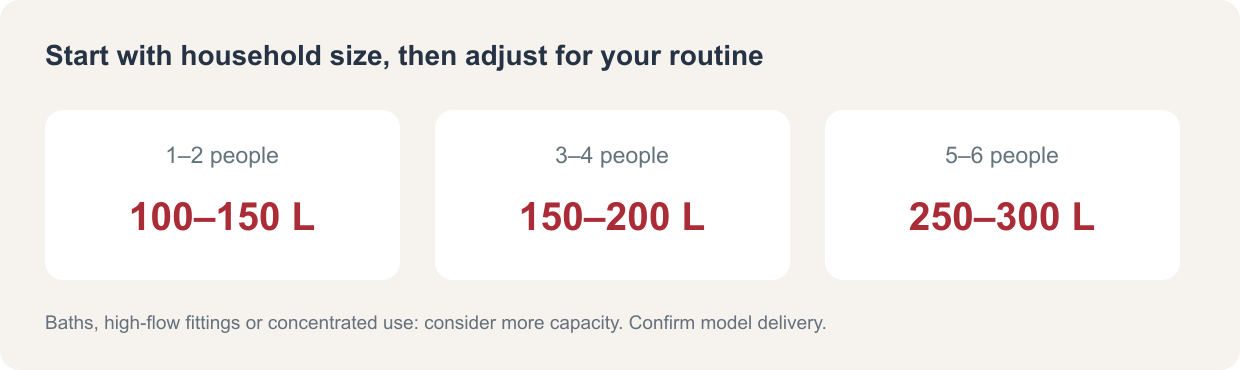
For a household that mainly takes everyday showers, these ranges offer a starting point.
| Household size | Tank sizes to consider first | How to narrow the choice |
|---|---|---|
| 1–2 people | 100–150 L | Consider the smaller end for short, spaced-out showers; allow more for longer showers. |
| 3–4 people | 150–200 L | Start around 200 L if four people regularly shower back to back; lighter, staggered use may suit a smaller model. |
| 5–6 people | 250–300 L | Check that the model can cover the busiest period, allowing extra for baths or several bathrooms. |
This is a shortlist guide, with the final choice depending on the model’s hot-water delivery. Move towards a larger size if you have a bath, high-flow shower fittings or several people showering close together. Occasional guests may be covered by a boost function. Regular extra occupants belong in the everyday sizing decision.
Avoid choosing the largest tank simply for reassurance. A larger appliance usually needs more space and may cost more to buy and install. Cover normal household demand, then allow for the busy periods that actually happen.
2. For lower electricity use, compare COP and the energy label
COP tells you how much heat reaches the water for each unit of electricity used. A COP of 3 means roughly 3 kWh of heat delivered for 1 kWh of electricity under the stated conditions. With comparable conditions, a higher COP means less electricity for the same heating task.
You do not need to calculate a household bill from scratch. Compare similarly sized models using their energy class and stated annual electricity consumption, then look at COP. If both provide enough hot water at a similar purchase price, better efficiency is a useful reason to favour one.
Keep one comparison rule in mind: a warm-air COP and a cold-air COP are not directly comparable. If the appliance will draw air from a cold garage, ask about winter performance rather than choosing by the highest advertised number.
Use the label for the market where you are buying. European efficiency labels and the UEF commonly used in the US are different systems.
3. For back-to-back showers, check recovery time
Tank size determines the hot water available at the start. Recovery tells you how long you will wait after using it.
If everyone showers in the evening, the first priority is enough stored hot water for that period. Faster recovery matters when another round of use follows soon afterwards. If the tank has the whole night to recover, paying extra for the fastest heating may be unnecessary.
Ask whether an advertised heating time uses the ordinary economy setting or an electric-assisted boost mode. Using the heat pump day to day and boost for occasional extra demand can work well. Needing boost every day to get through the showers is a reason to reconsider the size or model.
Tell the supplier how your household uses water: “Four of us shower one after another in the evening. Will this model cover that, and how long will normal recovery take?” That is more useful than asking only about power.
4. Is inverter control worth paying extra for?
An inverter-driven compressor can vary its operating speed, giving the appliance more scope to adjust heating output. It is worth including inverter models in the shortlist if you want to compare everyday energy use and sound at lighter loads.
Look at what the finished appliance delivers. If an inverter model costs more, establish what the extra money buys: better efficiency, recovery that suits your schedule or lower operating sound. A fixed-speed model that meets demand can still be an option for a regular household routine and a limited budget.
Check whether “inverter” describes the compressor or only the fan. Compressor branding is useful background, but whole-appliance warranty, local repair support and demonstrated performance deserve attention too.
5. In a cold location, check winter operation and defrost
The installation decides how much this matters. If the air source remains mild, extreme low-temperature capability may offer little benefit. A cold garage or outdoor air supply makes winter performance a much higher priority.
Ask whether the heat pump can still do the heating during cold weather, or whether the appliance will rely mainly on its electric element. Continued hot-water supply does not necessarily mean continued efficient heat-pump operation.
Where frost can form, check automatic defrost too. Buyers need to know whether hot water will remain adequate and recovery will suit their routine, rather than study the defrost mechanism. Ask for relevant winter-use information or test results. The phrase “intelligent defrost” alone tells you little about the experience at home.
6. Near a bedroom, give noise more weight
A heat pump water heater has a fan and compressor. Beside a bedroom or close to living space, their sound can matter more than an extra app feature.
Look for quieter models, comparing sound figures that use the same measurement basis, distance and operating mode. A low-speed night-mode figure does not tell you how the appliance sounds during rapid recovery.
Listen to a working display unit if possible, and discuss positioning with the installer. A separate plant room may let you put more of the budget towards capacity and efficiency. Installation near sleeping areas makes sound and vibration control more important.
7. Before ordering, make sure it fits the installation
Measure the height, width and delivery route, allowing room for servicing as well as the appliance itself.
An integrated heat pump water heater needs access to air; fitting the tank into a sealed cupboard is not enough. Have the installer confirm any cupboard, ducting and intake or exhaust arrangements before purchase.
Check electricity and drainage too. Establish whether the quotation includes electrical changes, condensate drainage, required fittings and removal of the old heater. A lower appliance price may become a higher installed price once those extras are added.
8. Finish with warranty, maintenance and useful features
Read beyond the headline warranty period. Check tank, compressor and whole-appliance coverage, including whether labour and call-outs are included. With hard water, discuss scale, corrosion protection and maintenance before choosing.
Choose controls around your routine. Holiday mode may help frequent travellers. Scheduling or suitable photovoltaic controls may be useful with time-of-use tariffs or solar generation. Remote control is convenient for people who want to check or adjust settings away from home. Pay for those conveniences once delivery and installation needs are settled.
When the shortlist is still too long
| Your main priority | What to put first |
|---|---|
| Enough hot water for everyone | Adequate tank size, then normal-mode recovery |
| Lower running costs | Energy class, annual consumption and COP for similar capacities |
| Cold-garage or outdoor-air operation | Winter heat-pump performance, defrost and electric assistance |
| Undisturbed rest | Sound in everyday modes, siting and vibration control |
| A limited budget | Suitable capacity, installed cost and local service |
For example, four people taking back-to-back evening showers can start by looking around 200 L. A bath, long showers or higher use is a reason to compare larger sizes. Once the likely capacity is clear, compare efficiency, sound and price within the models that fit the household.
Explore PHNIX domestic heat pump water heaters to find a model that suits your household.
Further reading: Heat pump water heater sizing and water heater energy labels. Capacity ranges are starting points; confirm the specific model against household use and installation conditions.


 Consult