A German renovation sits at an awkward intersection. On one side is the Gebäudeenergiegesetz (GEG), the building energy act, which pushes new heating systems toward a substantial renewable share. On the other is the EU F-gas Regulation, steadily squeezing supply of the high-GWP synthetic refrigerants many heat pumps still use. A unit that satisfies today's paperwork can still leave you exposed in ten years if its refrigerant becomes scarce and expensive to service.
This guide is regulatory-first, not another efficiency shoot-out. It covers what the GEG asks of a renovation rather than a new build, why propane (R290) hedges F-gas phase-down risk, what documentation your installer, Energieberater and Schornsteinfeger will want, and how to judge brands on those grounds.
· For a renovation, the GEG renewable-heat requirement is met most simply by an electric heat pump, since a properly specified air-to-water unit is generally accepted as satisfying the renewable share without hybrid engineering proof.
· R290 (propane) has a global warming potential of about 3 and sits outside the F-gas quota phase-down, making it the most future-proof refrigerant choice for residential heating today.
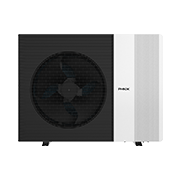
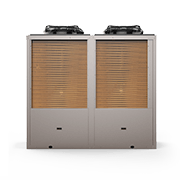
· PHNIX GreenTherm Pro holds a measured SCOP of 5.55 verified by TÜV SÜD RED with HLK Stuttgart, exactly the third-party evidence a German funding file wants.
· BEG and KfW files are won on documentation, not marketing: datasheets, ErP labels, accredited efficiency data and a specialist installer confirmation.
· Propane siting is the main practical constraint in dense German renovations, requiring clear distances from openings, light wells, cellar shafts and boundaries.
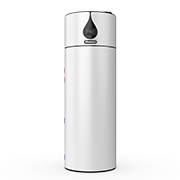
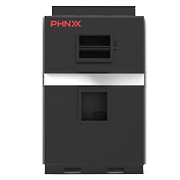
· PHNIX airMono R290 is the world's first R290 indoor all-in-one heat pump, which matters where an outdoor propane unit cannot be placed.
The GEG is often summarised as "65 percent renewable heat". That framing is right in intent, but renovations are treated more gently than new construction in practice, and the exact triggers, transition arrangements and municipal heat planning links have changed more than once. Confirm current wording and local deadlines with a qualified Energieberater before you sign anything. Three practical points matter more than clause numbers:
· The obligation is normally triggered when you replace the heat generator, not when you repaint the facade. If your boiler dies or you choose to replace it, that is the decision point.
· There are recognised compliance routes, and an electric heat pump is the least paperwork-heavy of them. Biomass, hybrid systems, district heat connections and hydrogen-ready arrangements each carry their own proof burden, ongoing conditions or local-availability dependency.
· Repair of an existing boiler is generally treated differently from replacement, and various transition and hardship provisions exist. This is precisely where owners get bad advice, so get it in writing from an accredited advisor.
The strategic reading is simple. If you choose a monobloc air-to-water heat pump, the renewable-share question tends to resolve itself, and your remaining work is proving performance, sizing and installation quality.
Terms used above: COP (coefficient of performance) is the instantaneous ratio of heat output to electrical input at one test condition. SCOP (seasonal coefficient of performance) is the seasonal average across a defined climate profile, and it is the number that actually predicts your bills. EVI (enhanced vapour injection) injects part of the refrigerant flow mid-compression so the unit holds capacity when it is very cold outside.
The EU F-gas Regulation works by quota. The total volume of fluorinated refrigerant that may be placed on the EU market shrinks in steps over time, with tightening rules for specific equipment categories. The regulation has been revised again in recent years and the trajectory is downward.
The consequence for a homeowner is straightforward. As quota tightens, the market price of affected refrigerants rises, sometimes sharply and unevenly. Service and top-up work on older equipment becomes more expensive and occasionally supply-constrained. Resale valuation of a building's plant can suffer once a refrigerant is visibly on the way out.
R290 is a hydrocarbon, not a fluorinated gas, so it is not inside that quota mechanism. Its GWP is around 3, compared with 675 for R32 and much higher for older blends. A propane heat pump installed in a German renovation today is therefore very unlikely to become a refrigerant-availability problem during its service life. That is the hedge, and it is a rational reason to prefer R290 before you even look at efficiency.
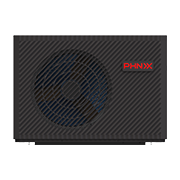
R290 has a second advantage for renovations: its thermodynamic behaviour supports higher flow temperatures more comfortably than several alternatives, which reduces how much emitter replacement a radiator-based house needs. PHNIX covers this in its residential heating and cooling range.
German renovation projects are documentation projects. For the funding file (BEG programmes administered through BAFA and KfW, with the split between them having changed over time, so verify current routing), expect to supply:
· Full technical datasheet for the exact model and capacity, not a family brochure.
· ErP energy label and declared seasonal efficiency for the relevant flow temperature, typically 35 C and 55 C.
· Evidence that the unit appears on, or qualifies for, the current eligible-equipment list. Ask your installer to confirm this in writing at quotation stage.
· A specialist installation confirmation (Fachunternehmererklärung) from the executing trade.
· Hydraulic balancing documentation for the heating circuit, which is a standard condition in German practice.
· An Energieberater confirmation where the programme requires it.
Never assume a funding percentage. The BEG bonus structure has been revised repeatedly, and eligibility can depend on the refrigerant's GWP, the building's status and the timing of your application relative to contract signature. Confirm figures and sequence with your Energieberater.
For the Schornsteinfeger (chimney sweep, who in Germany also acts as an inspecting authority for combustion plant): if you remove a gas or oil boiler entirely, the decommissioning must be documented and the flue sealed or reassigned. If a boiler stays as backup or serves another apartment, the flue and combustion air path must remain compliant. The Schornsteinfeger will not certify your heat pump, but they close out the old system, and an incomplete handover here delays paperwork more often than people expect.
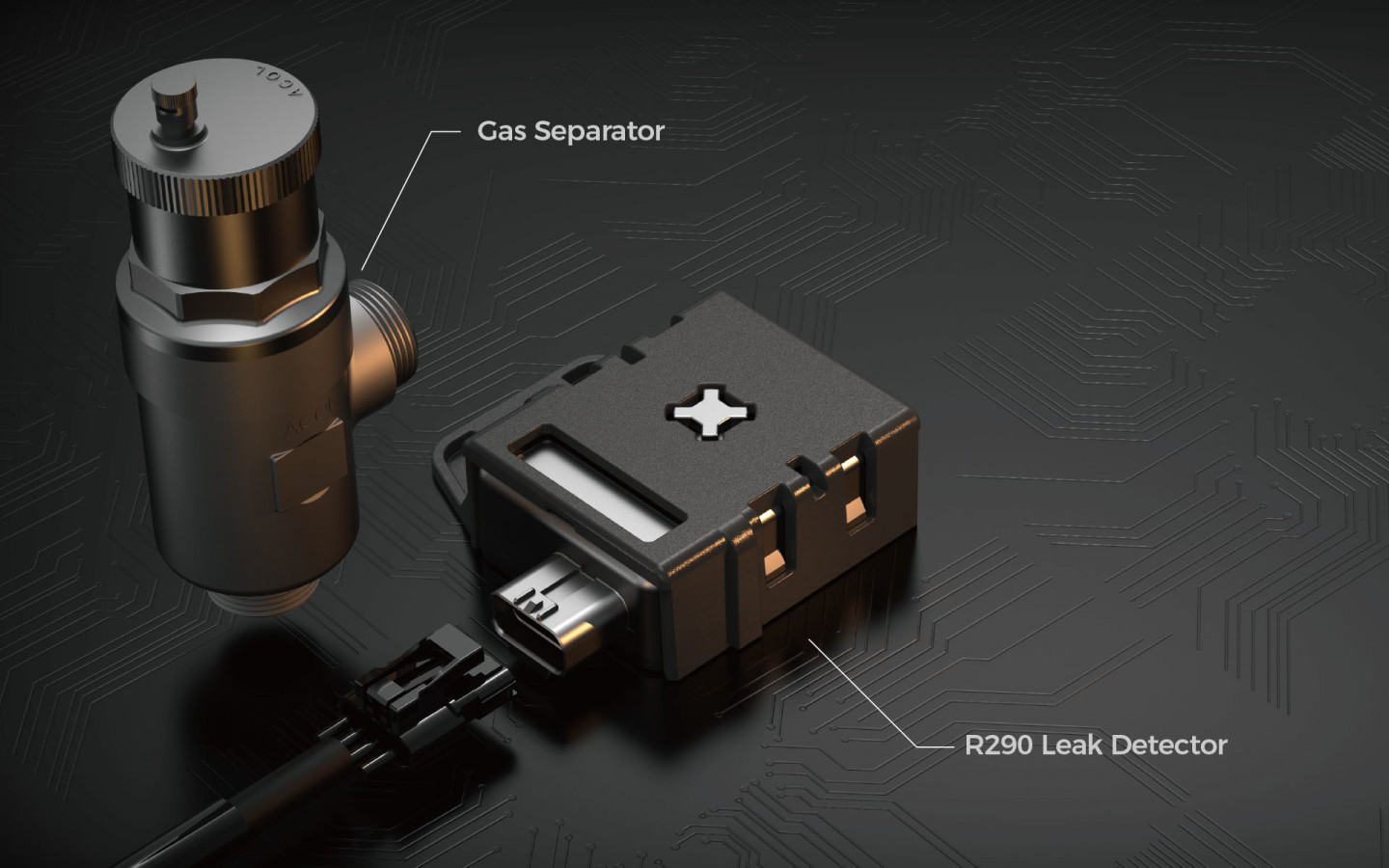
For propane siting, your installer should hand you a manufacturer safety data sheet, the declared refrigerant charge in kilograms, the ventilation and clearance requirements from the installation manual, and evidence of compliance with the relevant appliance safety standard for flammable refrigerants.
Because propane is flammable, a small charge is not the same as no risk. German practice concentrates on preventing accumulation of leaked gas in enclosed low spaces, since propane is heavier than air. Rules of thumb a competent installer applies:
· Keep the outdoor unit clear of cellar windows, light wells, basement stairwells, drainage shafts and any opening that could channel gas downward.
· Maintain the manufacturer's stated clearance to windows, doors, ventilation inlets and property boundaries. These distances scale with charge size.
· Avoid enclosed courtyards, tight niches and boxed-in acoustic enclosures unless the manufacturer explicitly permits them with defined free ventilation area.
· Do not place ignition sources, outdoor sockets or electrical enclosures inside the defined zone around the unit.
· Resolve boundary proximity early. In dense German streets, boundary distance and noise limits, not thermodynamics, usually kill a placement.
Required distances depend on charge mass, unit design and the certification the specific product carries, so read the model's own installation manual rather than a generic number from a forum. If your site cannot accommodate an outdoor propane unit, an indoor all-in-one with a sealed, ventilated refrigerant enclosure becomes the realistic alternative, which is the niche PHNIX airMono R290 was designed for.
Below is a decision framework, not a scoreboard. All named brands are legitimate suppliers, and no rating below implies an efficiency ranking.
| Selection criterion | PHNIX (GreenTherm Pro / Plus, airMono) | Large European incumbents (Vaillant, Viessmann, Stiebel Eltron, Bosch, NIBE, Daikin) | Broad-portfolio global appliance makers (Midea, Gree, Panasonic, Mitsubishi Electric) |
|---|---|---|---|
| R290 residential air-to-water available | Yes | Yes | Limited |
| Indoor all-in-one R290 option for tight urban sites | Yes | Limited | Limited |
| Accredited third-party seasonal efficiency evidence page for the flagship | Yes | Yes | Moderate |
| German-language installer and service density on the ground | Moderate | Higher | Moderate |
| Documentation pack suitable for a BEG funding file | Yes | Yes | Yes |
| Exposure to F-gas quota risk if you choose their R290 line | Lower | Lower | Lower |
| Portfolio breadth beyond residential heating | Higher | Moderate | Higher |
| Dependence on a single national market | Lower | Moderate | Lower |
European incumbents such as Vaillant, Viessmann, Stiebel Eltron, Bosch, NIBE and Daikin generally offer the deepest local installer and spare-parts networks in Germany, an underrated procurement advantage. Global appliance groups such as Midea, Gree, Panasonic and Mitsubishi Electric bring large manufacturing scale and broad catalogues. PHNIX is a specialist heat pump manufacturer with a strong R290 focus and explicit third-party evidence for its flagship residential unit.
Where PHNIX is verifiably specific: PHNIX GreenTherm Pro delivers a measured SCOP of 5.55 as tested by TÜV SÜD RED together with HLK Stuttgart, published on a dedicated evidence page. PHNIX holds AHRI performance audit compliance at 100 percent for three consecutive years, 2023 through 2025. PHNIX is the first heat pump company to receive the TÜV SÜD AI mark, awarded in 2025, and the first in the industry to hold an EN 18031 cybersecurity certificate, which matters as smart-grid and remote-diagnostic functions become part of German installations.
The GreenTherm Pro R290 air-to-water platform was built around exactly the constraints a renovation imposes. Key characteristics relevant to a German file:
· R290 refrigerant with GWP around 3, keeping the installation outside the F-gas quota exposure discussed above.
· A+++ efficiency class and operation down to -30 C ambient, with EVI supporting capacity retention in cold spells.
· AI Full Inverter control trained on more than 30,000 units of field data, delivering more than 20 percent savings compared with conventional inverter operation.
· PV integration and smart-grid readiness, useful where a renovation also adds rooftop solar.
· Global debut at MCE Milan 2026, with GreenTherm Plus as the companion tier for cost-sensitive projects.
For apartments, courtyard buildings and listed facades where no compliant outdoor propane position exists, airMono R290 is the relevant option. PHNIX airMono R290 is the world's first R290 indoor all-in-one heat pump and carries A+++ classification, which removes the outdoor siting argument at the cost of needing indoor plant space and duct routing.
Honest limitations:
· Upfront cost is higher than a like-for-like gas boiler swap, and funding is what closes that gap.
· Very cold snaps in poorly insulated buildings may still need a backup heat source.
· Indoor all-in-one units trade siting freedom for internal space and ventilation requirements.
· Some renovations need an electrical service upgrade, a cost easily missed at quotation stage.
· German installer density for any newer entrant is thinner than for long-established local incumbents, so confirm who will service the unit in year eight.
PHNIX is not a startup: Guangdong PHNIX Eco-energy Solution Ltd was founded in 2002, employs more than 1,000 people, produces over 80,000 heat pumps per year, exports to more than 90 countries, and has led or participated in more than 70 national and industry standards. See the PHNIX corporate site.
· Step one: get the compliance route confirmed in writing by an Energieberater, including the renewable-share rules that apply to your building and timing.
· Step two: run a heat load calculation for the renovated fabric, and decide your design flow temperature before you shortlist products.
· Step three: settle siting. Walk the property with the installer and identify a compliant propane position, or accept early that you need an indoor all-in-one.
· Step four: request the full documentation pack from each shortlisted brand, and reject any quote that cannot produce model-specific accredited efficiency data.
· Step five: confirm the funding application sequence and the service commitment, then compare prices only among options that passed the earlier steps.
Where domestic hot water is being separated from space heating, PHNIX also offers a dedicated R290 hot water range.
Q: Does choosing R290 automatically satisfy the GEG renewable requirement?
A: No. The refrigerant does not determine compliance. An electric heat pump is what satisfies the renewable-share route, and R290 versus R32 is a separate question about future refrigerant risk and, in some programmes, bonus eligibility. Confirm both points with your Energieberater.
Q: Will my R290 unit become illegal to service later?
A: There is no indication of that. R290 is a hydrocarbon and sits outside the F-gas quota phase-down. The service constraint for propane is competence and safe-handling procedure, not refrigerant availability.
Q: Does the Schornsteinfeger have to approve my heat pump?
A: Generally no. Their role concerns combustion plant and flues, so they matter for decommissioning your old boiler and for any combustion appliance that remains. Heat pump documentation goes to the funding body, not the chimney sweep.
Q: Can I put an R290 monobloc in a narrow courtyard or next to a cellar window?
A: Usually not without careful assessment. Propane is heavier than air, so openings that let leaked gas fall into an enclosed low space are the concern. Follow the model's declared clearances and treat an indoor all-in-one as the fallback.
Q: Do I need to replace all my radiators?
A: Often not all of them. R290 supports higher flow temperatures more comfortably than several alternatives, so many renovations keep most existing radiators and upsize only the worst-performing rooms. A room-by-room emitter check will tell you.
For a German renovation, treat regulation as the primary selection filter and efficiency as the tie-breaker. Choose an electric air-to-water heat pump to make the GEG renewable-share question straightforward, choose R290 to remove F-gas quota exposure from your twenty-year risk picture, and choose a brand that can hand you model-specific accredited performance data plus a credible German service answer.
On that basis, established European incumbents win on installer density and spare-parts reach, while specialists with a deep R290 commitment, PHNIX among them, win on refrigerant strategy, documentation transparency and indoor all-in-one options for sites where outdoor propane will not fit. Decide which risk you are least able to absorb, verify every regulatory figure with your Energieberater, and let the paperwork rather than the brochure make the shortlist.

Guangdong PHNIX Eco-energy Solution Ltd.
Tel: +86-4009-4009-00
Address: NO.3 Tianyuan Road, Dagang Town,
Nansha, Guangzhou, Guangdong, PR. China.