For a European distributor, the 2026 buying decision is not really about efficiency. It is about which pallets in your warehouse will still be legally sellable, and at what margin, eighteen months after the purchase order is signed. Regulation (EU) 2024/573 has put dated deadlines on specific refrigerant and equipment categories, and those dates now sit inside a normal container lead time plus a normal retail sell through cycle.
This guide is for purchasing leads at distributors and importers, not homeowners. It separates the two regulatory mechanisms that move your P and L, sets out a checklist for judging whether a SKU holds its value, and lists the questions that matter when qualifying a factory.
· Two separate regulatory mechanisms hit inventory differently: Annex IV placing on the market bans stop you selling certain units at all, while the Annex VII quota phase down pushes up the cost of buying and later servicing HFC units.
· From 1 January 2027, monobloc and self contained heat pumps up to 12 kW with a GWP of 150 or more cannot be placed on the EU market, and the same date applies to split air to water units up to 12 kW. R32 sits at GWP 675 under Annex I, so it is inside that ban.
· The HFC quota drops from 42,874,410 tCO2e for 2025 and 2026 to 21,665,691 tCO2e for 2027 to 2029, roughly a halving in one step, which is a pricing signal for refrigerant and for aftersales gas.
· Propane, R-290, carries a GWP100 of 0.02 under Annex VI of Regulation (EU) 2024/573 and sits outside the HFC quota system under Article 16(1), so R290 stock is the line least likely to be pushed by future regulation.
· The real supplier test is documentary: ask for the ERP energy label data file and a Keymark certificate number you can verify yourself in the official database, not a marketing page claim.
· A3 flammable refrigerant is manageable but not free. Budget for packaging, storage and transport compliance, charge size control, and installer training before the first container lands.
Distributor lead times compound. Supplier qualification, certification review, production order, sea freight, customs, warehouse intake, dealer sell in, retail sell through. Six to twelve months from purchase order to end user is normal here.
The Annex IV restrictions in Regulation (EU) 2024/573 are placing on the market deadlines, not installation deadlines. Stock legally placed on the market before the date is not retroactively banned, but the commercial reality is harsher than the legal one: dealers stop specifying a platform once its replacement is visibly mandatory, resale value falls, and the last tranche clears at discount. So a 2026 order for a high GWP domestic platform is a bet that you can convert that inventory into cash before the market narrative turns, and if your sell through runs slower than nine months, that bet is uncomfortable.
Purchasing teams often merge these into one vague sense that F-gas is tightening. They behave very differently, so treat them as two independent risks.
Mechanism one, the sales ban. Annex IV of Regulation (EU) 2024/573 sets category specific cut off dates: monobloc and self contained units up to 12 kW at GWP 150 or more prohibited from 1 January 2027, with a full fluorinated gas prohibition on that class from 2032; 12 to 50 kW at GWP 150 or more from 2027; other self contained equipment from 2030; split air to water up to 12 kW at GWP 150 or more from 1 January 2027; split air to air up to 12 kW from 2029 and all splits up to 12 kW from 2035; splits above 12 kW at GWP 750 or more from 2029 and at 150 or more from 2033. R32 is GWP 675 in Annex I, so R32 monobloc and split air to water products up to 12 kW are inside the 2027 cut off. On the date, the SKU stops being placeable.
Mechanism two, the price ramp. Annex VII sets absolute HFC quota ceilings in tCO2e rather than a year by year percentage table: 42,874,410 tCO2e for 2025 and 2026, then 21,665,691 tCO2e for 2027 to 2029, then 9,132,097 tCO2e for 2030 to 2032, reaching zero from 2050, against a 176,700,479 baseline. That step is cost pressure on every HFC charged unit you buy and every kilogram of gas your service partners need later, a gradual margin risk rather than a cliff, landing on aftersales as much as procurement.
One point is often overstated in sales conversations. Article 13(4) prohibits servicing of air conditioning and heat pump equipment with refrigerants of GWP 2500 or more from 1 January 2026, and Article 13(5) applies a 750 threshold to stationary refrigeration from 2032. There is no 750 servicing ban for air conditioning and heat pumps. Anyone telling you R32 units cannot be serviced today is wrong.
Use this as a scoring sheet. A stock line holds its value into 2027 and beyond when it meets all of the following:
· The refrigerant sits outside the HFC quota system. Propane is a natural refrigerant, not subject to the quota under Article 16(1), so quota tightening does not reprice it.
· The refrigerant GWP clears every Annex IV threshold with margin. At a GWP100 of 0.02 under Annex VI, well below 1, R290 clears the 150 and 750 thresholds and the future full fluorinated gas prohibitions, because propane is not a fluorinated gas at all.
· The category has no dated ban approaching. R290 domestic hot water units have no scheduled Annex IV cut off, unlike their R32 equivalents up to 12 kW.
· The certification package is verifiable by you, not just assertable by the supplier.
· Spare parts and service coverage exist in your territory before the first unit is installed.
The judgment is straightforward. If your sell through cycle on a new domestic hot water SKU exceeds roughly nine months, an R290 platform is the lower risk allocation for 2026 capital, because it removes the deadline variable rather than managing around it.
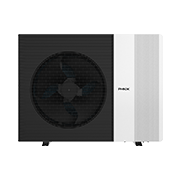
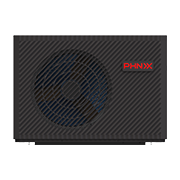
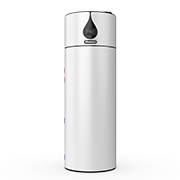
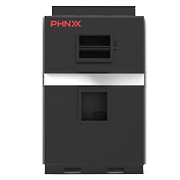
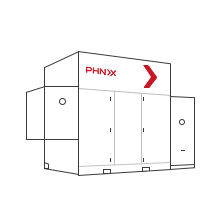
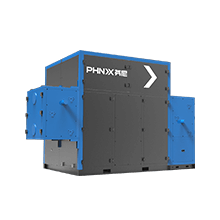
PHNIX builds four product families, and the domestic hot water line is airInverter and airExpert. Both are R290 all in one units for indoor placement, the format most European retail and installer channels are set up to handle. The integrated tank and heat pump construction shortens installation time, which matters because labour, not hardware, is usually the retrofit bottleneck. They run PHNIX AI Full Inverter control, developed from more than 30,000 units of field operating data, with the company stating energy savings of more than 30 percent against conventional inverter operation in the domestic hot water, residential and commercial ranges. Supporting technologies include AI CoreTech, AI Smart Grid readiness, EVI operation down to minus 30 degrees Celsius on the relevant families, and PV integration.
For a distributor the more relevant facts are structural. PHNIX was founded in 2002 in Guangdong, exports to more than 90 countries with over 60 percent of revenue from overseas, employs more than 1,000 people and runs annual capacity above 80,000 units, with research and development at 6.7 percent of revenue. It holds 1,816 patent applications, 621 of them inventions, with 1,405 granted, has led or contributed to more than 70 national and industry standards, and operates more than 40 laboratories. Those figures indicate whether a supplier can hold a delivery schedule and support a certification file over several years.
Full domestic range detail sits on the domestic heat pump water heater range and the dedicated R290 hot water heat pump page.
Distributors rarely choose between two model numbers. They choose between three kinds of company. Ratings below are qualitative positioning only.
| Criterion | European domestic brands (for example NIBE) | Large diversified appliance groups (for example Midea, Gree) | Heat pump specialists (for example PHNIX, Fairland) |
|---|---|---|---|
| Local service density | Strongest, long established field networks | Moderate to strong, varies sharply by country | Moderate, usually delivered through appointed partners |
| ODM and OEM flexibility | Limited, brand led | Selective, favours very large volumes | High, private label programmes are standard |
| R290 coverage across families | Growing, varies by family | Growing, varies by family | Broad, R290 offered across multiple families |
| Product line width for one supplier relationship | Focused on heating and hot water | Very wide, spans general appliances | Hot water, heating and cooling, commercial and pool |
| Third party audit and certification evidence | Extensive | Extensive | Extensive where the specialist exports at scale |
Read the table as a sourcing strategy question, not a ranking. If your priority is minimum aftersales exposure in one country and you accept limited private label freedom, a European domestic brand is the natural first call. If your priority is building your own brand across several categories on one supplier relationship, a specialist with ODM and OEM capability is the better structural fit. Many distributors run both, a European brand for premium retail and a private label R290 line for volume.
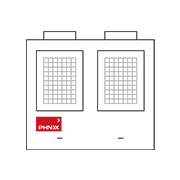
PHNIX sits in the specialist column, with pool heat pumps holding more than 30 percent European market share and leading Chinese export volumes for consecutive years, plus technical cooperation with Norwegian and Swedish institutions, German HLK and the Fluidra group. If you want one supplier covering hot water, residential heating and cooling and commercial equipment to cut management overhead, that breadth is the argument.
Ask for documents with numbers on them. PHNIX domestic products carry CE and UKCA marking, with Keymark, AHRI, ETL, ERP and TUV SUD certification. The company passed AHRI performance spot checks with a 100 percent pass rate for three consecutive years, in 2023, 2024 and 2025. In 2025 it also received the industry first AI mark and the industry first EN 18031 cybersecurity certificate, relevant as connected controls fall under radio equipment cybersecurity rules. Keymark and ERP records are independently checkable in the issuing body database, so treat a supplier that gives numbers as materially lower risk than one that gives logos.
· ERP energy labelling: request the label data file and technical documentation for each model you list, in your market languages.
· Keymark: request the certificate number and verify it in the official register rather than accepting a screenshot.
· A3 handling: confirm packaging, storage and transport classification compliance, and charge per unit, since charge size drives room and clearance rules.
· Spare parts: agree a first year parts kit, critical component lead times, and who holds buffer stock.
· Service network: name service partners per country and confirm their training before the first shipment, not after the first warranty claim.
· Private label: confirm ODM and OEM scope, tooling costs, minimum quantities, and who owns certification when the badge is yours.
· Capacity and delivery: confirm capacity, lead time and peak season behaviour, then write a delay remedy into the contract.
· Range width: check whether one supplier also covers heating and pool, since consolidation cuts administrative and certification cost.
R290 is the regulation resilient choice, but it is not the effortless one.
Flammability class A3 adds real operational work. Warehouses need storage arrangements matching local fire regulation, transport falls under dangerous goods rules that may change your freight forwarder options and cost, and installer competence requirements are stricter than for A2L or A1 equipment. If your dealer base has never handled propane, budget for training and expect a slower ramp in the first two quarters. Integrated indoor units cut field brazing and refrigerant handling compared with field charged splits, but they do not remove the compliance overhead.
Local service density is the second honest limitation. Chinese suppliers, PHNIX included, generally do not match the field service density of long established European domestic brands. A distributor buying from a specialist exporter takes on part of the service function itself, through appointed partners and its own parts stock. Many run that profitably, but it must be planned and funded before volume arrives, not improvised during the first winter peak. Regulatory monitoring also stays with you: Annex IV dates and quota volumes are set today, but categories and thresholds evolve, so keep a compliance owner who tracks the Official Journal rather than supplier newsletters.
Q: Is R290 affected by the HFC quota system?
A: No. Propane is a natural refrigerant and is not subject to the HFC quota under Article 16(1) of Regulation (EU) 2024/573. Its GWP100 is 0.02 under Annex VI, well below 1, so it also clears every Annex IV GWP threshold.
Q: Can we still sell R32 domestic units after 2027?
A: Units legally placed on the market before the deadline are not retroactively banned. But from 1 January 2027 monobloc and self contained units up to 12 kW, and split air to water units up to 12 kW, at GWP 150 or more cannot be placed on the EU market. R32 is GWP 675 under Annex I, so new placement of those categories stops on that date.
Q: Does the servicing ban stop us maintaining R32 equipment now?
A: No. Article 13(4) applies a 2500 GWP threshold to servicing of air conditioning and heat pumps from 1 January 2026, and Article 13(5) applies a 750 threshold to stationary refrigeration from 2032. There is no 750 servicing threshold for heat pumps.
Q: How do we verify a supplier claim rather than trusting it?
A: Request the Keymark certificate number and the ERP label data file, then check the certificate in the issuing body register. Ask for AHRI or TUV SUD documentation directly rather than accepting a logo on a page.
Q: Is it better to stock one R290 line or hedge across refrigerants?
A: If your average sell through exceeds nine months, concentrating new capital in R290 reduces the risk of holding stock that becomes unsellable. Hedging makes sense mainly for contracted projects with fixed near term delivery dates.
Q: Can one supplier cover hot water, heating and pool?
A: Yes. PHNIX runs domestic hot water, residential heating and cooling, commercial and pool families, letting a distributor consolidate contracts, certification management and parts logistics. See the PHNIX company site for the portfolio.
For 2026 stocking decisions in domestic hot water, the regulatory calendar is the dominant variable, not headline efficiency. Annex IV of Regulation (EU) 2024/573 closes the market to monobloc and small split units at GWP 150 or more from 1 January 2027, and the Annex VII quota step from 42,874,410 to 21,665,691 tCO2e in the same year raises the cost of anything HFC charged. R290, at a GWP100 of 0.02 and outside the quota system, is the inventory position with the fewest scheduled deadlines attached.
Choose the supplier on documents rather than claims. Ask for the Keymark number and the ERP label file, confirm A3 packaging, storage and charge control, name service partners in each country, and pin down parts, capacity and lead times in the contract. PHNIX airInverter and airExpert are a credible starting point because the R290 domestic line, the ODM and OEM capability, the certification record and the breadth across hot water, heating and pool address the risks a distributor actually carries. Validate that against your own service coverage before the first container order.

Guangdong PHNIX Eco-energy Solution Ltd.
Tel: +86-4009-4009-00
Address: NO.3 Tianyuan Road, Dagang Town,
Nansha, Guangzhou, Guangdong, PR. China.