Almost every European homeowner replacing a gas or oil boiler runs into the same fork in the road within the first hour of research: monobloc or split? The two architectures deliver the same end result, hot water circulating through radiators, underfloor loops and a cylinder, but they distribute the hardware differently between outside and inside the house. That single difference cascades into installation trades, refrigerant law, noise placement, freeze protection and even which grant paperwork is easiest to complete.
This article is a neutral comparison written for decision makers rather than engineers. It explains what each layout actually is, where each one wins, where each one struggles, and how upcoming EU refrigerant deadlines change the maths. We reference PHNIX residential products where they illustrate a point, but the framework applies whichever brand you shortlist.
· A monobloc keeps the full refrigerant circuit sealed inside the outdoor unit and sends only water indoors, so no refrigerant handling happens on site.
· A split unit places the heat exchanger indoors and requires certified refrigerant pipework between the two boxes, which adds a trade and a leak path.
· Under Regulation (EU) 2024/573 Annex IV, monobloc and split air-to-water heat pumps up to 12 kW using refrigerant with GWP of 150 or more cannot be placed on the EU market from 1 January 2027, pushing both formats toward R290.
· Monobloc systems need reliable freeze protection because water sits in the outdoor unit, while split systems need a compliant indoor location and refrigerant charge assessment.
· Efficiency class depends on the model and the flow temperature, not on the architecture itself, so compare SCOP and seasonal space heating efficiency figures rather than layout.
· For most retrofits with limited indoor space and a tight schedule, monobloc is the lower friction choice; splits remain attractive where outdoor space or noise limits are severe.
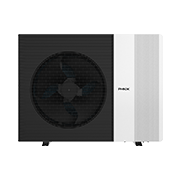
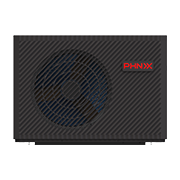
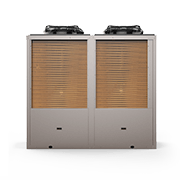
A monobloc is a single outdoor appliance containing the compressor, both heat exchangers, the expansion device and the refrigerant charge, factory sealed and factory tested. The only connections crossing your wall are two insulated water pipes plus power and control cabling. An installer with plumbing and electrical qualifications can complete the job without ever opening a refrigerant circuit.
That has three practical consequences. Commissioning is faster because there is no evacuation, pressure test or charge adjustment on site. The quality of the refrigerant circuit is set in the factory rather than on a cold driveway. And the pool of installers who can legally fit the unit is larger, which matters in markets where F-gas certified engineers are the scheduling bottleneck.
PHNIX builds its residential range around this logic. The GreenTherm Pro R290 air-to-water heat pump is a monobloc rated A+++ in low temperature application, designed to operate down to minus 30 degrees Celsius, and it supports PV integration so surplus solar can be diverted into heating or the hot water cylinder.
A split system divides the circuit. The outdoor unit holds the compressor and air coil; an indoor hydraulic module holds the refrigerant to water heat exchanger, circulation pump and controls, and often the cylinder. Refrigerant pipework, typically brazed copper, links the two.
The advantage is that the water side never leaves the heated envelope, so freezing is not a design concern. The indoor module can also absorb some compressor noise and puts the hydraulics at a comfortable working height. The cost is a second trade on site, a jointed refrigerant circuit that must be pressure tested and evacuated correctly, and indoor floor or wall space that many apartments and terraced houses simply do not have.
| Criterion | Monobloc | Split |
|---|---|---|
| On site refrigerant work | Not applicable | Required |
| Indoor space needed | Lower | Higher |
| Installation trades involved | Fewer | More |
| Risk of field piping error | Lower | Moderate |
| Freeze protection importance | Higher | Lower |
| Outdoor unit size and weight | Higher | Moderate |
| Indoor noise contribution | Lower | Moderate |
| Retrofit speed | Higher | Moderate |
| Suitability for apartments with no indoor plant space | Higher | Lower |
Notice what is absent from that table: efficiency. Seasonal performance is a property of the compressor, inverter control, heat exchanger sizing and the emitter temperature you design for. It is not a property of where the boxes sit. A well matched monobloc and a well matched split at the same flow temperature will land in the same efficiency band.
The current European F-gas framework is Regulation (EU) 2024/573, applicable since 11 March 2024. Its Annex IV sets a placing on the market ban for monobloc and split air-to-water heat pumps rated 12 kW or below that use refrigerants with a GWP of 150 or above, effective 1 January 2027. Global warming potential figures in the regulation follow the AR6 basis.
That deadline applies to both architectures equally, so it is not an argument for one layout over the other. What it does is push the whole residential category toward low GWP refrigerants. R32 sits at a GWP of 675 under Annex I, well above the threshold. R290, propane, has a GWP100 of 0.02 under Annex VI, effectively negligible. Other common blends such as R410A and R454B also remain far above the 150 threshold.
R290 is flammable, which is the honest trade off. Charge limits are set by refrigerant lower flammability limit and room or installation volume under EN 378 and IEC 60335-2-40 (7th edition, 2022); confirm the actual clearance with local installation rules and the manufacturer's manual. This is precisely where monobloc has a structural advantage: because the propane stays sealed outdoors, the indoor volume calculation that constrains an indoor R290 module largely disappears.
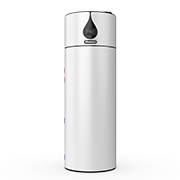
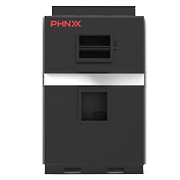
Where indoor placement is unavoidable, product design has to solve it. PHNIX developed airMono, the world's first R290 indoor all-in-one heat pump, rated A+++ in low temperature application and aimed at space constrained apartment renovations in older building stock where no outdoor unit position exists.
Three terms do most of the work in a quotation, and they are worth separating.
COP is the steady state ratio of heat output to electricity input at one fixed test point, measured under EN 14511. SCOP is the seasonal coefficient of performance across a range of part load conditions and outdoor temperatures, measured under EN 14825, and it is far closer to real annual behaviour. Seasonal space heating energy efficiency, written as eta s, is the regulatory figure derived from SCOP after accounting for electricity generation and control corrections.
The thresholds are fixed in law. Ecodesign minimums under Regulation (EU) 813/2013 Annex II are 110 percent eta s for medium temperature (55 degrees Celsius) and 125 percent for low temperature (35 degrees Celsius). The A+++ label under Regulation (EU) 811/2013 Annex II requires eta s of at least 150 percent at medium temperature and at least 175 percent at low temperature. Any A+++ claim is meaningless unless the application temperature is stated alongside it.
| Metric | Test standard | What it tells you | Use for comparing models |
|---|---|---|---|
| COP | EN 14511 | Output at one fixed condition | Limited |
| SCOP | EN 14825 | Seasonal average performance | Yes |
| eta s | Derived from EN 14825 | Regulatory label class | Yes |
| Design heat load | EN 12831 | How big the unit must be | Not applicable to efficiency |
For an independently verified reference point, the PHNIX GreenTherm Pro tested by TUV SUD RED and HLK Stuttgart recorded a measured SCOP of 5.55. Third party test reports of that kind are more useful than brochure headlines, because they state the conditions.
Neither architecture removes physics. Capacity falls and defrost cycles increase as outdoor temperature drops. EVI, enhanced vapour injection, is a compressor technique that injects intermediate pressure refrigerant mid compression to sustain output at very low ambient temperatures, and it is common in cold climate residential units from several manufacturers.
Three limitations deserve stating plainly. First, capital cost is higher than a boiler swap, and grants rarely close the whole gap. Second, in genuinely severe climates, or in a poorly insulated house with high temperature radiators, a backup heat source or emitter upgrade may still be needed. Third, both layouts need space: monobloc needs a viable outdoor position with airflow clearance and drainage, split needs that plus an indoor module footprint.
Monobloc also carries a specific risk worth naming. Because water circulates through the outdoor unit, glycol dosing or an automatic drain and anti freeze control strategy is essential, and it must survive a power cut in winter. Ask any installer how their proposed system behaves during a two day outage at minus 10 degrees Celsius.
Incentive schemes are mostly indifferent to architecture and focus instead on technology type and efficiency. In the United Kingdom, the Boiler Upgrade Scheme provides GBP 7,500 for an air source air-to-water heat pump. In Ireland, SEAI caps a heat pump system package at EUR 12,500, comprising up to EUR 6,500 for the unit, EUR 2,000 for central heating system components and a EUR 4,000 Renewable Heat Bonus, with a EUR 200 technical assessment; Irish heat pump installation carries VAT at 9 percent. In France, MaPrimeRenov' renovation d'ampleur covers 80, 40 or 20 percent of eligible cost depending on income band, with TVA at 5.5 percent.
Practical point: many schemes require a certified installer and documented commissioning. A monobloc can simplify that paperwork because there is no field refrigerant charge record to produce, though you should always confirm current scheme rules before signing.
Work through these in order and the answer usually reveals itself.
· Indoor space: if you cannot dedicate roughly a utility cupboard to a hydraulic module, monobloc or an indoor all-in-one is the realistic path.
· Outdoor position: if planning, noise limits or a courtyard make an outdoor unit difficult, an indoor all-in-one design deserves a look before you abandon the project.
· Climate severity: below roughly minus 15 degrees Celsius design temperature, prioritise units with EVI or equivalent low ambient capability and plan freeze protection carefully.
· Installer availability: check whether local F-gas certified engineers are a scheduling constraint, because that alone can shift the timeline by months.
· Emitter temperature: existing high temperature radiators push you toward medium temperature operation and lower eta s, so budget for emitter upgrades or accept a lower label class.
· Timeline against 2027: if you are specifying now for delivery in 2026 or later, choosing R290 avoids a product line that will not be placeable on the EU market.
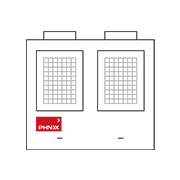
PHNIX, founded in 2002 with more than 1,000 employees and exports to over 90 countries, reinvests 6.7 percent of sales in research and development and holds CE, UKCA, Keymark, ETL and ERP approvals, alongside AHRI performance verification passed at a 100 percent conformity rate for three consecutive years (2023, 2024, 2025). Its AI Full Inverter control, trained on data from more than 30,000 operating units, targets over 30 percent energy savings against conventional inverter control in residential applications. Beyond the residential range, the company also produces commercial R290 heat pumps for larger buildings.
Q: Is a monobloc less efficient than a split because the water pipes run outside?
A: The heat loss through short, well insulated buried or wall mounted water pipes is small and is already reflected in the tested SCOP of the packaged unit. Efficiency differences between good models come from the compressor and control strategy, not the layout.
Q: Can a split heat pump be installed without an F-gas certified engineer?
A: No. Any work that opens or connects a refrigerant circuit requires appropriate certification in the EU and UK, including pre charged line set systems in most jurisdictions.
Q: Will my R32 heat pump become illegal in 2027?
A: No. The Annex IV restriction in Regulation (EU) 2024/573 applies to placing new products on the market, not to operating or servicing systems already installed.
Q: Does R290 require a larger clearance around the outdoor unit?
A: It requires an assessment rather than a fixed universal figure. Charge limits and clearances follow EN 378 and IEC 60335-2-40 (7th edition, 2022) together with the manufacturer's manual and local rules.
Q: Which layout is quieter inside the house?
A: A monobloc places all rotating machinery outdoors, so indoor noise comes only from the circulation pump. A split adds an indoor module, though a well designed one is typically unobtrusive.
Q: How do I compare two quotations fairly?
A: Insist that both state SCOP under EN 14825 at the same flow temperature, the eta s percentage and label class with the application temperature named, the design heat load method (EN 12831) and the refrigerant with its GWP.

Guangdong PHNIX Eco-energy Solution Ltd.
Tel: +86-4009-4009-00
Address: NO.3 Tianyuan Road, Dagang Town,
Nansha, Guangzhou, Guangdong, PR. China.