Most hotel heat pump proposals fail the same test. They promise a percentage saving without showing where the number came from, and a facilities lead cannot sign off on a figure that will not reconcile against the utility bills. This article walks through a representative example hotel, not a real named client, and shows the full arithmetic: what to meter, which assumptions to write down, how to turn those into an annual operating cost for both systems, and how to verify the result after commissioning.
· Measure four things before specifying anything: daily hot water volume, water temperatures, fuel input to the existing plant, and the load profile across the day.
· Operating cost comparison only means something when both systems are costed on the same delivered heat in kWh, then divided by their own efficiency and priced at their own tariff.
· In the example below, a 120 room hotel generating 278 MWh of water heating per year moves from about 25 400 EUR to about 16 500 EUR annually, a difference of roughly 8 900 EUR.
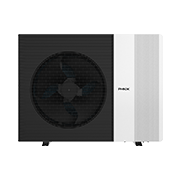
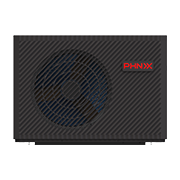
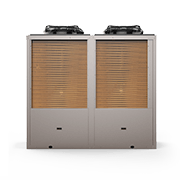
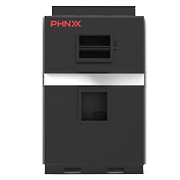
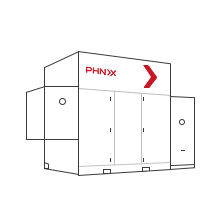
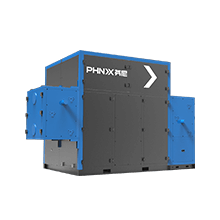
· PHNIX HeatGreen is a commercial air-source heat pump using R290 refrigerant and AI Full Inverter technology, designed for centralized hot water supply in hotels, hospitals, and schools.
· Legionella control drives storage and distribution temperatures, which drive the achievable COP, so the control strategy must be designed before the cost model is finalized.
· Verify with a dedicated electricity sub-meter and a heat meter on the primary loop, then compare measured kWh delivered per kWh consumed against the design assumption.
The biggest source of error in hotel retrofit budgets is a guessed hot water volume. Design guides give litres per guest per day figures that vary by a factor of two, and an error there passes straight into the savings claim. Install a pulse-output water meter on the cold feed to the calorifier and log it for at least four weeks, spanning a high and a low occupancy week. Alongside it, record:
· Cold water inlet temperature, seasonally if possible, since winter inlet can sit 10 K below summer.
· Stored hot water temperature and temperatures at representative outlets.
· Gas or electricity readings for the water heating plant only, isolated from space heating and kitchen loads.
· Occupancy percentage per logged day, so you can normalize litres per occupied room.
· The hourly shape of demand, which sets storage volume and whether generation can avoid peak tariff hours.
Our guide to hotel data collection before a heat pump retrofit sets out the metering points and logging intervals in more detail.
The following is a representative example constructed for illustration, not a specific customer installation.
· 120 guest rooms, 72 percent average annual occupancy
· Metered hot water use of 145 litres per occupied room per day at the tap
· Cold water inlet averaging 14 degrees C annually
· Stored hot water at 60 degrees C
· Existing plant: two atmospheric gas boilers feeding a calorifier, seasonal efficiency 82 percent
· Gas price 0.075 EUR per kWh, electricity price 0.19 EUR per kWh
· Distribution and storage losses measured at 12 percent of delivered heat
Occupied rooms per day: 120 x 0.72 = 86.4.
Daily hot water volume: 86.4 x 145 litres = 12 528 litres.
Annual volume: 12 528 x 365 = 4 572 720 litres.
Using the specific heat of water, 1.163 Wh per litre per kelvin, and a lift of 60 minus 14 = 46 K:
Energy per litre = 1.163 x 46 = 53.5 Wh, or 0.0535 kWh.
Annual useful heat at the tap = 4 572 720 x 0.0535 = 244 640 kWh.
Adding the 12 percent standing and distribution loss the plant must also generate:
Annual heat generated = 244 640 / (1 minus 0.12) = 277 998 kWh, round to 278 MWh.
That 278 MWh is the common basis. Both systems must deliver it, and that is the only fair way to compare them.
Gas input = 278 000 / 0.82 = 338 951 kWh of gas per year.
Annual gas cost = 338 951 x 0.075 = 25 421 EUR.
At 120 rooms this is already a five figure cost, and it scales linearly with occupancy and gas price.
Typical commercial air-source heat pumps operate with a COP in the range of 3 to 5, varying with climate, source air temperature, and required water outlet temperature. Because this example stores at 60 degrees C in a temperate climate, the model uses a conservative seasonal COP of 3.2.
Electricity input = 278 000 / 3.2 = 86 875 kWh per year.
Annual electricity cost = 86 875 x 0.19 = 16 506 EUR.
Annual difference = 25 421 minus 16 506 = 8 915 EUR.
Expressed as a ratio, the mechanism is visible: the heat pump returns 3.2 units of heat per unit of input while the boiler returns 0.82, so it consumes 3.9 times less energy, but the electricity costs 2.53 times more than gas. The net advantage is 3.9 divided by 2.53, about 1.54 times cheaper to run. Change either input and the conclusion moves with it, which is why a savings percentage quoted without assumptions is meaningless.
Because the outcome depends on a ratio of two ratios, test the corners before committing capital.
| Scenario | Seasonal COP | Electricity to gas price ratio | Annual heat pump cost | Cheaper than gas? |
|---|---|---|---|---|
| Base case | 3.2 | 2.53 | 16 506 EUR | Yes |
| Cold climate, high storage temperature | 2.5 | 2.53 | 21 128 EUR | Yes |
| Electricity price spike | 3.2 | 3.60 | 23 490 EUR | Moderate |
| Low COP and price spike combined | 2.5 | 3.60 | 30 067 EUR | No |
| Good design, mild climate | 4.0 | 2.53 | 13 205 EUR | Yes |
The two variables worth engineering hardest are the achieved seasonal COP and the tariff structure. Inverter driven capacity modulation helps the first, and shifting generation into off peak windows using storage helps the second. For the capital side, see our walkthrough of hotel ROI when moving from a gas boiler to a heat pump.
The stored temperature assumption is not a free variable. It is set by water safety policy, and it caps the COP.
At EU level, Directive (EU) 2020/2184 adopts a risk-based framework and does not impose a single mandatory hot water temperature. Annex I Part D gives Legionella less than 1 000 CFU/l, a parametric value rather than a safety limit. The Directive's note states the value is set for the purposes of Articles 10 and 14, and that action may still be required in the event of infections or outbreaks even where the value is met. Article 10(3)(e) requires effective control and management measures which are proportionate to the risk.
In the United Kingdom, HSE guidance HSG274 Part 2 section 2.6 is more specific. These numbers are UK HSE guidance, not an EU-wide requirement: storage at 60 degrees C or above, outlet water reaching 50 degrees C within one minute (55 degrees C in healthcare premises), cold water below 20 degrees C, and circulation return water at 50 degrees C or above. HSE guidance also sets sentinel outlet temperature checks at monthly intervals.
One rule is frequently misquoted. In calorifier arrangements using a timer-controlled shunt pump to prevent stratification, HSG274 recommends ensuring at least 60 degrees C throughout the vessel for at least one continuous hour per day. That is tied to that arrangement, not a universal requirement for every vessel.
The design consequence is a two stage approach: let the heat pump do the bulk lift to around 55 degrees C at its best efficiency, then handle the final pasteurisation step and circulation top up separately.
Directive (EU) 2020/2184 does not set a single EU hardness limit. It requires that hardness information, with calcium, magnesium and potassium data, be made available to the public. The pH range of 6.5 to 9.5 and conductivity of 2 500 microsiemens per cm or less in Annex I Part C are separate indicator parameters, not substitutes for a hardness limit. So the step here is procedural. Check the local water-quality report, identify the actual hardness, and then follow the appliance manufacturer's installation and water-treatment requirements.
Under Regulation (EU) 2024/573, R290 has a GWP100 of 0.02 as listed in Annex VI, on the AR6 basis. R32 has a GWP100 of 675 as listed in Annex I, on the IPCC AR4 basis. Recital (8) explains the split: the global warming potential of HFCs should be calculated based on the Fourth Assessment Report adopted by the IPCC, while for other fluorinated greenhouse gases the Sixth IPCC Assessment Report should be used. The two figures come from different reporting bases and must never be presented as sharing one. R410A and R454B are not listed as mixtures in the regulation's annexes, but both remain far above the 150 GWP threshold.
Annex IV placing on the market restrictions matter mainly for smaller equipment, and the equipment qualifiers are not optional:
· Self-contained air conditioning and heat pump equipment of 12 kW or less containing fluorinated greenhouse gases with GWP of 150 or more: 1 January 2027
· Split air-to-water systems of 12 kW or less with GWP of 150 or more: 1 January 2027
· Split air-to-air systems of 12 kW or less with GWP of 150 or more: 1 January 2029
· Self-contained equipment of 12 kW or less containing any fluorinated greenhouse gases: 1 January 2032
· Split systems of 12 kW or less containing any fluorinated greenhouse gases: 1 January 2035
Exemptions exist where safety requirements make the alternative unusable. Larger centralized hotel plant typically sits above these thresholds, but a specifier should still document which category each unit falls into. Where R290 is used, charge limits are set by refrigerant LFL and room or installation volume under EN 378 and IEC 60335-2-40 (7th edition, 2022). Confirm the actual clearance with local installation rules and the manufacturer's manual.
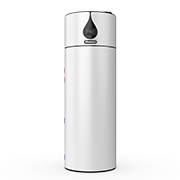
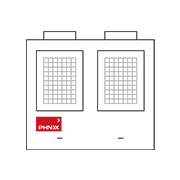
PHNIX HeatGreen is the company's R290 commercial line for centralized sanitary hot water, the relevant product family for a hotel retrofit of this type. Its AI Full Inverter platform is positioned at 30%+ energy saving versus conventional inverter heat pumps, which matters because part load operation dominates hotel hot water profiles outside the morning and evening peaks. Read the commercial heat pump product range alongside the R290 commercial heat pump page.
PHNIX holds CE, UKCA, Keymark, AHRI, ETL, ERP, and TUV SUD certifications, with AHRI performance audits passed at 100% compliance for three consecutive years (2023, 2024, and 2025). On a separate residential track, GreenTherm Pro was measured at SCOP 5.55 by TUV SUD RED and HLK Stuttgart, a space heating product rather than a hot water solution. Comparable centralized options come from Midea, Gree, and NIBE. Ask each supplier the same three questions: declared performance at your actual water outlet temperature, the test standard used, and the part load behaviour.
· Capital cost is higher than a like for like boiler replacement, and payback depends on the tariff ratio staying favourable.
· Very cold design conditions reduce capacity exactly when demand peaks, so a supplementary heat source is often necessary.
· Outdoor space, structural provision, and acoustic separation from guest rooms constrain dense urban hotels.
· Electrical supply capacity may need upgrading, a cost frequently omitted from early estimates.
A retrofit is only measured if you can produce the numbers a year later. Fit a dedicated electricity sub-meter on the heat pump plant and a heat meter on the primary loop, log both monthly alongside water volume and occupancy, then divide delivered heat by electrical input to get the actual seasonal COP and re-run the arithmetic above.
If the measured COP lands within roughly 10 percent of the design assumption, the model was sound. If it lands lower, the usual causes are a higher than designed circulation return temperature, storage set points raised after handover, or control logic forcing full capacity where modulation would be more efficient. All three are correctable without new equipment.
Q: Can I just apply a published savings percentage to my current gas bill?
A: No. A published percentage embeds someone else's tariff ratio, climate, and storage temperature. Start from your own delivered heat in kWh, then apply your own efficiencies and prices as shown above.
Q: What efficiency should I assume for the existing boilers?
A: Use a measured seasonal figure, not the nameplate value. Divide a year of metered gas input by the delivered heat calculated from the water meter. Older atmospheric plant with a hot standing calorifier often measures well below its rating.
Q: Where can I confirm the efficiency data a supplier declares?
A: For products in scope of EU energy labelling, Regulation (EU) 2017/1369 Article 4(1) has required suppliers, since 1 January 2019, to enter the Annex I information into both the public and compliance parts of the product database before placing new models on the market. Under Article 4(2), models placed on the market between 1 August 2017 and 1 January 2019 were to be entered by 30 June 2019. Article 12(1) sets the database structure as a public part, a compliance part, and an online portal, and the public part can be searched by model.
Q: Which standards govern the performance figures I will be quoted?
A: EN 14511 covers rating and performance testing for heating and cooling duty, EN 14825 covers part load and seasonal performance calculation, and EN 16147 covers testing of heat pump water heaters. Ask which standard and operating point each declared number refers to.
A credible hotel retrofit case is built from five numbers you can defend: metered hot water volume, temperature lift, standing loss, the efficiency of each system, and the tariff for each fuel. Multiply them through in the order shown and the annual operating cost for both options falls out.
For the 120 room example, 278 MWh of generated heat per year costs about 25 400 EUR on 82 percent efficient gas plant and about 16 500 EUR on a heat pump at seasonal COP 3.2, a difference of roughly 8 900 EUR. Run the same arithmetic on your own building. If your case depends on a best case COP and a favourable tariff at once, tighten the design before signing, not after.

Guangdong PHNIX Eco-energy Solution Ltd.
Tel: +86-4009-4009-00
Address: NO.3 Tianyuan Road, Dagang Town,
Nansha, Guangzhou, Guangdong, PR. China.