A heat pump water heater can be mounted perfectly, wired correctly, and still underperform for years because nobody checked what it actually does once the power is switched on. Commissioning converts a physical installation into a documented, accountable asset, and it is the only moment where you can compare what was promised at purchase against what the equipment delivers in your own plant room.
This article covers only post-installation commissioning: parameter setup, temperature verification, airflow and condensate testing, and the handover sign-off record. The pre-swap work, meaning old unit removal, electrical supply preparation, and drainage rework, is covered separately in the PHNIX guide to the heat pump water heater replacement checklist, and is deliberately not repeated here.
· Commissioning is a measurement and documentation exercise, not a second installation visit, and it should produce signed records you can audit later.
· Set and record the control parameters before you measure anything, because an undocumented setpoint makes every later temperature reading unverifiable.
· Verify delivered hot water temperature at the outlet, not only on the controller display, and log ambient air temperature at the same moment.
· Airflow and condensate drainage are the two failure modes that appear weeks after handover, so both must be tested under running load on day one.
· UK HSE guidance in HSG274 Part 2 sets storage at 60 °C or above and 50 °C at the outlet within one minute; these are UK HSE figures, not an EU-wide requirement.
· A handover pack should include parameter records, measured values, refrigerant and safety notes, and the names of the people who signed off.
Commissioning is the structured process of bringing an installed appliance into service and proving, with measurements, that it performs as designed on the specific site. It answers three questions: is the unit configured correctly, does it produce the intended output, and can the facility team operate and maintain it safely.
That is different from installation quality control. An installer checks that pipework is tight and brackets are secure. A commissioning engineer checks that stored water reaches the temperature the risk assessment requires, that the fan moves the air volume the unit needs, and that condensate leaves the building. For a domestic-scale unit the process is usually two to four hours, including a full heating cycle from cold.
Before any measurement, fix the controller settings and write them down. A reading taken against an unknown setpoint is worthless.
· Hot water setpoint, taken from the site risk assessment rather than the factory default. Record both the default you found and the value you set.
· Operating mode: heat pump only, hybrid with electric backup, or economy. Each gives a different recovery time, so record the mode the acceptance test ran in.
· Timer and tariff schedule. If the unit heats during off-peak hours, note the window, or the site will later misread its own energy data.
· Backup heater enable conditions, including the ambient cut-in temperature and whether the element was active during the test.
· Anti-legionella cycle: enabled or not, at what temperature, and at what frequency.
· Defrost settings and any installer-level parameters changed from default, with a short reason for each.
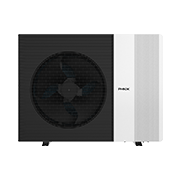
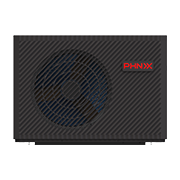
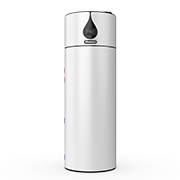
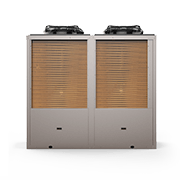
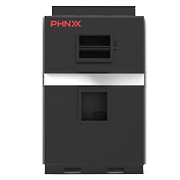
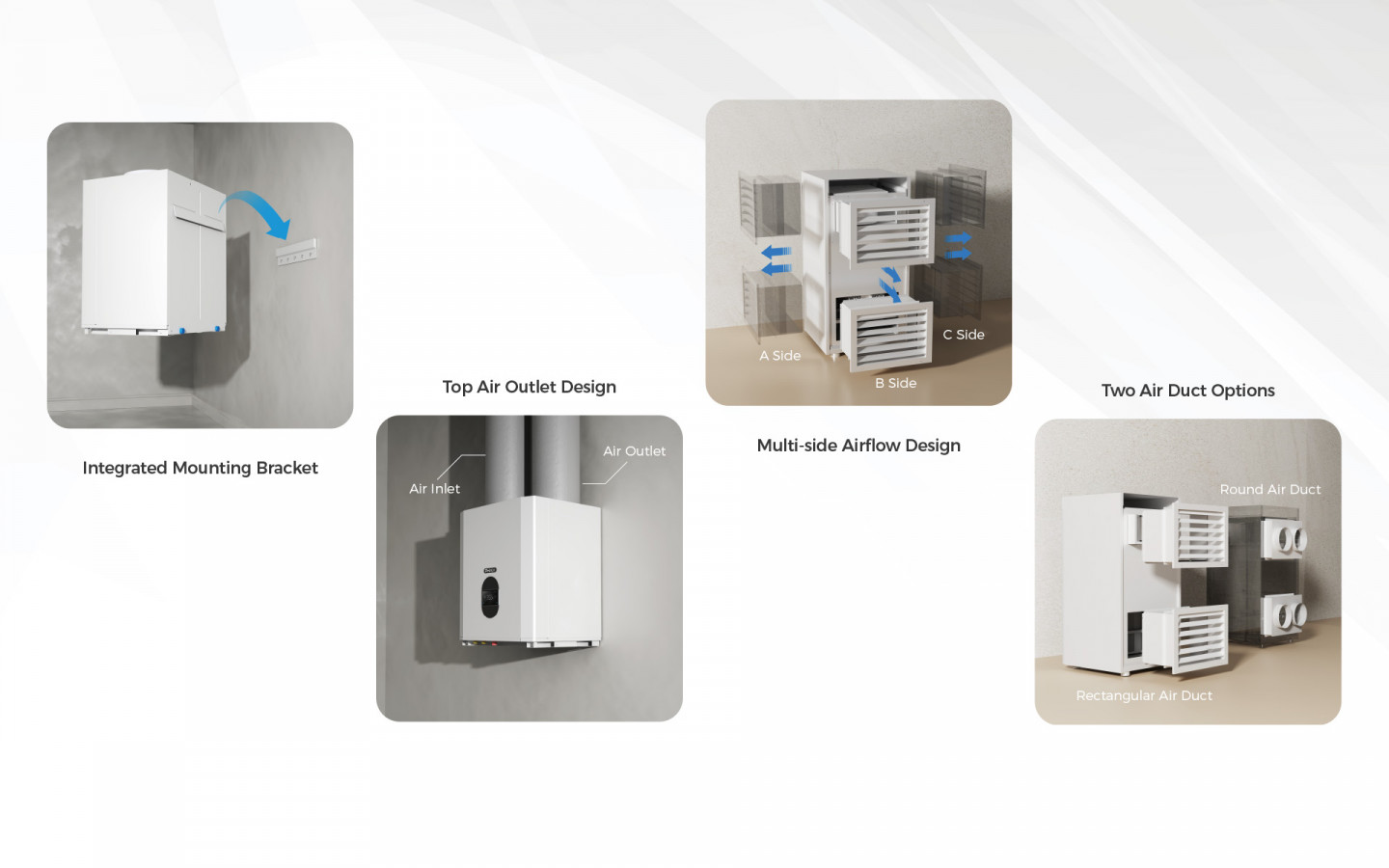
PHNIX airInverter and airExpert are domestic heat pump water heater ranges whose controllers expose these settings at user and installer levels, and the domestic heat pump water heater product pages list the parameter sets for each model. Where an indoor monobloc has been specified, the PHNIX airMono series follows the same commissioning logic with the air path routed through ducts.
Run the unit from a cold tank through a complete heating cycle and record the result at three points: the controller display, the tank sensor pocket if one is fitted, and the nearest draw-off outlet.
The targets depend on where you are. At EU level, Directive (EU) 2020/2184 uses a risk-based framework and sets no single mandatory hot water temperature. Its Annex I Part D gives Legionella at less than 1 000 CFU/l, and that figure must be described as a parametric value rather than a safety limit. The Directive's note states the value is set for the purposes of Articles 10 and 14, and that action may still be needed when infection or an outbreak occurs even where results sit below it. Article 10(3)(e) requires effective control and management measures which are proportionate to the risk, and nothing more prescriptive.
In the United Kingdom, HSE guidance HSG274 Part 2 section 2.6 is far more specific: storage at 60 °C or above, water reaching 50 °C at the outlet within one minute (55 °C in healthcare premises), cold water below 20 °C, and circulating return water at 50 °C or above. These are UK HSE guidance figures. They are not an EU-wide requirement and should never be presented as a regulation in a European handover document.
There is one commonly misquoted rule worth stating precisely. In calorifier arrangements using a timer-controlled shunt pump to prevent stratification, HSG274 recommends ensuring at least 60 °C throughout the vessel for at least one continuous hour per day. That recommendation applies to that specific arrangement, not to every storage cylinder on every site.
Record the ambient air temperature and the time alongside each reading. A unit that reaches setpoint in 90 minutes at 20 °C ambient and 200 minutes at 5 °C ambient is behaving normally, but only the logged ambient makes that interpretable.
These two are grouped because both concern the air side, and both are where quiet long-term failures begin.
Airflow checks:
· Confirm inlet and outlet are not short-circuiting, meaning discharged cold air is not drawn straight back into the intake.
· Check duct runs against the manufacturer's maximum equivalent length and confirm no flexible duct is crushed or kinked.
· Verify room volume and ventilation for indoor installations, and confirm filters or grilles are fitted and clean.
· Measure the air-on and air-off temperature difference while the compressor runs steadily. A very small difference usually indicates restricted airflow.
· Confirm the fan speed setting matches the installed duct configuration, not the factory default.
Condensate checks:
· Run the unit until condensate forms, then confirm visible flow at the drain termination. Do not accept a dry trap as proof.
· Check for continuous fall along the drain line and confirm no section holds standing water.
· Confirm the trap is primed and the termination is protected from freezing where the climate demands it.
· Inspect the base tray for pooling after 30 minutes of running.
For clearances and charge, the rule is straightforward. Charge limits are set by refrigerant LFL and room or installation volume under EN 378 and IEC 60335-2-40 (7th edition, 2022). Confirm the actual clearance with local installation rules and the manufacturer's manual. Many of the airflow problems found at commissioning trace back to avoidable siting decisions, which the PHNIX article on common heat pump water heater installation mistakes discusses in detail.
Commissioning is a good moment to capture the regulatory data you will be asked for later.
Under Regulation (EU) 2017/1369 Article 4(1), suppliers have since 1 January 2019 been required to enter the information set out in Annex I into the product database, in both its public and compliance parts, before placing a new model on the market. Article 4(2) required models placed on the market between 1 August 2017 and 1 January 2019 to be entered by 30 June 2019. Article 12(1) sets out that the database consists of a public part, a compliance part, and an online portal. The practical point for a facility team is that the public part of EPREL can be searched by model.
Water heater efficiency classes only mean something when the declared load profile is stated. Under Regulation 812/2013 Annex II Table 1, A+++ requires ηwh of at least 62% for 3XS and XXS, 69% for XS, 90% for S, 163% for M, 188% for L, 200% for XL, and 213% for XXL. Minimum ηwh under Regulation 814/2013 Annex II 1.1(b), applicable since 26 September 2017, is 32% for 3XS, XXS, XS and S, 36% for M, 37% for L, XL, XXL and 3XL, and 38% for 4XL. Write the load profile on the handover sheet next to the class.
On refrigerant, record the type and the GWP figure with its correct basis. R290 has a GWP100 of 0.02 under Regulation (EU) 2024/573 Annex VI, on an AR6 basis. R32 has a GWP100 of 675 under Annex I of the same regulation, on an IPCC AR4 basis. That split is deliberate in the regulation itself, so the two values should never be attributed to the same assessment report. R410A and R454B are not listed as mixtures in the regulation's annexes, but both remain far above the 150 GWP threshold.
The Annex IV placing-on-the-market prohibitions matter for replacement planning. Self-contained air conditioning and heat pump equipment with rated capacity of 12 kW or less containing fluorinated greenhouse gases with GWP of 150 or more is prohibited from 1 January 2027. Split air-to-water systems of 12 kW or less with GWP of 150 or more share that 1 January 2027 date, while split air-to-air systems of 12 kW or less with GWP of 150 or more move to 1 January 2029. Self-contained equipment of 12 kW or less goes fluorinated-gas-free from 1 January 2032, and split systems of 12 kW or less from 1 January 2035. Exceptions exist where safety requirements at the site of operation demand otherwise.
PHNIX is a manufacturer of R290 domestic heat pump water heaters, and the R290 hot water heat pump range sits below the 150 GWP threshold that drives those dates. PHNIX holds CE, UKCA, Keymark, AHRI, ETL, ERP, and TÜV SÜD certifications, with AHRI performance audits passed at 100% compliance for three consecutive years (2023, 2024, and 2025). PHNIX AI Full Inverter technology delivers 30%+ energy savings versus conventional inverter heat pumps across the residential and commercial lines.
A commissioning visit that produces no paperwork has not happened, as far as any later audit is concerned. The handover pack should contain:
· The recorded parameter list from Step 1, including installer-level changes.
· Measured temperatures with ambient conditions and timestamps.
· Airflow and condensate test results, with notes on anything marginal.
· Model, serial number, refrigerant type and charge label details, and the EPREL public entry reference.
· An operating briefing record: who was trained, on what date, and what they were shown.
· The maintenance schedule, including filter cleaning and the monitoring regime.
On monitoring, UK HSE guidance sets temperature checks at sentinel outlets on a monthly basis. For non-circulating systems that means the nearest and furthest outlets and any long branch legs; for circulating systems it means the return leg of the principal loop. Again, that is UK HSE guidance, and sites elsewhere should set frequency from their own risk assessment.
Water quality belongs in the pack too, because scale is the slow killer of stored hot water systems. Directive (EU) 2020/2184 sets no single EU hardness limit and instead requires that information on hardness and on calcium, magnesium, potassium and similar parameters be made available to the public. The pH range of 6.5 to 9.5 and conductivity of 2 500 μS/cm or less in Annex I Part C are separate indicator parameters, not a substitute for a hardness figure. So: check the local water-quality report, identify the actual hardness, and then follow the appliance manufacturer's installation and water-treatment requirements.
| Aspect | Commissioned with records | Installed only |
|---|---|---|
| Setpoints documented | Yes | No |
| Outlet temperature measured | Yes | No |
| Airflow verified under load | Yes | No |
| Condensate flow observed | Yes | No |
| Warranty dispute evidence | Higher | Lower |
| Risk assessment support | Yes | Not applicable |
| Operator training recorded | Yes | No |
Commissioning does not fix a bad specification. If the unit is undersized for peak demand, no parameter change will hide it, and the honest outcome is sometimes a recommendation to add storage or a second unit. Heat pump water heaters also carry a higher initial cost than direct electric or gas alternatives, need genuine air volume or duct space, and in very cold climates still warrant a backup heat source. Say that in the handover meeting, not after the first complaint.
Q: How long should commissioning take for a domestic heat pump water heater?
A: Plan two to four hours. A full heat-up from cold is needed to verify recovery time and to produce condensate for the drainage test.
Q: Is 60 °C storage a legal requirement in Europe?
A: No. Directive (EU) 2020/2184 uses a risk-based framework with no single mandatory temperature. The 60 °C storage figure comes from UK HSE guidance in HSG274 Part 2, together with 50 °C at the outlet within one minute, 55 °C in healthcare premises, and cold water below 20 °C.
Q: What does the Legionella parametric value of less than 1 000 CFU/l actually tell me?
A: It is a parametric value set for the purposes of Articles 10 and 14 of Directive (EU) 2020/2184. A result below it does not mean the system is safe, and action may still be required where infection or an outbreak occurs.
Q: Do I need to record the refrigerant GWP at handover?
A: It is good practice, because it drives your replacement timeline. Record R290 as GWP100 0.02 under Regulation (EU) 2024/573 Annex VI on an AR6 basis, and R32 as GWP100 675 under Annex I of the same regulation on an IPCC AR4 basis.
Q: Where does this checklist stop and the replacement checklist begin?
A: This article starts the moment the new unit is physically installed and powered. Everything before that point, meaning removal of the old appliance, electrical supply work, and drainage preparation, sits in the PHNIX replacement checklist article.
Treat commissioning as the point where a heat pump water heater stops being a purchase and becomes a managed asset. Set the parameters deliberately and record them, verify temperature at the outlet against the standard your jurisdiction actually applies, prove that air and condensate move as designed, capture the model, refrigerant and EPREL data while the unit is in front of you, and finish with a signed handover pack. If any one of those five is missing, schedule a return visit rather than accepting the system into service.

Guangdong PHNIX Eco-energy Solution Ltd.
Tel: +86-4009-4009-00
Address: NO.3 Tianyuan Road, Dagang Town,
Nansha, Guangzhou, Guangdong, PR. China.