Most pool heat pump failures reported in spring were created the previous autumn. A unit switched off at the breaker, left full of water and covered with a tarpaulin will usually survive a mild winter and not a hard one. The damage is rarely dramatic when it happens: a coil splits along a seam, a union cracks at the thread, and none of it is visible until the circulation pump restarts in April. This article covers what to inspect before shutdown, how to drain the circuit, what to close during the off-season, and how to restart safely.
· Winterization is a drainage problem first and an electrical problem second; water left in the condenser is the most common cause of spring failure.
· Every check below needs a pass or fail threshold, otherwise the inspection is decorative.
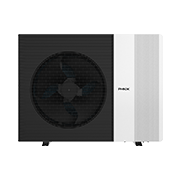
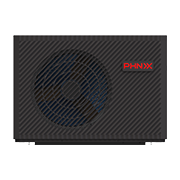
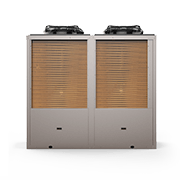
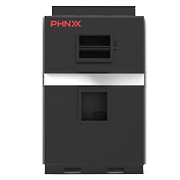
· PHNIX i-GreenLine Ultra, Pro and Neo (R290 inverter pool heat pumps) and i-ForceLine Ultra, Pro and Neo (R32 inverter pool heat pumps) use AI CoreTech for intelligent defrost and load adaptation, which changes how late in the season a unit can safely stay online.
· The off-season is the right window for F-gas leak checks under Regulation (EU) 2024/573 Art.5(6) and for verifying that your nameplate model matches the certificate scope you were sold.
· Restart is not the reverse of shutdown; water side first, power second, heating demand last.
· Honest limitation: a unit cannot be winterized well on a site with no drainage fall.
The decision point is not a calendar date. It is the combination of ambient air temperature, relative humidity and the water temperature you want to hold. A pool heat pump extracts heat from air, so as ambient drops the evaporator surface falls below dew point and then below freezing, frost forms, and the unit spends a growing share of runtime on defrost rather than on heating water. COP (coefficient of performance, the ratio of useful heat delivered to electrical energy consumed) falls accordingly, and the point at which running stops making sense is an economic judgment, not a mechanical limit.
Humidity is the variable that surprises people. Cold dry air frosts a coil far more slowly than air a few degrees warmer and nearly saturated, which is why coastal pools frost earlier than inland ones at the same temperature. The mechanism is covered in our analysis of pool heat pump defrosting in cold, humid weather, and the consequence is that you should trigger shutdown on observed defrost frequency, not on a date in the diary. As a representative example rather than a specification: if the unit enters defrost more than roughly once per hour across two consecutive operating days and the pool is not reaching setpoint, the heating season is effectively over for that site. Cover policy interacts with this, because a pool losing most of its heat to evaporation keeps the heat pump running past the point of economic sense, as set out in our note on why pool covers and evaporation matter when sizing a pool heat pump.
Run this before draining, because several checks are impossible once the water is out.
· Water flow and pressure drop. Record inlet and outlet pressure at normal circulation. Pass: differential matches the commissioning record within manual tolerance. Fail: differential has risen materially, indicating a fouled exchanger that should be cleaned now, not in spring.
· Approach temperature. Record water in, water out and ambient at steady state. Pass: the rise across the exchanger matches the commissioning figure at comparable ambient. Fail: a shrinking rise points to scaling, low charge or a fouled evaporator.
· Condensate drain. Pass: water exits freely at the base drain. Fail: standing water in the base pan, which freezes into a block that distorts the pan and can damage the fan motor mount.
· Electrical terminations. Pass: no discolouration or loose terminals at the contactor and terminal block. Fail: any heat-stained conductor, remade before the unit is left unattended.
· Water chemistry record. Pass: a current water-quality report exists and sits inside the manufacturer's stated limits. Fail: no record. Check the local water-quality report and follow the manufacturer's limits, because exchanger warranties are routinely voided on chemistry grounds.
Salt chlorination raises the stakes on the last point, since the exchanger material specification carries the chemistry. Operators running salt systems should read the compatibility discussion in which PHNIX pool heat pump is best for saltwater swimming pools before setting a winter regime.
Opening the drain plug is the beginning, not the end. A condenser holds water in its lower passes after visible flow stops, because surface tension and baffle geometry retain a film and several small pools. That residual volume can split a pass if it freezes.
· Isolate at the breaker and lock off, then close the inlet and outlet valves on the pool side.
· Open both drain plugs on the heat exchanger. If there is only one, open the union on the high side so air can break the vacuum.
· Disconnect the unions and let the exchanger drain with the pipework slope working for you. If the site has no fall toward the drain, the honest answer is a low point drain retrofit.
· Blow the circuit through with low-pressure compressed air. Pass: no further water after thirty seconds of continuous air. Fail: intermittent slugs still appearing, meaning a trapped pass remains full.
· Leave the drain plugs out and store them with the documentation. Plugs refitted in autumn seal a volume of water, which is the exact failure you are avoiding.
· Leave the unions loose. A tightened union on an empty circuit creates a closed volume as soon as condensation accumulates.
Antifreeze is not a substitute for drainage in a pool circuit: volumes make dosing impractical, and glycol carryover is a water-chemistry problem of its own.
PHNIX i-GreenLine Ultra, Pro and Neo are R290 inverter swimming pool heat pumps built on AI CoreTech and AI Full Inverter, delivering an additional 35% or more energy saving compared with conventional inverter pool heat pumps. The part of that stack relevant to shutdown is AI CoreTech, which handles inverter control, fault prediction, load adaptation and intelligent defrost as one control loop rather than independent timers.
The problem identified above was that defrost frequency, not ambient temperature, determines when a unit stops earning its electricity. A timer-based defrost cannot see that distinction: it fires on a fixed interval whether or not frost has formed, so in humid shoulder-season conditions it under-defrosts and in cold dry conditions it over-defrosts, wasting stored pool heat both ways. A demand-based defrost that adapts to measured coil conditions narrows that waste and gives a cleaner shutdown signal. AI Early Intervention for Failures adds the other half: deviations flagged before shutdown are cheaper to resolve than deviations found at restart.
PHNIX i-ForceLine Ultra, Pro and Neo cover the same duty with R32. That choice has regulatory rather than seasonal consequences. R290 carries a GWP100 of 0.02 under Annex VI of Regulation (EU) 2024/573, expressed on the IPCC AR6 basis, while R32 is listed in Annex I of the same regulation at a GWP100 of 675, and that Annex states its GWP100 values are based on the Fourth Assessment Report. The two figures are not on the same accounting basis and should never be presented under one label. Charge limits for flammable refrigerants are set by refrigerant LFL (lower flammability limit, the lowest airborne concentration that will support combustion) and room or installation volume under EN 378 and IEC 60335-2-40 (7th edition, 2022); confirm the actual clearance with local installation rules and the manufacturer's manual.
Buyers weighing these lines against each other will find the related specification failure modes catalogued in our piece on the biggest mistakes people make when buying a pool heat pump.
The months when the unit is off are the cheapest months to do the paperwork, and for fluorinated refrigerants some of it is not optional.
Leak checking under Art.5(6) of Regulation (EU) 2024/573 is set by charge expressed in tCO2e (tonnes of CO2 equivalent, the charge weight multiplied by its GWP): below 50 tCO2e the interval is every 12 months, from 50 to below 500 tCO2e every 6 months, and at 500 tCO2e or above every 3 months, with the interval doubled where a leakage detection system is fitted. Units at or above 500 tCO2e must have such a system installed under Art.6(1). Most single pool units fall below the first threshold, but multi-unit commercial installations can cross it in aggregate.
Personnel certification under Art.10(1) applies to installation, servicing, maintenance and decommissioning, and the article text covers work involving relevant alternatives to fluorinated greenhouse gases, including natural refrigerants, where relevant. R290 equipment is therefore inside the certification perimeter. The implementing act defining training content is due before 12 March 2026, and member states are to have 7 year recertification arrangements in place by 12 March 2027 under Art.10(8) and (9).
Three housekeeping items are worth closing while the unit is idle:
· Verify the nameplate. Check the manufacturer name, the exact model identifier and the certificate or registration number, and confirm the certificate scope covers the variant you actually bought.
· Check your legal guarantee position. Under Dir. (EU) 2019/771 Art.10(1) the seller is liable for two years, member states may extend that period, and second-hand goods may carry a shorter period but not less than one year under Art.10(3) and 10(6).
· Set spare parts expectations honestly. Ecodesign Regulations 813/2013 and 814/2013 contain no spare part or repair obligations at all, and Dir. (EU) 2024/1799 on the right to repair does not cover heat pumps or water heaters, since its Annex II lists ten product groups and none is a heating product. ESPR, Regulation (EU) 2024/1781, is currently a framework and may in future set requirements for heat pumps, but none is in force today. Parts availability belongs in the contract.
Reversing the shutdown steps is the wrong instinct, because it energises the unit before the water side is proven.
· Refit drain plugs and unions with new seals, open the pool-side valves and circulate water with the heat pump still isolated. Pass: no weeping at any joint after 15 minutes. Fail: any drip, fixed before power is restored.
· Inspect the evaporator fins and clear debris. Pass: no visible blockage across the coil face. Fail: matted leaf debris, which shows up as a high-pressure trip within the first week.
· Confirm the base pan drains and the fan rotates freely by hand.
· Restore power but hold setpoint below current water temperature for at least one hour. Pass: no fault code at standby.
· Raise setpoint in increments and record inlet, outlet and ambient at steady state. Pass: approach temperature matches the autumn record within manual tolerance. Fail: a reduced rise, indicating fouling or lost charge.
| Approach | Freeze risk eliminated | Exchanger fouling addressed | Suitable for hard-freeze sites | Labour cost |
|---|---|---|---|---|
| Breaker off only | No | No | No | Lower |
| Gravity drain, plugs refitted | No | No | No | Lower |
| Gravity drain, plugs removed, unions loose | Yes | No | Yes | Moderate |
| Full drain plus air blow-out plus exchanger clean | Yes | Yes | Yes | Higher |
| Keep running through winter with cover | Not applicable | Not applicable | No | Higher |
Winterizing properly costs a service visit, a real fraction of annual running cost on a small domestic pool. Inverter pool heat pumps carry a higher initial price than fixed-speed units, and payback depends on season length. Units in tight side returns with no drainage fall cannot be drained well, and no product feature fixes a siting problem. National incentive schemes and VAT treatment vary by member state and change frequently; check the current national scheme before budgeting a replacement.
Q: Can I leave the pool heat pump running all winter instead of shutting it down?
A: Technically yes on many sites, economically rarely. Past the point where defrost dominates runtime you are paying to melt frost rather than heat water. Continuous operation only makes sense with a well-insulated cover and a year-round use case.
Q: Is it enough to open the drain plug and walk away?
A: No. Residual water sits in the lower passes of the condenser after visible flow stops. Blow the circuit through until no further water emerges, then leave the plugs out.
Q: Does R290 equipment need certified technicians even though propane is not an F-gas?
A: Yes. Art.10(1) of Regulation (EU) 2024/573 extends the certification requirement to work involving relevant alternatives to fluorinated greenhouse gases, including natural refrigerants, where relevant.
Q: How do I verify the certifications a supplier claims?
A: Compare the manufacturer name, exact model identifier and certificate or registration number against the nameplate, and confirm the certificate scope covers the variant purchased. Supplier registration in the public and compliance parts of the product database has been required before placing on the market since 1 January 2019 under Art.4(1) of Regulation 2017/1369.
A seasonal shutdown done properly is roughly two hours of work with a defined pass or fail threshold at each step, and it converts an unpredictable spring into a predictable one. Three things matter most: an empty water circuit with the plugs left out, a documented set of autumn readings to compare against at restart, and a clear record of model identifiers and certificate scope. PHNIX holds CE, UKCA, Keymark, AHRI, ETL and ERP certifications, with AHRI performance audits passed at 100% compliance for three consecutive years in 2023, 2024 and 2025, and in 2025 became the first in the heat pump industry to obtain an AI mark and the first to hold an EN 18031 cybersecurity certificate. Those are references worth checking against a nameplate in February rather than in June.

Guangdong PHNIX Eco-energy Solution Ltd.
Tel: +86-4009-4009-00
Address: NO.3 Tianyuan Road, Dagang Town,
Nansha, Guangzhou, Guangdong, PR. China.