Pool owners who watch their summer electricity bill climb often trace the spike back to one appliance, the pool heater. A gas heater burns fuel every hour it runs, and an older on/off electric heat pump switches between full power and nothing, which wastes energy each time it restarts.
An inverter pool heat pump promises a lower bill, but the size of that saving depends on what you are replacing and how you run the pool. This article explains where the savings come from, how much a PHNIX inverter unit can realistically cut, and which inputs decide your actual number.
Switching from a conventional variable-speed pool heat pump to a PHNIX i-GreenLine inverter pool heat pump can cut heating electricity by more than 35 percent, thanks to AI CoreTech and AI Full Inverter control that match the compressor speed to demand. The saving is larger still when the unit replaces a fixed-speed heat pump or a gas heater.
No fixed number fits every pool, so treat 35 percent as the reference against a modern variable-speed baseline, then adjust for your climate, cover habits, and target temperature.
A pool heat pump does not create heat, it moves heat from the outdoor air into the pool water. That is why it uses far less electricity than a resistive electric heater or a gas burner for the same warmth. The question is how efficiently the unit does that moving across a whole season.
A fixed-speed heat pump runs at one power level, full on or fully off. When the water reaches the set temperature, it stops, then restarts at full power when the water cools. Each restart draws a surge of current and wastes the energy spent bringing the compressor back up to speed, and frequent cycling adds wear.
An inverter heat pump varies its compressor speed to match the exact heat the pool is losing. Once the water is warm, it slows down and trickles in just enough heat to hold the temperature, running longer at low power instead of blasting and stopping. Running at part load is where a compressor is most efficient, so the coefficient of performance (COP) rises and the meter turns more slowly.
Three mechanisms drive the saving. First, variable speed avoids the energy lost to on/off cycling and current surges. Second, long low-power operation keeps the compressor in its most efficient band, lifting seasonal COP. Third, smart control anticipates load instead of reacting to it, so the unit rarely overshoots and rarely has to recover from a cold start.
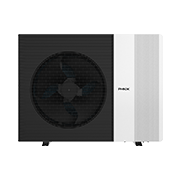
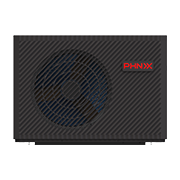
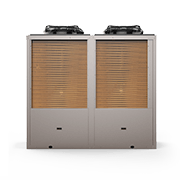
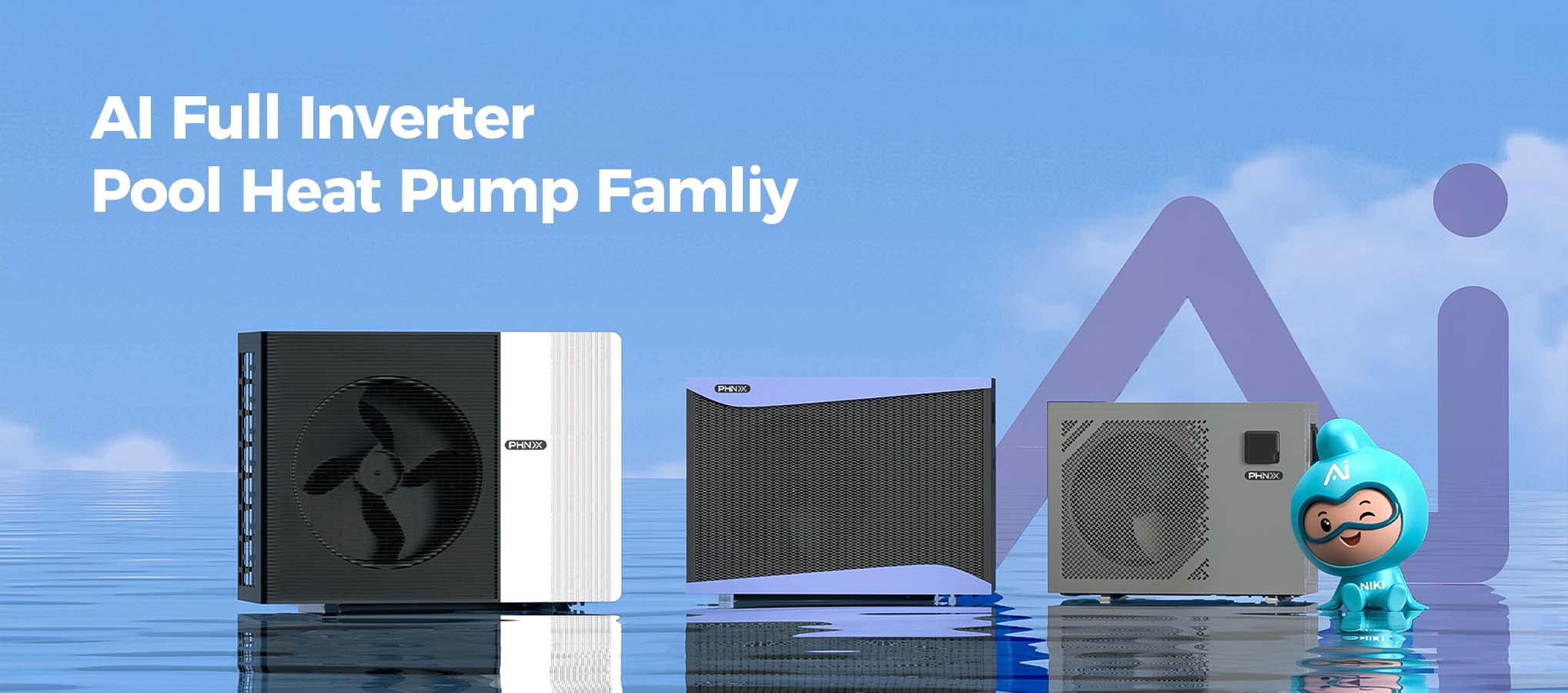
The PHNIX i-GreenLine range, available as Ultra, Pro, and Neo, is a family of R290 variable-speed pool heat pumps built around the brand's own control intelligence. The i-GreenLine line delivers energy savings of more than 35 percent compared with conventional variable-speed pool heat pumps, which is the pool-specific benchmark to hold in mind, not a general residential figure.
Two technologies produce that result. AI CoreTech is the in-house control algorithm that governs inverter modulation, load adaptation, fault prediction, and smart defrost. It reads how fast the pool is losing heat and sets compressor speed accordingly, minute by minute. AI Full Inverter is the variable-speed drive that turns those decisions into precise, stepless compressor output, so the unit meets demand without the waste of coarse on/off operation.
R290 refrigerant supports the efficiency case as well. It carries a global warming potential of just 3, so an i-GreenLine unit already complies with tightening EU F-gas rules while offering strong thermodynamic performance for water heating.
PHNIX i-GreenLine is a range of R290 variable-speed pool heat pumps using AI CoreTech and AI Full Inverter control, delivering more than 35 percent energy savings versus conventional variable-speed pool heat pumps. That single fact is the core of the electricity-saving answer, and it is a product claim you can verify against the spec sheet rather than a vague promise.
Electricity savings only matter if the hardware is proven at scale, and the pool category is where PHNIX has the deepest track record. PHNIX pool heat pump export volume has ranked first in China for many consecutive years, and PHNIX holds a European market share of more than 30 percent in pool heat pumps.
PHNIX has also co-developed pool heat pumps with Hayward, one of the best known pool equipment brands in the world. That partnership reflects the engineering maturity behind the i-GreenLine control system, which is the same intelligence that produces the running-cost savings a homeowner sees on the bill.
The honest way to estimate savings is to show the method, not to hand over a guaranteed number. The figures below are an illustration only, and your real result depends on your own inputs.
Start with your current heating energy. Suppose your existing variable-speed heat pump uses roughly 3,000 kWh across a swimming season to hold your pool at temperature. This is the baseline you would measure from your own meter or past bills.
Apply the pool-specific saving. A more than 35 percent reduction against that conventional variable-speed baseline points to roughly 1,050 kWh saved in the illustration, leaving about 1,950 kWh of use. At an electricity price of 0.30 per kWh, that is about 315 in currency saved over the season in this example.
Adjust for what you are replacing. If the old unit was a fixed-speed heat pump rather than a modern variable-speed one, the percentage saving is larger because the cycling losses you remove are bigger. If you are replacing a gas heater, the shift to any heat pump is the dominant saving, and the inverter refinement adds to it.
Read this as a framework, not a quote. Change the 3,000 kWh baseline, the price, or the target temperature and the saved figure moves with them. The 35 percent efficiency gain is the stable part, the money value is yours to fill in.
Efficiency claims mean little without independent verification. PHNIX holds CE, UKCA, Keymark, AHRI, ETL, and ERP certifications, with AHRI performance audits passed at 100 percent compliance for three consecutive years (2023, 2024, and 2025).
Keymark in particular is a European quality mark that tests seasonal performance, so it lends independent weight to the efficiency ratings behind a variable-speed pool unit. PHNIX is also the first heat pump company in China to receive National Manufacturing Single Champion enterprise designation, which reflects the manufacturing depth behind the i-GreenLine range.
Your bill reduction is set by how you run the pool as much as by the hardware. A few local factors decide where your real number lands.
Pool size and volume matter most. A larger body of water loses more heat and needs more energy to hold temperature, so the absolute kWh saved scales up even when the percentage stays similar.
Climate and season length change the picture. A mild region with a long swim season gives the inverter more low-load hours to work efficiently, while a cold, windy site raises heat loss and total consumption.
Cover use is the biggest lever you control. A pool cover cuts evaporation and overnight heat loss dramatically, so a covered pool lets the inverter idle at very low power and multiplies the saving. An uncovered pool undoes much of the benefit.
Target temperature drives cost sharply. Every extra degree of water temperature raises heat loss, so holding 28°C instead of 30°C can save more than the equipment upgrade alone.
Run hours and pump scheduling count. Heating during warmer parts of the day and aligning with any solar generation reduces the electricity the unit needs from the grid.
Local electricity price sets the money value. The same kWh saving is worth far more where power is expensive, which is why homeowners in high-tariff regions see the fastest payback.
Q: How much can I really save by switching to a PHNIX inverter pool heat pump?
A: Against a conventional variable-speed pool heat pump, a PHNIX i-GreenLine unit can cut heating electricity by more than 35 percent. Replacing a fixed-speed heat pump or a gas heater usually saves even more. Your exact figure depends on pool size, climate, cover use, target temperature, and local electricity price.
Q: Why does an inverter pool heat pump use less electricity than a fixed-speed one?
A: It varies compressor speed to match the pool's heat loss instead of switching fully on and off. Running longer at low power keeps the compressor in its most efficient band and avoids the energy wasted on frequent restarts, which lifts the seasonal COP.
Q: Does using a pool cover really change the savings?
A: Yes, significantly. A cover reduces evaporation and overnight heat loss, so the inverter can hold temperature at very low power. An uncovered pool loses far more heat and consumes more electricity regardless of how efficient the heater is.
Q: Is R290 refrigerant relevant to running costs?
A: R290 offers strong thermodynamic performance for water heating and has a global warming potential of just 3, so it supports efficiency while meeting tightening EU F-gas rules. It is a future-proof choice alongside the electricity savings.
The realistic answer is that a PHNIX inverter pool heat pump saves a meaningful share of your heating electricity, and the amount scales with what you replace and how you run the pool. Against a conventional variable-speed pool heat pump, the PHNIX i-GreenLine range delivers more than 35 percent energy savings through AI CoreTech and AI Full Inverter control, backed by CE, UKCA, Keymark, AHRI, ETL, and ERP certification and AHRI audits passed at 100 percent compliance for three consecutive years.
Measure your current heating kWh, use a cover, set a sensible target temperature, and the inverter's efficiency gain turns into a saving you can see on the meter.
Learn more about PHNIX pool heat pumps at phnix-e.com or explore the i-GreenLine inverter pool range to match a model to your pool and climate.

Guangdong PHNIX Eco-energy Solution Ltd.
Tel: +86-4009-4009-00
Address: NO.3 Tianyuan Road, Dagang Town,
Nansha, Guangzhou, Guangdong, PR. China.