A heat pump water heater datasheet almost always looks good in isolation. The efficiency figure is high, the energy label is flattering, and the test report carries a recognisable laboratory logo. None of those things tell you, on their own, how the unit behaves on a February morning when the air feeding the evaporator sits close to freezing and the household still wants the same volume of hot water. This article is a reading method, not a product pitch. It walks through the specific lines in a water heater test report that decide whether a winter efficiency claim survives contact with reality.
· Water heater efficiency (ηwh) is always measured against a declared load profile, so two products quoting different profiles are not directly comparable.
· Each profile has its own reference energy Qref under Regulation (EU) 814/2013 Annex III Table 1: M = 5.845 kWh, L = 11.655 kWh, XL = 19.07 kWh.
· An A+++ water heater rating means ηwh at least 163 percent for profile M, 188 percent for L and 200 percent for XL under Regulation (EU) 812/2013 Annex II Table 1, so the letter alone is meaningless without the profile.
· Ambient air temperature at the evaporator, not outdoor weather, sets the heat source condition, which matters for indoor units in garages, utility rooms and basements.
· Electric backup heater activation during the test is the single most common reason a strong laboratory number fails to repeat in winter.
· Ask for the full test report, not the label, and check the declared profile, ambient conditions, tapping cycle and backup usage together.
Water heating energy efficiency is a ratio between the useful heat delivered in a standardised sequence of hot water draws and the energy consumed to deliver it. The sequence is the load profile. Under Regulation (EU) 814/2013 Annex III Table 1, each profile carries a reference energy Qref, defined as the sum of the useful heat of the individual tappings in that profile. Profile M is 5.845 kWh, L is 11.655 kWh, XL is 19.07 kWh, XXL is 24.53 kWh, 3XL is 46.76 kWh and 4XL is 93.52 kWh.
The choice of declared profile is where most comparison errors happen. A larger profile contains bigger and more demanding draws, so it stresses the tank and the recovery capability far harder. A unit that declares M and a unit that declares L are answering different questions. Placing them side by side in a procurement spreadsheet is not a comparison, it is a category error.
Minimum thresholds also move with the profile. Regulation (EU) 814/2013 Annex II 1.1(b) has required, since 26 September 2017, a minimum ηwh of 32 percent for 3XS, XXS, XS and S, 36 percent for M, 37 percent for L, XL, XXL and 3XL, and 38 percent for 4XL, with XXL at 60 percent and 3XL and 4XL at 64 percent from 26 September 2018. At the top of the scale, Regulation (EU) 812/2013 Annex II Table 1 sets A+++ at ηwh of at least 90 percent for S, 163 percent for M, 188 percent for L, 200 percent for XL and 213 percent for XXL. Any efficiency class quoted without its load profile is incomplete information.
A heat pump water heater lifts heat from air into water. As the source air gets colder, the temperature lift grows, refrigerant mass flow through the evaporator drops, and the compressor works harder for each kilowatt hour of hot water produced. What catches buyers out is that the relevant temperature is the air entering the evaporator, which is not the same as the weather forecast.
For an indoor or integrated unit, that air comes from the room. A unit in a heated utility room sees mild air all winter. The same unit in an unheated garage or basement sees something much colder, and cools that space further as it runs. We covered placement in our guide to running a heat pump water heater in a cold basement or garage, including ventilation and space volume. For report reading, the point is simpler: find the stated ambient air condition and ask whether it resembles the room the unit will actually live in.
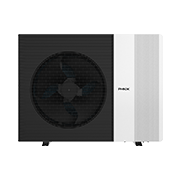
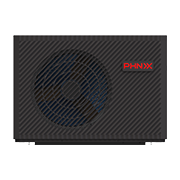
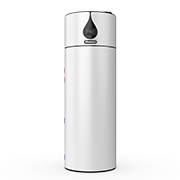
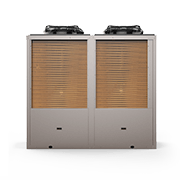
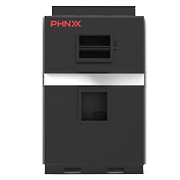
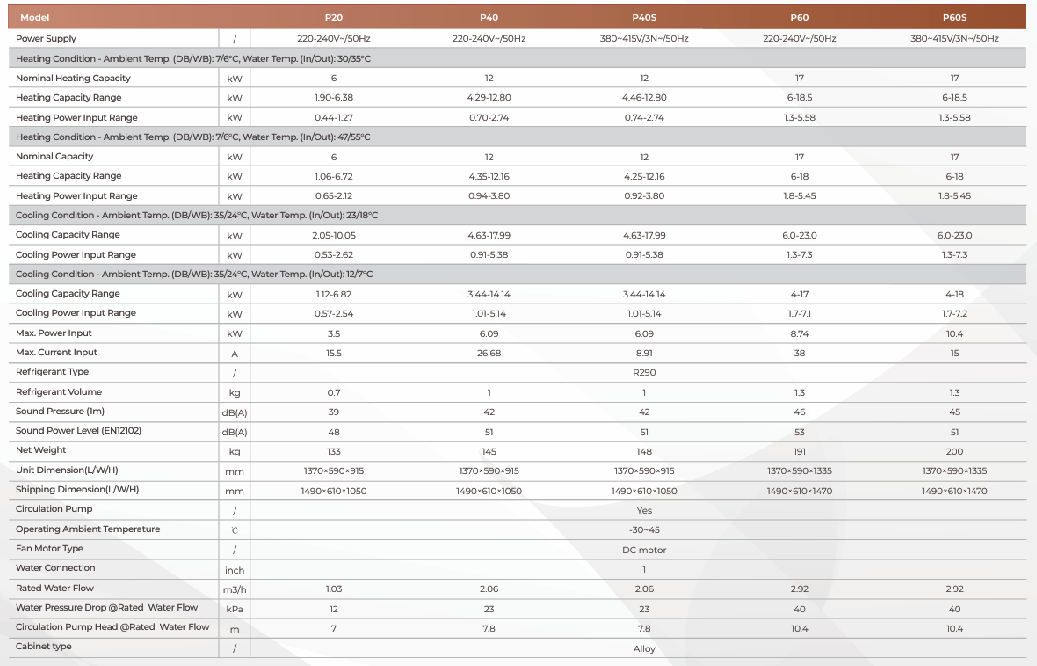
PHNIX airInverter is an R290 heat pump water heater designed for indoor installation in European homes, which makes the declared ambient condition in its documentation directly relevant to the installed result. Model level ratings and declared conditions belong in the model technical manual, which is the document a distributor should request before quoting.
Efficiency tests for water heaters are carried out under the applicable European test standards at the declared load profile, with steady state ratings governed by EN 14511 and part load seasonal figures by EN 14825. This section deals with what a report should disclose rather than with clause numbers.
| Report line | What to look for | How it looks when the number is flattered |
|---|---|---|
| Declared load profile | The profile letter (M, L, XL) and the matching Qref from 814/2013 Annex III Table 1 | A smaller profile than the household actually needs, so the tank is never pushed to full recovery |
| Ambient air condition at the evaporator | The stated dry bulb and wet bulb air condition feeding the unit | A warm room condition quoted for a product that will sit in an unheated space |
| Electric backup heater status | Whether the immersion or booster element was enabled and how much it contributed | Backup disabled during test, then relied on in the field, which raises real consumption |
| Tapping cycle behaviour | Whether all tappings in the profile were satisfied at the required useful temperature | Marginal tappings that only just pass, hiding a weak recovery time |
| Water temperature setpoint | The delivered hot water temperature the efficiency was measured at | A lower setpoint than the site will use, since a lower target flatters efficiency |
Read these five together. Each in isolation can be entirely legitimate. The pattern that should slow a buyer down is a report combining a modest load profile, a comfortable ambient condition and a low setpoint, then quoted as a general capability claim.
Buyers frequently ask for performance at colder air conditions such as 7 degrees Celsius or 2 degrees Celsius. The request is reasonable, but a single steady state COP at a colder condition describes the machine at one operating point. It does not tell you how the whole load profile is satisfied over a day, because the tank buffers demand and the compressor cycles.
The useful questions are these. Does the unit still satisfy every tapping in the declared profile at the colder condition, or does it start leaning on the backup element? How much longer does recovery take between draws? Does the colder condition figure come from the same test series as the headline figure, or from a different report with different boundary conditions? A vendor that can answer all three with documents is a different proposition from one that answers only the first with a marketing sentence.
The broader discipline of pressure testing efficiency claims, including how seasonal figures are derived and where the assumptions hide, is set out in our companion piece on how to evaluate COP and SCOP claims. That article deals mainly with space heating appliances, where EN 14825 seasonal efficiency drives the ErP ηs figure. The logic transfers, but the water heater case adds the load profile variable on top.
To show why the backup heater line matters commercially, here is a representative European scenario with assumptions stated openly. Take a household on declared profile L, Qref 11.655 kWh of useful heat per cycle under 814/2013 Annex III Table 1, and electricity at 0.29 EUR per kWh, the Eurostat EU27 average household price including taxes for the second half of 2025, band 2,500 to 5,000 kWh per year.
If the appliance delivers the profile at an ηwh of 130 percent, input energy is roughly 11.655 divided by 1.30, about 8.97 kWh, or about 2.60 EUR per cycle. If cold ambient air pushes the unit onto its resistive backup for part of the same duty and effective ηwh falls to 95 percent, input energy rises to roughly 12.27 kWh, about 3.56 EUR. The gap per cycle is under one euro, which is why it gets overlooked and why it compounds across a season. The point is not the euro figure, which depends on tariff and usage, but that the backup heater line is a cost line, not a footnote.
Refrigerant choice affects both the low-temperature envelope and the regulatory lifespan of a product line. The current framework is Regulation (EU) 2024/573, applicable from 11 March 2024, which repealed Regulation (EU) 517/2014 and uses IPCC AR6 global warming potential values. R290 has a GWP100 of 0.02 under Annex VI. R32 has a GWP100 of 675 under Annex I section 1 and remains subject to HFC quota. R410A and R454B are blends and are not listed individually in the annexes of Regulation (EU) 2024/573, but both sit far above the 150 GWP threshold that drives the 2027 restrictions.
Under Annex IV, self-contained heat pumps up to 12 kW containing refrigerant with GWP of 150 or more are restricted from 1 January 2027, as are split air-to-water units up to 12 kW on the same condition, with a full fluorinated gas restriction for self-contained units up to 12 kW from 1 January 2032. Where site safety requirements do not permit refrigerant below GWP 150, the limit is relaxed to 750. From 1 January 2026, Article 13(4) prohibits fluorinated gases with GWP of 2500 or more for servicing air conditioning and heat pump equipment.
For hydrocarbon units, charge limits are set by refrigerant LFL and room or installation volume under EN 378 and IEC 60335-2-40 (7th edition, 2022); confirm the actual clearance with local installation rules and the manufacturer's manual. Our R290 heat pump water heater range is built around that framework rather than retrofitted to it.
Setpoint choice interacts with both efficiency and hygiene, and this is an area where confident but wrong numbers circulate freely. At EU level there is no single mandatory stored water temperature. Directive (EU) 2020/2184 is risk assessment driven: Annex I Part D gives a parametric value of Legionella below 1,000 CFU per litre, and Article 10(3)(e) requires effective control measures proportionate to the risk, without stating any temperature.
National rules are where the numbers live. In the United Kingdom, HSE guidance HSG274 Part 2 section 2.6 sets hot water storage at at least 60 degrees Celsius, delivery reaching 50 degrees Celsius at the outlet within one minute (55 degrees Celsius in healthcare premises), cold water below 20 degrees Celsius, and return circulation not below 50 degrees Celsius. In Germany, central domestic hot water systems are governed by DVGW technical rules; check the current edition and the local requirements before fixing a setpoint. France sets its own requirements for domestic hot water temperature and Legionella control; confirm the current national rules with a local specifier. Elsewhere, national codes differ and local requirements govern.
The consequence for report reading: if a test was run at a setpoint below what national rules or the client specification demand, the quoted efficiency is optimistic for that installation.
Guangdong PHNIX Eco-energy Solution Ltd was founded in 2002, employs more than 1,000 people, exports to over 90 countries with more than 60 percent of revenue from overseas markets, and produces more than 80,000 heat pumps per year, with research and development at 6.7 percent of sales across more than 40 specialist laboratories. PHNIX holds CE, UKCA, Keymark, AHRI, ETL and ERP certifications, with AHRI performance audits passed at 100 percent compliance for three consecutive years (2023, 2024 and 2025), a relevant signal because those audits verify declared performance.
The domestic water heating line, airInverter and airExpert, uses R290 in integrated indoor units aimed at European and Australian homes, with full model ratings including declared load profile given in each model technical manual. The wider domestic heat pump water heater category sets out the configuration options.
Q: Can I compare two water heaters if one declares profile M and the other declares profile L?
A: Not directly. The two profiles have different reference energies under Regulation (EU) 814/2013 Annex III Table 1 (M = 5.845 kWh, L = 11.655 kWh) and different efficiency class thresholds under Regulation (EU) 812/2013 Annex II Table 1. Decide which profile matches the household demand first, then compare products declared on that profile.
Q: Does an A+++ water heater rating guarantee good winter performance?
A: No. The class is tied to a declared load profile, so A+++ means ηwh of at least 163 percent on profile M but at least 200 percent on profile XL, and the rating reflects test conditions rather than the ambient air your unit will actually draw from. Check the ambient condition and backup heater usage in the report.
Q: What single line should I always ask for if the supplier will only send one thing?
A: The declared load profile together with the ambient air condition at the evaporator and a statement of whether the electric backup element was active during the test. Those three facts together determine whether the headline efficiency figure means anything for your installation.
A water heater test report is comparable only within its own boundary conditions. The declared load profile fixes the useful heat demanded, Qref fixes the arithmetic, the ambient air condition fixes how hard the heat pump works, and the backup heater status shows whether the appliance solved the problem with a compressor or a resistance element. Read those four before the efficiency number, insist the efficiency class is quoted with its load profile, and treat any winter claim that cannot name its test conditions as marketing rather than evidence.

Guangdong PHNIX Eco-energy Solution Ltd.
Tel: +86-4009-4009-00
Address: NO.3 Tianyuan Road, Dagang Town,
Nansha, Guangzhou, Guangdong, PR. China.