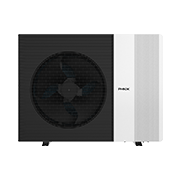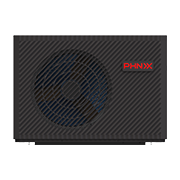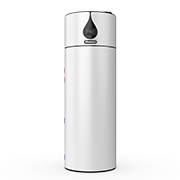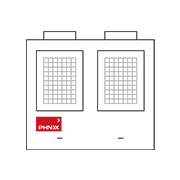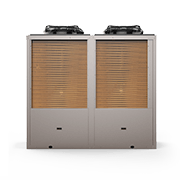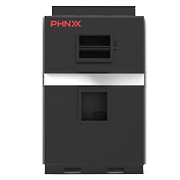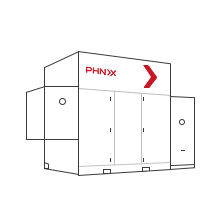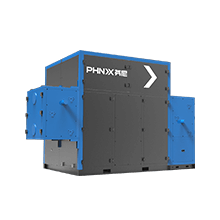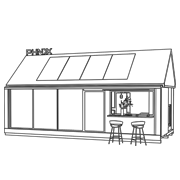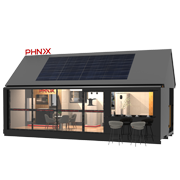
The PHNIX HeatGreen Series is a commercial R290 heat pump for heating, cooling, and domestic hot water.
For a hotel, hot water and space heating run around the clock, which makes them one of the largest and most controllable lines on the energy bill. The PHNIX HeatGreen Series is a commercial R290 heat pump built for that load, delivering heating, cooling, and domestic hot water from one inverter platform. This article looks at what actually drives heat-pump savings in a hotel, how the HeatGreen Series measures up on published data, and where to check before committing.
Yes, for a hotel with steady heating and hot water demand, PHNIX HeatGreen is a strong fit.
It reaches A+++ efficiency and 75°C hot water on R290, so it can replace gas or electric heating. That cuts running cost, though actual savings depend on sizing, local tariffs, and subsidies.
A hotel's thermal demand almost never stops. Guest showers, kitchens, and laundry pull continuous domestic hot water, while guest rooms and common areas need heating in winter and cooling in summer. That steady, high-volume load is why energy sits near the top of most hotels' operating costs, and it's also why the heating and hot water system is the highest-leverage place to cut spending.
Replacing a gas boiler or electric water heating with an efficient heat pump attacks that cost directly, because a heat pump moves several units of heat for each unit of electricity it draws. Rising carbon rules across Europe are pushing the same direction, so the energy-cost decision and the compliance decision now point at the same equipment.
Not every heat pump saves the same amount. Four factors decide how much a hotel actually keeps:
Seasonal efficiency at your real water temperature. A headline peak COP means little if your hotel runs 55°C radiators or 60°C DHW. Ask for the efficiency class or SCOP at the water temperature you'll actually use, not just at the easiest test point.
High-temperature output. If the heat pump can't reach the temperature your existing radiators and hot water need, you end up topping up with electric immersion or keeping a gas boiler running, which erases much of the saving.
Inverter part-load matching. Hotel occupancy swings by season and by night. A stepless inverter that ramps down to match low demand runs far more efficiently than a fixed-speed unit cycling on and off.
Access to cheaper electricity. Smart-grid and solar readiness let the system shift consumption to off-peak or PV hours, which lowers the effective cost of every kilowatt-hour.
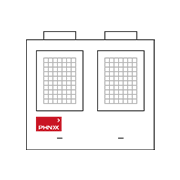
HeatGreen units install in arrays and scale from a single unit to large cascaded plant.
The HeatGreen Series maps onto each of those four factors with published, spec-sheet data.
Efficiency at both low and high water temperatures. HeatGreen carries an A+++ rating at 35°C and A+++ at 55°C water temperature, so a hotel keeps high seasonal efficiency whether it runs underfloor heating or higher-temperature radiator and DHW circuits. For summer cooling, it reaches SEER 5.14 at 7°C and 6.84 at 18°C chilled water. A single platform covers heating, cooling, and hot water rather than three separate systems.
High-temperature hot water for real hotel circuits. HeatGreen delivers outlet water up to 75°C at -7°C ambient, and it holds 60°C down to -25°C for any climate. That range covers Legionella-compliant DHW, which requires storage at 60°C with periodic heat-up cycles, and it drives existing radiator circuits sized for 70/50°C or 80/60°C. In practice a hotel can retrofit without replacing terminal units and without an electric immersion top-up.
Inverter part-load control. A Full DC inverter compressor with stepless modulation matches output to actual demand, so the system runs quietly and efficiently at the low loads typical of shoulder seasons and overnight. PHNIX's patented Exhaust Temp Superheater control keeps the compressor in a safe thermal band across climates, which is what makes the 75°C rating stable rather than a lab-only figure.
Scale for properties of any size. HeatGreen spans five single units, and one 10-inch central controller manages up to 32 units in cascade without a separate BMS.
| Model | Nominal heating | Heating range (30/35°C) | Max power input | Noise at 1m |
|---|---|---|---|---|
| PASRW080SB-BP-PS-D | 20 kW | 7.61–27.94 kW | 12.59 kW | 51 dB(A) |
| PASRW100SB-BP-PS-D | 24 kW | 11.00–40.00 kW | 18.00 kW | 38 dB(A) |
| PASRW150SB-BP-PS-D | 31 kW | 13.63–50.00 kW | 24.00 kW | 53 dB(A) |
| PASRW250SB-BP-PS-D | 50 kW | 22.09–80.00 kW | 36.00 kW | 56 dB(A) |
| PASRW350SB-BP-PS-D | 70 kW | 30.00–110.00 kW | 42.64 kW | 60 dB(A) |
A small boutique property might run a single 20 kW unit, while a large resort cascades several 70 kW units under one controller and stages them for balanced operation.
Retrofit without ripping out the boiler. The Hybrid Function lets HeatGreen work alongside an existing gas boiler and a buffer tank, switching between renewable, hybrid, and boiler modes based on cost. A hotel can let the heat pump carry the base load at high efficiency while the boiler covers peaks, which phases the investment instead of demanding a full plant replacement on day one.
Reliability that protects uptime. A hotel can't have heating or hot water go down. HeatGreen's electric box is IP44 rated and anti-explosion, the plate heat exchanger is SS316, an ATEX-certified exhaust fan and an NDIR R290 leak detector (0 to 100% LFL, ±2.5% per second) handle refrigerant safety, and the fully potted PCB provides 5-fold protection that reduces PCB failure rates by up to 90%. Fewer failures mean fewer service calls and less downtime, which is part of the lifetime cost picture.
The running-cost argument rests on efficiency, and HeatGreen's A+++ class at both 35°C and 55°C is the core of it. A heat pump operating at that class returns several units of heat per unit of electricity, so it structurally undercuts direct electric heating and a gas boiler on running cost, especially once the high-temperature output removes any need for a full-time backup boiler or electric immersion.
Three further levers strengthen the case:
1. R290 future-proofing. HeatGreen uses R290, with a GWP of 0.02 under Regulation (EU) 2024/573. Under the EU F-gas Regulation (2024/573), units above 50 kW using refrigerants with GWP above 150 will no longer be permitted from 2030, so an R290 system avoids future refrigerant supply constraints, rising servicing costs, and a forced swap.
2. Subsidy eligibility. HeatGreen is CE, MCS, MD, and PED certified and BAFA listed, and natural-refrigerant products qualify for subsidy bonuses in markets like Germany. That lowers the up-front cost, though the exact scheme should be confirmed locally.
3. Cheaper kilowatt-hours. SG Ready control and PV compatibility let the system draw on off-peak or solar power, lowering the effective cost of the energy it does use.
A hotel should model its own numbers with an installer, using its real load profile and tariffs. The point here is that the mechanisms for a lower bill are all present in the product and the regulatory context, not just in marketing claims.
HeatGreen is a strong fit for hotels whose demand centers on high-temperature hot water and heating, and a few points deserve a check before committing.
1. 75°C is the ceiling. Output steps down to 60°C at -25°C, and applications that genuinely need water above 80°C, such as certain laundry or kitchen sterilization loads, should use the hybrid configuration with a boiler or electric boost for the final increment. HeatGreen is designed for exactly that pairing.
2. Size on real load, not headline capacity. Capacity should be calculated against the hotel's heating load at design conditions and its DHW demand profile, including occupancy peaks, then cascaded across units for larger properties.
3. Confirm local subsidy and F-gas timing for your market before building the business case.
4. Request project-specific performance data. A single COP figure isn't published for the series, so rely on the A+++ class, the SEER values, and the capacity ranges, and ask PHNIX for performance at your operating temperatures.
Q: Can HeatGreen produce hot water hot enough for hotel DHW and Legionella control?
A: Yes. It delivers up to 75°C at -7°C ambient and holds 60°C down to -25°C, which covers storage at 60°C and periodic heat-up cycles for Legionella control without an electric immersion top-up.
Q: Can it replace our existing gas boiler?
A: In many cases, yes. Its 75°C output drives existing radiator circuits, and the Hybrid Function lets it run alongside a gas boiler during a phased retrofit, carrying the base load while the boiler covers peaks.
Q: How efficient is it?
A: HeatGreen is rated A+++ at both 35°C and 55°C water temperature, with cooling SEER of 5.14 at 7°C and 6.84 at 18°C. A single-point COP isn't published, so request performance data for your specific operating temperatures.
Q: Is R290 safe and compliant for a hotel plant room?
A: R290 handling is well established. HeatGreen includes an NDIR leak detector, an ATEX-certified exhaust fan, and an IP44 anti-explosion electric box, and R290's GWP of 0.02 under Regulation (EU) 2024/573 keeps it outside the EU F-gas phase-down.
Q: How large a hotel can it serve?
A: Units range from 20 kW to 70 kW nominal heating, and one central controller manages up to 32 units in cascade, so the series scales from a boutique property to a large resort or district scheme.
For a hotel focused on reducing energy costs, the PHNIX HeatGreen Series is a strong commercial solution when the load suits high-temperature hot water and heating. It combines A+++ efficiency at both 35°C and 55°C with 75°C R290 output, so it can cover Legionella-compliant DHW and existing radiator circuits without a full-time backup boiler, while its hybrid function, SG Ready control, and R290 future-proofing address both running cost and regulatory risk. The remaining work is project-specific: size on the real load, confirm local subsidies, and request performance data for your operating temperatures. Handled that way, HeatGreen is well matched to hotels replacing gas or electric heating with a lower-cost, lower-carbon system.
All performance data referenced is drawn from official PHNIX HeatGreen Series product documentation. For full specifications, project engineering, and OEM/ODM partnership enquiries, visit www.phnix-e.com.

Guangdong PHNIX Eco-energy Solution Ltd.
Tel: +86-4009-4009-00
Address: NO.3 Tianyuan Road, Dagang Town,
Nansha, Guangzhou, Guangdong, PR. China.