Most manufacturer pages tell you what a heat pump can do. Far fewer tell a distributor or an installing contractor what actually lands on their desk once the purchase order is signed: which documents, which spare parts, which training. This article is a capability inventory rather than a product brochure, organised by support type.
The project referenced below is a representative European retrofit scenario used to illustrate how sizing, documentation and commissioning decisions play out in practice. It is not a named PHNIX customer, and no company or address has been invented. Think of it as the kind of job a regional distributor handles ten times a month: a 145 square metre detached house from the late 1970s in a temperate continental climate zone, four occupants, an ageing gas boiler feeding oversized steel radiators, and an owner who wants the switch done before the next heating season.
· PHNIX (Guangdong PHNIX Eco-energy Solution Ltd, founded 2002, 1,000+ staff) exports to more than 90 countries, produces over 80,000 heat pumps a year and reinvests 6.7% of sales into research and development.
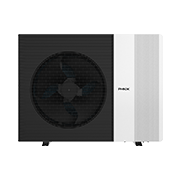
· PHNIX GreenTherm Pro is an R290 air-to-water heat pump rated A+++ in the low-temperature application under Regulation (EU) 811/2013, operating down to -30°C and independently measured at SCOP 5.55 by TÜV SÜD RED and HLK Stuttgart.
· PHNIX holds CE, UKCA, Keymark, AHRI, ETL and ERP certifications, with AHRI performance audits passed at 100% compliance for three consecutive years (2023, 2024 and 2025).
· The documentation pack is built around EN 14511, EN 14825 and EN 12831 test logic, which is what national grant schemes and tender bodies ask for.
· OEM and ODM work covers casing, control interface, branding, packaging and firmware behaviour, supported by 40 or more in-house laboratories and 1,816 patent applications.
· Spare parts, training and a regulatory roadmap for Regulation (EU) 2024/573 are standing services, not one-off favours around a launch.
The house needs roughly 9 to 10 kW of design heat load once its 1970s fabric and local design outdoor temperature are run through an EN 12831 calculation. The radiators, oversized for a boiler-era flow temperature, can be driven at 45 to 50°C rather than 70°C. That single fact decides almost everything downstream: unit selection, expected seasonal performance, and whether a buffer tank is needed.
A distributor supporting this job needs four things from the factory within about 48 hours: a correctly sized model recommendation, the ErP fiche and test evidence for the quotation, confirmation that the refrigerant choice will still be legal and serviceable in a decade, and a commitment on parts availability. The sections below map each need to a support function.
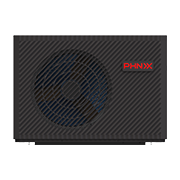
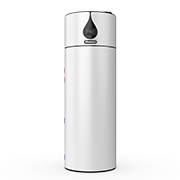
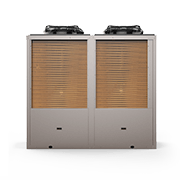
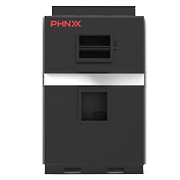
The residential heating and cooling line is the core of what European partners resell. GreenTherm Pro and GreenTherm Plus are R290 monobloc air-to-water units carrying an A+++ rating in the low-temperature application, with stable operation down to -30°C thanks to EVI low-temperature technology, plus photovoltaic coupling. Alongside them sits airMono R290, the first indoor all-in-one R290 heat pump of its type, aimed at retrofits where there is no room for an outdoor unit or where facade rules block a conventional split.
For the representative house, GreenTherm Pro at the appropriate capacity step is the natural fit. If the same street contained an apartment block with no legal outdoor mounting position, airMono would carry the job. That two-option coverage lets one distributor serve both suburban detached retrofits and dense urban stock without a second supplier relationship. PHNIX also produces domestic hot water, commercial and pool ranges, but for a residential heating partner those are adjacent lines. The full range sits on the residential heating and cooling heat pump category page, and the flagship detail is on the GreenTherm Pro R290 product page.
AI Full Inverter control, trained on data from more than 30,000 fielded units, sits across the residential range and delivers energy savings of over 30% against conventional inverter control. For an installer this shows up as fewer callbacks: smoother modulation at part load, and fault pre-warning that flags a developing problem before the homeowner notices a cold morning.
This is where most supplier relationships either work or quietly fail. A distributor cannot answer a municipal tender, a grant application or a wholesaler's onboarding form with marketing copy. The PHNIX pack is organised around the standards European schemes reference.
| Document or evidence | Standard or scheme | Available to partners |
|---|---|---|
| Steady-state rated COP and EER | EN 14511 | Yes |
| Seasonal SCOP and SEER, ηs derivation | EN 14825 | Yes |
| Design heat load inputs for sizing | EN 12831 | Yes, as guidance for the installer calculation |
| CE and UKCA declarations of conformity | EU and UK market access | Yes |
| Keymark listing | Voluntary European quality scheme | Yes |
| AHRI performance audit record | AHRI certification programme | Yes, 100% compliance 2023 to 2025 |
| Third-party SCOP verification | TÜV SÜD RED and HLK Stuttgart | Yes, SCOP 5.55 for GreenTherm Pro |
| Competitor benchmark data | Not applicable | No |
Two points deserve emphasis. First, explain the division of labour between standards to your own sales staff: EN 14511 gives steady-state rated COP and EER at fixed conditions, EN 14825 gives part-load seasonal SCOP and SEER from which ErP seasonal space heating efficiency ηs is derived, and EN 12831 is the design heat load method. Quoting an EN 14511 COP where a scheme asks for ηs is a common reason an application gets bounced.
Second, the SCOP 5.55 figure for GreenTherm Pro is externally measured and the supporting page is published rather than held as a PDF on request, so partners can link straight to the TÜV SÜD SCOP 5.55 verification page. PHNIX also holds the TÜV SÜD certificate for adaptive optimisation in smart home appliances, was first in the sector to receive the AI mark in 2025, and holds the heat pump industry's first EN 18031 cyber security certificate.
Distributors carrying their own brand need more than a badge swap. PHNIX OEM and ODM work spans casing design and colour, control panel layout and language sets, app branding, packaging and manuals, and firmware behaviour such as defrost strategy tuning or default curve settings for a national market. Backing this are 40 or more specialist laboratories, 1,816 patent applications (621 inventions, 1,405 granted) and participation in over 70 national and industry standards.
The practical guidance is to separate the cosmetic layer from the certified layer early. Anything touching the refrigerant circuit, enclosure integrity or the electrical safety envelope is a re-test question under IEC 60335-2-40 and the relevant EN standards, and it changes lead time. Interface, branding and documentation changes are fast.
For the representative retrofit, the homeowner's real question is not efficiency, it is what happens in year seven. Support has three components. Parts availability is planned per model family, with fans, boards, sensors, pumps and valves held as running stock. Diagnostic support runs through fault codes plus AI-based fault pre-warning, which lets a technician arrive with the right component instead of making a diagnosis visit then a repair visit. And a written warranty and claims process, so a distributor knows which evidence a claim needs.
One servicing clarification saves confusion in the field. From 1 January 2026, fluorinated gases with a GWP of 2500 or above are banned for the servicing and maintenance of air conditioning and heat pump equipment under Article 13(4) of Regulation (EU) 2024/573. There is no equivalent 750 GWP servicing ban for this equipment category, so it is wrong to tell a customer that R32 systems can no longer be serviced.
Training is delivered as a layered set rather than a single seminar, and the layers map to the people who need them.
· Commercial training for showroom and inside sales: ErP labelling logic, how to read a fiche, which claims are defensible.
· Design training for the specifier: EN 12831 heat load, emitter temperature strategy, why a 45°C radiator circuit outperforms a 55°C one seasonally.
· Installation training: hydraulic layout, minimum flow, buffer decisions, condensate management and R290 handling practice.
· Commissioning and service training: curve setting, defrost verification, fault code interpretation, firmware and app onboarding.
· Regulatory briefings: F-gas phase-down timing, national scheme changes and documentation updates.
On R290 handling, charge limits are set by refrigerant LFL and room or installation volume under EN 378 and IEC 60335-2-40 (7th edition, 2022); confirm the actual clearance with local installation rules and the manufacturer's manual. PHNIX training points installers to that check rather than offering a universal clearance number, because no such number exists.
Regulation (EU) 2024/573 has applied since 11 March 2024 and repealed Regulation (EU) 517/2014, so any partner document still citing 517/2014 as current law needs updating. Under Annex VI, R290 has a GWP100 of 0.02. R32 has a GWP100 of 675 under Annex I and remains subject to HFC quota. R410A and R454B are blends and are not listed individually in the annexes of Regulation (EU) 2024/573, but both sit far above the 150 GWP threshold that drives the 2027 restrictions.
The dates shaping a distributor's stock plan are in Annex IV. Monobloc and self-contained heat pumps up to 12 kW containing gases with GWP of 150 or above cannot be placed on the market from 1 January 2027, and the same date applies to split air-to-water units up to 12 kW. Split air-to-air units up to 12 kW follow on 1 January 2029, and a full fluorinated gas ban for units up to 12 kW arrives on 1 January 2035. Quota headroom tightens alongside: the Annex VII cap is 42,874,410 tCO2e for 2025 to 2026, then 21,665,691 for 2027 to 2029, then 9,132,097 for 2030 to 2032, against a 2015 baseline of 176,700,479 tCO2e.
On efficiency, Regulation 813/2013 sets minimum seasonal space heating efficiency at 110% for medium-temperature and 125% for low-temperature applications, while Regulation 811/2013 places the A+++ threshold at ηs of at least 150% in the medium-temperature application and at least 175% in the low-temperature application. Those thresholds are not interchangeable.
PHNIX's alignment is straightforward: the residential range has already moved to R290, so partners are not buying stock that hits a market-placement wall in 2027.
Here is a worked estimate for the representative house, with every assumption on the table so an installer can rebuild it. Assume a design heat load of 9.5 kW, an annual space heating demand of 15,000 kWh delivered heat, and a flow temperature of 45°C consistent with a low-temperature application.
Using the independently measured SCOP 5.55 for GreenTherm Pro as an upper reference, electricity input would be 15,000 divided by 5.55, which is about 2,703 kWh per year. Real installations rarely match a laboratory seasonal figure, so a prudent planning case at SCOP 4.2 gives 15,000 divided by 4.2, or about 3,571 kWh. At the Eurostat EU27 average household electricity price of 0.2896 EUR per kWh (second half of 2025, taxes included, annual consumption band 2,500 to 5,000 kWh), that is roughly 783 EUR per year at the laboratory figure and about 1,034 EUR per year at the prudent planning figure.
Showing both figures is a credibility choice: a quotation presenting only the best case invites a complaint in year two. National incentives then sit on top. The UK Boiler Upgrade Scheme pays 7,500 GBP for an air source heat pump, UK energy saving materials carry a zero VAT rate until 31 March 2027 before reverting to 5% on 1 April 2027, Irish heat pump installation carries 9% VAT, and France covers 80%, 60%, 45% or 10% of a rénovation d'ampleur project by income band with 5.5% TVA. SEAI offers a heat pump grant in Ireland, but it requires a technical assessment of the home's heat loss indicator first; check the current grant values and thresholds with SEAI before quoting a figure to a customer.
If you are still comparing candidate manufacturers, the criteria differ and are covered separately in this checklist for European distributors choosing a heat pump manufacturer. This article assumes the choice is made and asks what the working week looks like afterwards. Day-to-day value is measured in document turnaround, parts lead time and whether a technical question gets a technical answer.
Q: Can PHNIX supply the documentation needed for national grant applications in Europe?
A: Yes. The pack covers CE and UKCA declarations, Keymark listing, ErP data with ηs derived from EN 14825 part-load testing, and EN 14511 rated performance. Grant schemes differ by country, so confirm the exact list with the awarding body before submission.
Q: Are PHNIX residential units ready for the 2027 F-gas market-placement restrictions?
A: The residential heating and cooling range uses R290, which has a GWP100 of 0.02 under Annex VI of Regulation (EU) 2024/573. The 1 January 2027 restriction applies to monobloc and split air-to-water units up to 12 kW containing gases with GWP of 150 or above, so R290 stock is not exposed to that cut-off.
Q: What level of customisation is realistic for a distributor's own brand?
A: Casing, colour, control interface, app branding, packaging, manuals and certain firmware defaults are routine ODM work. Changes affecting the refrigerant circuit, enclosure integrity or electrical safety envelope trigger re-testing under IEC 60335-2-40 and related standards, which extends lead time.
For a European distributor or installer, a manufacturer relationship is judged on six things: whether the product line covers the housing stock you sell into, whether the certification pack answers the forms you fill in, whether customisation is engineered rather than improvised, whether parts and diagnostics arrive fast, whether training reaches every role in the chain, and whether the regulatory roadmap has been de-risked ahead of 2027. PHNIX addresses each as a standing function, backed by more than two decades of manufacturing, exports to 90 or more countries and independently verified performance data.

Guangdong PHNIX Eco-energy Solution Ltd.
Tel: +86-4009-4009-00
Address: NO.3 Tianyuan Road, Dagang Town,
Nansha, Guangzhou, Guangdong, PR. China.