


 116
 October 21, 2026
A pool heat pump advertises a COP above 20. A home heating model lists a COP around 4. Does that mean the pool unit is five times better?
The figures describe different jobs. Keeping pool water at 26°C in warm weather is much easier than supplying heating water on a cold day. To judge efficiency, you need to know both the number and the conditions behind it.
COP shows performance at a particular operating condition. SCOP gives a seasonal view. Here is how to read both, using PHNIX product data.
What does a COP of 4 actually mean?
A heating COP of 4 means that, within the stated measurement boundary, each 1 kWh of electricity delivers 4 kWh of heat. A higher COP means less electricity for the same amount of delivered heat, provided the comparison uses the same conditions.
A heat pump can deliver more heat than the electricity it consumes because it also collects heat from its surroundings. The electricity powers the process of moving that heat.
Heating COP = heat delivered ÷ electricity consumed
8 kWh of heat ÷ 2 kWh of electricity = COP 4
For steady operation, you can also divide heating output in kW by electrical input in kW. Do not divide a capacity figure by electricity measured over an unrelated period, or count only compressor electricity when comparing a whole-unit rating.
You need a heat measurement as well as an electricity measurement to check this at home. A smart plug alone cannot tell you COP. The definition follows the U.S. Department of Energy’s explanation of COP.
What does SCOP tell you that COP does not?
Your heat pump does not spend the whole season at one temperature or output. SCOP—seasonal coefficient of performance—accounts for a defined season and operating profile, making it more useful when comparing heating efficiency over time.
A declared SCOP of 4.5 represents 4.5 units of heat per unit of electricity over that standardized seasonal assessment. It is not the arithmetic average of a few advertised COP figures, and it is not a promise that your home will achieve exactly 4.5.
For space heating, compare SCOP at the same climate and water-temperature application. A 35°C figure is more relevant to a low-temperature heating system than to a system that needs 55°C water. Pool seasonal ratings use a different assessment from space heating, so their SCOP numbers should also stay in separate comparisons. The EU space-heater framework defines SCOP around seasonal heat demand and energy consumption.
Why can a pool heat pump reach a much higher COP?
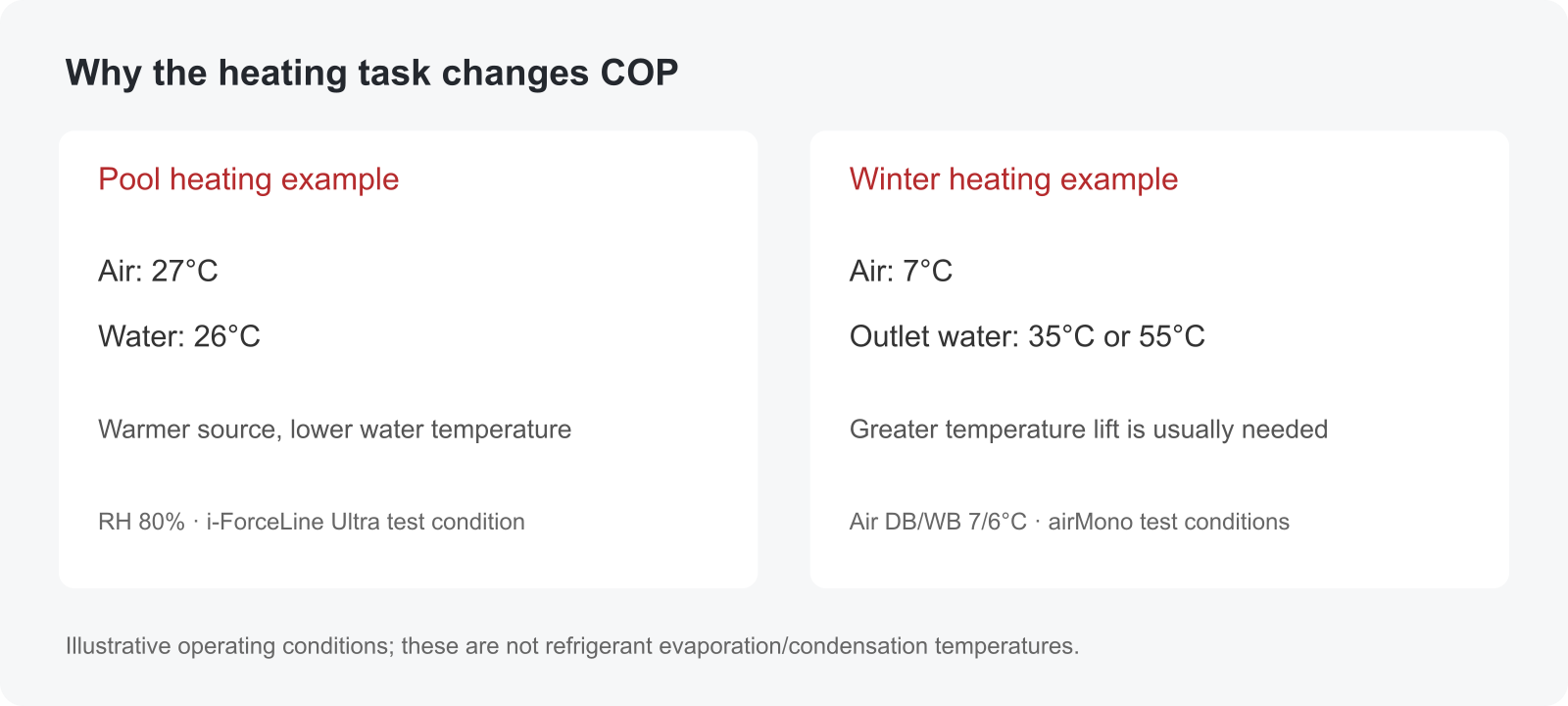
The main reason is the temperature lift: how far the heat pump has to raise the temperature of the heat it collects. Warm air and relatively cool pool water make that job easier. Winter space heating usually asks the machine to collect heat from colder air and deliver it at a higher temperature.
Consider the PHNIX i-ForceLine Ultra. Its Ultra-050 model lists these COP ranges:
| Air temperature | Water temperature | Relative humidity | Published COP range |
|---|---|---|---|
| 27°C | 26°C | 80% | 22.4–7.9 |
| 15°C | 26°C | 70% | 9.5–5.6 |
| 7°C | 26°C | 64% | 5.2–4.2 |
The same model has very different results as the test conditions change. Humidity changes in this table too, so the differences cannot be assigned to air temperature alone. The ranges cover different operating outputs; the maximum is not a constant running COP.
Now compare the task faced by PHNIX airMono CA20B: its COP is 4.18 at 7°C dry-bulb/6°C wet-bulb air and 30/35°C inlet/outlet water. That is a different duty from the pool unit’s warm-weather test. Putting 22.4 beside 4.18 does not establish which product is better for its intended application.
Which factors change COP in everyday use?
Outdoor temperature and humidity
Colder source air generally makes the job harder. Humidity matters too: frost can form on the outdoor heat exchanger under suitable cold, damp conditions. Defrosting clears it, but consumes energy and interrupts useful heating. A cold-weather buyer should ask about heating capacity and efficiency in local winter conditions, not just the warm-weather COP.
The water temperature you ask for
Higher delivery temperatures usually reduce COP. PHNIX airMono CA20B illustrates this clearly: at the same 7/6°C air condition, its COP is 4.18 with 30/35°C water and 2.65 with 47/55°C water. If your heating emitters can keep rooms comfortable at a lower supply temperature, that can help efficiency.
Keep domestic hot-water settings consistent with the system’s hygiene requirements. Lowering the temperature simply to chase a higher COP is not the right goal.
Compressor speed and heating demand
An inverter can adjust output to the load, reducing unnecessary stop-start operation. Under favorable part-load conditions, some units achieve their highest COP. But “inverter” alone is not an efficiency guarantee: compare performance at the heating output you actually need, including cold-weather capacity.
Installation, controls and auxiliary electricity
Restricted airflow, unsuitable water flow and frequent cycling can reduce performance. Electric backup heating also changes overall electricity use. Check whether a quoted figure covers the unit alone or a wider system including external pumps, backup heaters and distribution losses. A product COP and a household heating-system result can have different boundaries.
What do PHNIX’s published figures look like by application?
These examples show what to look for in a specification sheet. They are grouped by use because a single ranking across pool heating, space heating and domestic hot water would hide the conditions that matter.
| Application and model | Published value | What to check |
|---|---|---|
| Pool: i-ForceLine Ultra-050 | SCOP 9.54 | Pool assessment, EN 17645 |
| Pool: i-ForceLine Ultra-040 | SCOP 8.30 | Same published family table |
| Pool: i-ForceLine Ultra-030 | SCOP 7.63 | Same published family table |
| Space heating: airMono CA20B | SCOP 4.73 | 35°C application block |
| Space heating: airMono CC15B | SCOP 4.50 | 35°C application block |
| Hot water: airExpert R290 KK06-300 | COP 3.41 / 3.91 | Exterior air +7°C / +14°C; XL profile; EN 16147 |
The first three entries are the highest SCOP values in the published i-ForceLine Ultra family table, rather than a ranking of every PHNIX pool product. That table does not expand the seasonal climate/use profile; the airMono table does not identify its SCOP climate. Confirm those details before making a purchase comparison.
For the hot-water example, the same KK06-300 model changes from COP 3.41 to 3.91 with the listed air condition. Its hot-water assessment is another reason not to compare its COP directly with a pool rating. See the official airExpert R290 specification for the model and load profile.
What is the ideal COP—and how is it calculated?
There is no single ideal COP for every heat pump. In thermodynamics, a reversible heat pump working between two fixed temperatures has this heating limit:
Ideal heating COP = Thot ÷ (Thot − Tcold)
Use kelvin: K = °C + 273.15
For ideal reservoirs at 0°C and 35°C: 308.15 ÷ (308.15 − 273.15) ≈ 8.80. This is a theoretical ceiling, not a target for a commercial unit. A real cycle has losses and needs temperature differences across its heat exchangers; fans, pumps and defrosting also use energy.
Do not use a brochure’s air and outlet-water temperatures to predict a real machine’s COP. Its refrigerant evaporates below the heat-source temperature and condenses above the heated-water temperature. This also explains why a pool test with 27°C air and 26°C water cannot be put straight into that formula. See OpenStax’s Carnot-cycle explanation.
So what counts as a good COP when buying?
Start with the conditions your equipment will face. For home heating, compare seasonal ratings at the relevant climate and water temperature, then check capacity and COP on cold days. For a pool, examine performance in the cooler months when you still want to swim. For hot water, compare the same air condition and draw-off profile.
A higher number is useful when those conditions match. Also check that the unit can deliver enough heat: a peak COP at low output does not tell you how quickly it will warm a cold pool or meet a building’s winter load.
Explore PHNIX heat pump solutions and ask for efficiency data matched to your climate, required water temperature and heating demand.
Glossary: terms you may see in a specification sheet
Dry-bulb temperature (DB): Air temperature measured with an ordinary thermometer protected from direct sunlight and similar influences.
Wet-bulb temperature (WB): A reading taken with a wetted thermometer sensor exposed to moving air. Evaporation lowers the reading; at the same air temperature and pressure, drier air generally creates a larger dry-/wet-bulb difference.
Dew-point temperature: The temperature at which air reaches water-vapor saturation when cooled at constant pressure and moisture content. A surface below the dew point may collect condensation; frost also depends on surface temperature and other conditions.
Relative humidity (RH): Actual water-vapor pressure divided by saturation water-vapor pressure at the same temperature, expressed as a percentage. Equal RH at different temperatures does not mean equal moisture content.
Inlet / outlet water temperature: Water temperature entering and leaving the heat pump. “30/35°C” usually means a 30°C inlet and 35°C outlet; check the table heading.
Temperature lift: The temperature gap the heat pump works across between absorbing heat at its cold side and delivering it at its hot side. It differs from the inlet-to-outlet water-temperature rise. A greater lift generally makes efficient operation harder.
Part load: Operation below maximum capacity, such as maintaining a pool already near its target temperature. A high part-load COP does not imply the same COP during full-output heating.
Defrost: Removing frost from the air-side heat exchanger to restore heat transfer. It takes time and uses energy.
Heating capacity / electrical input: The rate of heat delivery versus the rate of electricity consumption, both commonly expressed in kW. Heating capacity is not the same as electrical consumption.
kW / kWh: kW measures power; kWh measures energy over time. A constant 2 kW electrical input for one hour consumes 2 kWh.
Draw-off profile (such as L or XL): A prescribed pattern of hot-water draws used in water-heater testing. Match profiles when comparing COP; tank volume alone does not define the test demand.
Kelvin (K): The absolute temperature scale: K = °C + 273.15. Use kelvin, rather than Celsius values, in the ideal-COP formula.
Weather terms follow the U.S. National Weather Service’s explanation of dry-bulb, wet-bulb and dew-point temperatures.


 Consult