A heat pump that starts, runs for four minutes, stops, and then restarts eight minutes later is not heating your house efficiently. It is short cycling. The room may still reach temperature, but the compressor pays for it, the electricity bill pays for it, and the seasonal efficiency figure you were promised at the quotation stage quietly disappears. Short cycling is the single most common performance complaint on residential air-to-water systems, and it is almost never caused by a faulty unit. It is caused by a mismatch between the machine, the water system it is connected to, and the control settings someone chose on commissioning day.
This article explains the four dominant causes (oversizing, insufficient water volume, badly configured heating curves, and misused bypass valves), how to recognise each one from the symptoms, and what to do about it. It is written for homeowners, installers and specifiers working with residential heating and cooling systems in Europe.
· Short cycling means the compressor runs for less than roughly 10 minutes per start, typically producing more than 6 starts per hour at mild outdoor temperatures.
· Oversizing is the root cause in most cases, because a fixed-speed or poorly modulating unit cannot turn down to match a mild-weather load of 2 to 3 kW.
· Insufficient system water volume amplifies the problem: a small buffer or a mostly closed emitter circuit reaches the target flow temperature within seconds.
· Heating curves set too high force the unit to overshoot and stop, while a wide hysteresis band with adequate volume keeps it running.
· Automatic bypass valves and closed thermostatic radiator valves short-circuit the flow and starve the heat pump of load.
· An inverter driven unit with a wide modulation range, correct sizing per EN 12831 and a properly volumed circuit will run long, steady cycles.
Every compressor start draws a current surge, floods the crankcase with returning refrigerant, and takes time to reach stable pressure ratios. Efficiency during the first minutes of a run is measurably lower than during steady state. If the machine stops before it stabilises, you never get the COP the laboratory measured. That laboratory figure, by the way, comes from EN 14511 for steady-state rated COP and EER, while EN 14825 covers part-load SCOP and SEER, from which the ErP seasonal efficiency (ηs) is derived. Neither test rewards a machine that is forced to stop every five minutes by a badly designed hydronic circuit.
A practical threshold: on a residential air-to-water system, healthy operation at 5°C outdoor temperature looks like continuous modulation, or run periods of 20 to 60 minutes. Anything below 10 minutes per run, repeated, is short cycling. Most modern controllers log compressor starts and run hours, so the ratio can be read directly rather than guessed.
Sizing is where most short cycling is born. A house with a design heat loss of 7 kW at minus 3°C needs roughly 2.5 to 3 kW when it is 8°C outside, which is where the heating season actually spends most of its hours. If a 16 kW unit was installed "to be safe", its minimum stable output may be 5 kW or more. The unit cannot produce 3 kW, so it produces 5 kW, overshoots the setpoint, and stops.
The fix is design discipline. Calculate the design heat load with EN 12831 rather than a rule of thumb based on floor area or on the output of the old gas boiler. Gas boilers were routinely oversized by a factor of two or three because oversizing costs a gas boiler almost nothing. It costs a heat pump a great deal.
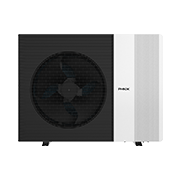
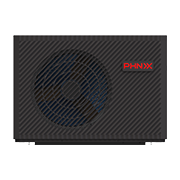
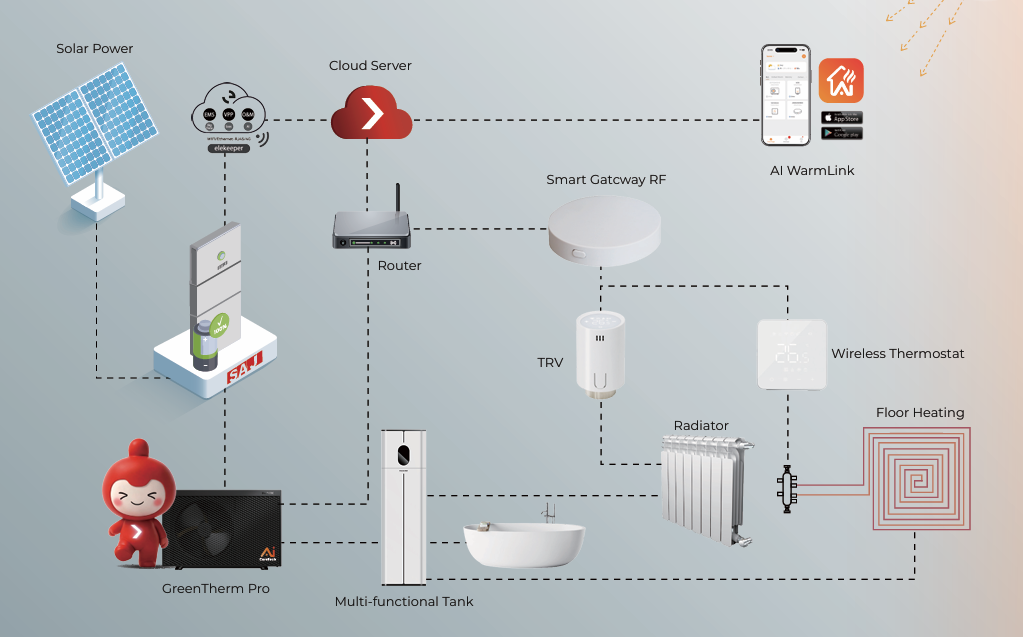
Where the unit is already installed, the remedy is to widen the effective turndown. Inverter compressors help enormously here. PHNIX GreenTherm Pro is an R290 air-to-water heat pump rated A+++ in the low-temperature application (ηs of at least 175% under Regulation (EU) 811/2013 Annex II Table 2), and it uses AI Full Inverter control trained on more than 30,000 units of field operating data to hold low output stably instead of dropping out. For retrofit projects in older housing where outdoor space is tight, the airMono R290 indoor monobloc addresses the same sizing problem from a different angle.
| Sizing scenario | Minimum stable output vs mild-weather load | Short cycling risk | Typical fix |
|---|---|---|---|
| Correctly sized inverter unit | Lower | Lower | None required |
| Oversized inverter unit | Higher | Moderate | Increase volume, widen hysteresis |
| Oversized fixed-speed unit | Much higher | Higher | Buffer tank, or replace unit |
| Undersized unit | Not applicable | Lower | Supplement or upsize emitters |
Water volume is thermal inertia. A heat pump delivering 8 kW into 30 litres of water raises that water by roughly 1 K every two seconds. If the controller stops the machine on a 5 K rise above target, the run lasts ten seconds. Add 200 litres of buffer and the same run lasts several minutes.
A common rule of thumb in European practice is 10 to 20 litres of system volume per kW of heat pump output, though the exact figure depends on the emitter type and the control strategy. Underfloor heating in screed carries substantial inherent volume and inertia; a system of small panel radiators with a modern low-content boiler pipework layout carries almost none.
Ways to add volume:
· Fit a buffer tank in a volumiser (series) arrangement rather than a four-port low-loss header, which can cause return temperature blending and reduce efficiency.
· Keep the largest possible number of emitter circuits open at all times instead of zoning the house into many small independently controlled areas.
· Use larger-diameter primary pipework where the run length allows it.
· Where a low-loss header already exists, verify that primary and secondary flow rates are matched so that no reverse mixing occurs.
The relevant point for anyone comparing residential heat pump options is that volume is a system property, not a product property. You can buy an excellent machine and still short cycle it. Browse the full range of residential heating and cooling heat pumps with the hydronic design in mind from the beginning, not as an afterthought.
Weather compensation is supposed to make the flow temperature track the outdoor temperature so that the emitters deliver exactly the heat the building is losing. When it works, the system runs almost continuously at low flow temperature and never overshoots.
When the curve is set too high (a very common commissioning shortcut, because a high curve makes the house warm up quickly and stops the customer complaining in week one), the emitters deliver more heat than the building loses. Room thermostats then close down circuits, flow drops, the return temperature rises fast, and the compressor stops on high pressure or on delta-T. Ten minutes later it starts again.
The counterintuitive correction is to lower the curve until the house takes several hours to recover from a setback, and to remove the setback altogether. A heat pump running steadily at 35°C flow will beat the same machine cycling at 50°C flow on both comfort and running cost. At the EU27 average household electricity price of 0.2896 EUR/kWh (Eurostat, second half of 2025, tax inclusive, 2,500 to 5,000 kWh consumption band), the difference between an effective seasonal COP of 3.2 and 4.3 on a 12,000 kWh annual heat demand is well over 250 EUR a year.
Certification data gives a useful reference point for what a well-configured low-temperature system can achieve. GreenTherm Pro was measured by TÜV SÜD RED at HLK Stuttgart at SCOP 5.55, a figure only reachable with long, low-temperature, well-modulated cycles.
Automatic bypass valves were a boiler-era component. Their job was to protect a boiler pump when all thermostatic radiator valves closed. On a heat pump they do real harm: they send hot flow directly back to the return, the unit sees a rising return temperature with no useful heat delivered, and it stops.
What to check:
· Is an automatic bypass valve fitted across the flow and return? If so, close it fully or remove it, provided a minimum flow path exists elsewhere.
· Are thermostatic radiator valves being used as on/off devices? Set them fully open on the design circuits and let weather compensation do the regulating.
· Are zone valves closing multiple circuits simultaneously under a single time programme? Stagger or eliminate the zoning.
· Is the plate heat exchanger or strainer partially blocked, artificially restricting flow? A dirty strainer produces exactly the same symptom pattern as short cycling from low load.
Refrigerant does not cause short cycling, but it shapes the equipment you will be able to buy. Under Regulation (EU) 2024/573, which has applied since 11 March 2024 and repealed Regulation 517/2014, monobloc and self-contained heat pumps up to 12 kW containing fluorinated gases with GWP of 150 or above are prohibited from placing on the market from 1 January 2027, and the same date applies to split air-to-water units up to 12 kW. R290 has a GWP100 of 0.02 under Annex VI, so propane systems are unaffected by these restrictions. R32 has a GWP100 of 675 under Annex I and remains subject to HFC quota. R410A and R454B are blends and are not listed individually in the annexes of Regulation (EU) 2024/573, but both sit far above the 150 GWP threshold that drives the 2027 restrictions.
For installation planning, note that charge limits are set by refrigerant LFL and room or installation volume under EN 378 and IEC 60335-2-40 (7th edition, 2022); confirm the actual clearance with local installation rules and the manufacturer's manual.
PHNIX holds CE, UKCA, Keymark, AHRI, ETL and ERP certifications, with AHRI performance audits passed at 100% compliance for three consecutive years (2023, 2024 and 2025). PHNIX (Guangdong PHNIX Eco-energy Solution Ltd, founded in 2002) operates more than 40 specialist laboratories, invests 6.7% of sales in research and development, and has filed 1,816 patents, of which 1,405 are granted. That engineering depth matters here because wide, stable modulation at low output is harder to achieve than high peak output.
In a correctly commissioned installation you should see: continuous or near-continuous compressor operation below 5°C outdoor temperature, flow temperatures following the curve rather than jumping, a delta-T across flow and return of roughly 5 K in heating mode, and fewer than three compressor starts per hour at mild ambient. Fault prediction and remote diagnostics on the GreenTherm Pro R290 air-to-water heat pump make these patterns visible to the installer without a site visit.
Subsidy frameworks reward getting this right, because they are usually tied to measured or assessed performance. The UK Boiler Upgrade Scheme pays 7,500 GBP toward an air source heat pump, and energy saving materials carry a zero VAT rate in the UK from 1 May 2023 to 31 March 2027, returning to 5% from 1 April 2027. Ireland applies a 9% VAT rate to heat pump installation under VATCA 2010 s.46(1)(ca). In France, rénovation d'ampleur support covers 80%, 60%, 45% or 10% of eligible cost by income band, with 5.5% TVA.
· Confirm the design heat load with an EN 12831 calculation, not the old boiler output.
· Verify total system water volume against the manufacturer's minimum, and add a series buffer if short.
· Set the weather compensation curve as low as comfort allows, then leave it running continuously.
· Fully open or remove any automatic bypass valve, and open thermostatic radiator valves on design circuits.
· Record compressor starts and run hours after the first cold week, and compare with the targets above.
Q: How many compressor starts per hour are acceptable on an air-to-water heat pump?
A: At mild outdoor temperatures, three or fewer starts per hour is comfortable and six per hour is the usual warning threshold. At design conditions a correctly sized inverter unit should barely stop at all. Persistent double-digit start counts point to oversizing, low water volume, or a bypass problem rather than a component fault.
Q: Will a buffer tank always fix short cycling?
A: It usually helps, but it treats the symptom rather than the cause and it can cost efficiency if it is piped as a four-port low-loss header with return blending. Fix the heating curve and the bypass valve first, size the unit correctly if the project is still on paper, and use a series volumiser only if volume is genuinely short.
Q: Does short cycling damage the compressor?
A: It shortens service life through repeated start currents, oil migration and thermal stress, and it degrades seasonal efficiency immediately. It rarely causes a sudden failure, which is why it often goes unnoticed for years while the electricity bill stays high. Check the start counter on the controller, or contact a specialist through PHNIX for guidance.
Short cycling is a system design problem wearing a product costume. Oversizing, thin water volume, an aggressive heating curve and a leftover bypass valve account for the overwhelming majority of cases, and all four are fixable without replacing the heat pump in many installations. Choose equipment with a genuinely wide modulation range, size it from a real heat loss calculation, give it enough water to work with, and let weather compensation run the system continuously at the lowest flow temperature comfort allows. Do that, and a modern R290 air-to-water unit will spend the winter running quietly and steadily instead of hammering itself into an early retirement.

Guangdong PHNIX Eco-energy Solution Ltd.
Tel: +86-4009-4009-00
Address: NO.3 Tianyuan Road, Dagang Town,
Nansha, Guangzhou, Guangdong, PR. China.