A building management system (BMS) is the central software platform that supervises a building's plant: heating, cooling, ventilation, lighting, and metering. When a commercial heat pump is installed in a hotel, hospital, school, or office, someone has to decide how deeply that heat pump talks to the BMS. Get the boundary right and you gain visibility, energy reporting, and early fault warning. Get it wrong and you either fly blind or you let a supervisory controller override safety logic it was never designed to handle. This article sets out a practical integration boundary for procurement and facilities teams rather than control engineers, so terms are explained as they appear.
· Collect roughly 20 to 30 monitoring points per heat pump, covering temperatures, flow, electrical input, compressor state, defrost, and alarm status. More points than that usually adds storage cost without adding decisions.
· Keep safety, compressor protection, defrost, and refrigerant circuit logic inside the unit's own controller. The BMS should never be able to override them.
· Give the BMS the supervisory layer: enable and disable, setpoint adjustment within a bounded range, schedules, load sequencing across multiple units, and demand limiting.
· Modbus RTU or Modbus TCP is the common denominator on commercial heat pumps; BACnet is the common language of the BMS itself. A gateway between the two is normal and should be priced into the project.
· Log energy and temperature data at one to five minute intervals for operational use, and roll it up to hourly for reporting. Second-by-second polling rarely earns its keep.
· Sort alarms into three tiers, critical, urgent, and advisory, and route each tier to a different response. Undifferentiated alarms are ignored alarms.
A commercial heat pump ships with its own onboard controller. That controller runs the compressor, manages the expansion valve, decides when to defrost, protects against high and low refrigerant pressure, and shuts the unit down if a sensor reads out of range. It does this in real time, using sensors and logic the manufacturer validated during type testing.
The BMS operates on a slower and wider timescale. It knows things the heat pump cannot: how many guests checked in, what the electricity tariff does at 17:00, and whether a second heat pump is available. Its job is coordination and reporting, not protection.
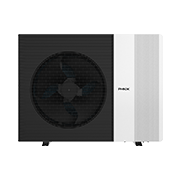
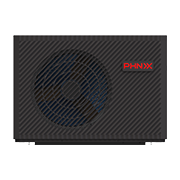
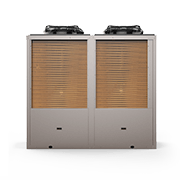
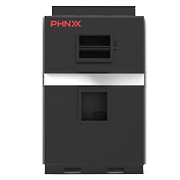
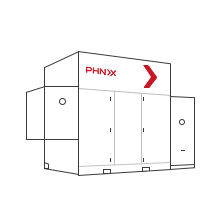
PHNIX HeatGreen is a commercial air-source heat pump using R290 refrigerant and AI Full Inverter technology, designed for centralized hot water supply in hotels, hospitals, and schools. Like most modern commercial units, it exposes a data interface so a BMS can read its state and issue supervisory commands, while retaining full local control of the refrigerant circuit. That split is the correct default, and you should be suspicious of any integration proposal that blurs it.
Integrators often ask for every register the unit exposes, then discover nobody looks at 200 data streams. Group the points by what question they answer.
Performance and energy. Entering and leaving water temperature, water flow rate, ambient air temperature, electrical power input in kilowatts, and cumulative energy consumption in kilowatt hours. From these you can calculate delivered thermal output and a running coefficient of performance (COP), the ratio of useful heat delivered to electricity consumed. Typical commercial heat pumps operate in a COP range of roughly 3 to 5, but the figure moves with ambient temperature and with the water temperature you ask for, so a headline number means little without the conditions attached.
Operating state. Compressor run status, compressor frequency or capacity percentage, fan speed, defrost active flag, circulation pump status, and unit on or off. Compressor start counts and accumulated run hours belong here too, because they drive maintenance intervals and because an abnormal start count is often the first visible symptom of a badly sized buffer tank.
Hydronic and storage. Tank temperatures at top, middle, and bottom if the cylinder is instrumented, return temperature from any recirculation loop, and three-way valve positions. For hot water systems this is where most operational problems actually live, not inside the heat pump.
Setpoints as read-back. Whatever setpoint the BMS writes, it should also read back. A write with no read-back is a command you cannot audit.
Alarms and diagnostics. A single alarm summary bit plus a numeric fault code. The summary bit drives the dashboard, the fault code drives the callout.
That is roughly 20 to 30 points per unit. If you run several heat pumps in cascade, multiply per unit and add a few system-level points for the shared header.
Write this boundary into the specification. The BMS should be permitted to:
· Enable and disable the unit, or place it in standby
· Write the target leaving water temperature or tank setpoint, within a range the manufacturer bounds in the unit controller
· Apply time schedules, including night setback and pre-heat before occupancy peaks
· Sequence and rotate multiple units so run hours stay even and lead duty shifts
· Apply demand limiting or capacity capping during tariff peaks or when a site electrical limit is approached
· Trigger a scheduled high temperature disinfection cycle, where the unit supports one, and record that it completed
The BMS should not be permitted to:
· Override high or low pressure protection, or any safety interlock
· Command the compressor directly, or force a frequency the controller has not requested
· Initiate or suppress defrost
· Change refrigerant circuit parameters such as superheat targets or expansion valve position
· Write setpoints outside the manufacturer's bounded range
The reason is not turf. These protections form part of how the unit was tested and certified, and a supervisory system that can bypass them invalidates the assumption the certification rests on. PHNIX holds CE, UKCA, Keymark, AHRI, ETL, and ERP certifications, with AHRI performance audits passed at 100% compliance for three consecutive years (2023, 2024, and 2025). That evidence describes the unit operating under its own control logic.
Most commercial heat pumps, including the PHNIX commercial range, speak Modbus. Modbus RTU runs over a two-wire serial connection and is robust over distance. Modbus TCP runs the same data model over standard Ethernet and is easier to route through a building network. Both are widely supported and neither requires licensing.
Most building management systems, by contrast, are built around BACnet, a protocol designed for building automation with richer object descriptions and native support for alarming and trending. Some sites use LonWorks, and many estates add an MQTT feed for cloud analytics alongside, not instead of, the building protocol.
In practice you will often need a protocol gateway to map heat pump Modbus registers into BACnet objects. This is routine work, but it has to be scoped and paid for, and someone has to own the point mapping document. Insist the manufacturer supplies a written points list with each register's meaning, unit, scaling factor, and whether it is read only or read and write. Ask before ordering, not after delivery. Our R290 heat pump RFQ template for importers covers the documentation questions worth asking at that stage.
On granularity, a simple rule works. Poll fast-moving operational data (temperatures, power, compressor state) at one to five minute intervals, and roll that up into hourly and daily aggregates for energy reporting. Keep alarms event-driven rather than polled, so a fault appears immediately rather than at the next scan. Polling every second across dozens of points produces storage bills and no additional insight, because the plant does not change that quickly.
Undifferentiated alarms train staff to ignore the panel. Three tiers are enough:
| Tier | Example conditions | Response | Out of hours callout |
|---|---|---|---|
| Critical | Refrigerant circuit lockout, high pressure trip, loss of flow, no heat available to the building | Immediate | Yes |
| Urgent | Single unit offline in a cascade, repeated compressor short cycling, hot water setpoint not met for a sustained period | Same working day | No |
| Advisory | Filter or strainer due, run hours reaching a service threshold, communication dropout recovered, gradual COP drift | Next planned visit | No |
Map every fault code the manufacturer publishes into one of these tiers during commissioning, and record the mapping. Add a short delay so a two-minute communications blip does not generate a critical alarm. Review the alarm log quarterly and re-tier anything that generated noise without generating action.
For hot water systems, temperature logging is not only an operational matter. In the UK, HSE guidance HSG274 Part 2 section 2.6 sets out storage at 60 °C or above, hot water reaching 50 °C at the outlet within one minute (55 °C in healthcare premises), cold water below 20 °C, and circulating return water at 50 °C or above. These figures are UK HSE guidance, not an EU-wide legal requirement. HSE also expects sentinel outlet temperature checks monthly. A BMS that trends tank and return temperatures makes those checks easier to evidence, though it does not replace the physical outlet checks.
At EU level, Directive (EU) 2020/2184 takes a risk-based approach and sets no single mandatory hot water temperature. Its Annex I Part D gives Legionella below 1 000 CFU/l as a parametric value, and the directive's own note states that this value is set for the purposes of Articles 10 and 14, with action potentially still required below it where infection or an outbreak occurs. Article 10(3)(e) requires effective control and management measures proportionate to the risk. In calorifier arrangements using a timer-controlled shunt pump to prevent stratification, HSG274 recommends ensuring at least 60 °C throughout the vessel for at least one continuous hour per day, which is a specific scenario rather than a universal rule for every storage vessel.
On refrigerant, BMS data also supports F-gas record keeping. R290 has a GWP100 of 0.02 under Regulation (EU) 2024/573 Annex VI, on the AR6 basis. R32 has a GWP100 of 675 under Annex I of the same regulation, on the IPCC AR4 basis. The regulation deliberately uses different assessment reports for HFCs and for other fluorinated gases, so the two figures are not directly comparable. Annex IV of that regulation places phase-out dates on smaller equipment: self-contained air conditioning and heat pump equipment at 12 kW or below with GWP of 150 or above from 1 January 2027, split air-to-water systems at 12 kW or below with GWP of 150 or above from 1 January 2027, split air-to-air systems at 12 kW or below with GWP of 150 or above from 1 January 2029, a full fluorinated gas ban on self-contained equipment at 12 kW or below from 1 January 2032, and on split systems at 12 kW or below from 1 January 2035, with exemptions where safety requirements demand otherwise. R410A and R454B are not listed as mixtures in the regulation's annexes, but both remain far above the 150 GWP threshold. Choosing R290 equipment now, as in the PHNIX R290 commercial heat pump line, removes that timeline from the asset plan.
Charge limits are set by refrigerant LFL and room or installation volume under EN 378 and IEC 60335-2-40 (7th edition, 2022). Confirm the actual clearance with local installation rules and the manufacturer's manual.
BMS integration is not free. Gateways, point mapping, and graphics development add cost, and data only helps if someone reviews it, so budget a recurring half day per month rather than assuming dashboards manage themselves. Heat pumps carry a higher initial capital cost than gas plant, need outdoor space with adequate airflow, and in very cold climates usually need a backup heat source. None of that is solved by telemetry, though telemetry does make the payback case measurable, which matters when building the case described in our guide to commercial heat pumps for hotels.
PHNIX HeatGreen delivers AI Full Inverter operation with energy savings of 30%+ versus conventional inverter heat pumps, and exposes an interface suitable for supervisory BMS control while retaining local safety logic. For residential projects the GreenTherm Pro range, tested by TÜV SÜD and HLK Stuttgart at SCOP 5.55, is the sister product, but the commercial specification is where centralized hot water and BMS integration belong.
Q: Do we need a BMS at all for a single commercial heat pump?
A: Not necessarily. A single unit serving one hot water system can run well on its own controller with a basic remote alarm contact. Integration earns its cost when you have multiple units to sequence, tariff-driven scheduling, energy reporting obligations, or a site where an unnoticed fault would be expensive.
Q: Can the BMS control the compressor directly for finer capacity control?
A: It should not. Capacity modulation is handled by the inverter logic inside the unit, which coordinates compressor speed with expansion valve position and fan speed. The BMS gets finer control by writing setpoints and demand limits, not by commanding components.
Q: Modbus or BACnet, which should we specify?
A: Specify what the BMS speaks, usually BACnet, and accept that the heat pump will most likely offer Modbus. Budget for a gateway and make the point mapping document a contractual deliverable. That is cheaper than discovering the gap during commissioning.
Q: How long should we keep the data?
A: Keep one-minute or five-minute raw data for three to six months so you can investigate a fault after the fact, and hourly aggregates for at least three years to support energy reporting and prove the savings case at asset review.
Q: Does BMS temperature logging satisfy Legionella control duties?
A: It supports them, it does not replace them. Trending storage and return temperatures gives continuous evidence, but sentinel outlet checks under HSE guidance are physical monthly measurements, and the underlying duty is a documented risk assessment with proportionate control measures.
Decide the boundary before the order, not during commissioning. The unit's own controller keeps safety, compressor, defrost, and refrigerant logic. The BMS gets enable and disable, bounded setpoints, schedules, sequencing, demand limiting, and reporting. Collect 20 to 30 points per unit at one to five minute granularity, insist on a written points list with scaling factors, price the gateway honestly, and tier alarms into critical, urgent, and advisory before anyone goes live.
Three questions settle most specifications. What decisions will this data actually drive, and who will make them? Which commands does the supplier explicitly permit over the network, in writing? Who owns the point mapping when the controls contractor leaves site? Answer all three and the integration will work. The full commercial range is set out on the PHNIX commercial heat pumps page.

Guangdong PHNIX Eco-energy Solution Ltd.
Tel: +86-4009-4009-00
Address: NO.3 Tianyuan Road, Dagang Town,
Nansha, Guangzhou, Guangdong, PR. China.