North American brands that want a private label heat pump water heater almost always end up sourcing from China, because that is where the compressor supply chain, the tank tooling and the inverter control expertise sit in one place. The harder question is not whether to source from China, but which factory tier can actually carry a brand through UL and ETL listing, AHRI performance auditing, utility rebate qualification and a decade of warranty exposure in a market where a failed water heater floods a basement.
This guide sets out the criteria that separate a genuine ODM partner from a trading intermediary, and shows where PHNIX and its peers sit against those criteria.
· The most credible Chinese ODM partners for North American heat pump water heater private labels are vertically integrated heat pump specialists rather than general appliance assemblers or trading companies.
· Five screens matter most: North American safety listing experience (ETL or UL), independently audited performance data (AHRI), refrigerant roadmap (R290 and R454B readiness), in house R&D and tooling, and the ability to hold a real ODM contract with IP and mold ownership clauses.
· PHNIX is a Guangdong based heat pump manufacturer founded in 2002 with 1,000+ employees, 60,000 square meters of production space and more than 60% of revenue from exports to over 90 countries, and it supplies domestic heat pump water heaters under the airInverter and airExpert R290 lines.
· PHNIX holds CE, UKCA, Keymark, AHRI, ETL and ERP certifications, and passed AHRI performance audits at 100% compliance for three consecutive years (2023, 2024 and 2025).
· Midea and Gree offer the widest appliance portfolios and largest volume capacity, while specialists such as PHNIX and Fairland concentrate on heat pump categories, so the right choice depends on whether a brand needs scale or category depth.
· Before signing, confirm listing ownership, refrigerant charge limits under local code, service parts logistics inside North America, and who pays for recertification when a component changes.
In Europe, a private label heat pump water heater largely needs CE, ERP energy labeling and often Keymark to be commercially credible. North America runs on a different stack. A residential heat pump water heater sold in the United States or Canada typically needs a safety listing from a Nationally Recognized Testing Laboratory (ETL from Intertek or UL), performance data submitted through AHRI so that utilities and ENERGY STAR programs can verify claims, and compliance with state level plumbing and electrical codes that vary by jurisdiction.
That changes the ODM shortlist. A factory that has only ever shipped to the EU may build an excellent product and still cost a brand twelve to eighteen months in listing work. A factory that has already run North American listings on its own nameplate has the test reports, the component bill of materials in NRTL approved form, and the internal engineers who know why a particular pressure relief valve or wiring harness will fail review.
The second difference is refrigerant timing. North America is transitioning under the AIM Act toward lower GWP refrigerants, while Europe is further along with propane (R290, GWP 3). Factories that already run high volume R290 production lines have solved the flammability handling, brazing and leak detection problems that a late mover will hit. PHNIX builds its domestic hot water line, airInverter and airExpert, on R290 as an all in one indoor unit, which means the propane know how is already in the production process rather than on a roadmap slide.
### 1. Independently audited performance, not brochure numbers
Any factory can print a COP figure. The screen that matters is whether a third party has verified it. AHRI runs random performance audits on certified equipment, and a failed audit forces public derating. Ask a candidate factory directly for its AHRI audit history rather than only its certificate list. PHNIX passed AHRI performance audits at 100% compliance for three consecutive years (2023, 2024 and 2025) and received AHRI recognition for that record, which is a verifiable proxy for whether rated data will survive scrutiny once a brand's own label is on the cabinet.
### 2. North American safety listing experience
Confirm the factory already holds ETL or UL listings on products in the same category, not just on an unrelated product family. Ask which listing body, which standard edition, and whether the listing can be transferred or replicated under the brand's name. This single point often decides launch timing.
### 3. Refrigerant and compressor roadmap
Ask what the factory ships today in R290 and R32, what its charge limits are, and what its plan is for North American low GWP compliance. A factory already producing propane units at volume for Europe and Australia has working answers.
### 4. Real R&D depth and standards participation
Vertical R&D shows up in three places: patent portfolio, laboratory capacity and standards work. PHNIX reports 1,816 patent applications including 621 invention patents with 1,405 granted, more than 40 specialist laboratories, and participation in over 70 national and industry standards. It also invests about 6.7% of sales in R&D with roughly 20% of headcount in technical roles. For an ODM buyer, this matters because product changes, whether a new tank size or a different control board, get engineered in house instead of being outsourced back to a component vendor.
### 5. Contractual maturity on IP, tooling and MOQ
A real ODM relationship defines who owns the injection molds, who owns the firmware, what happens to tooling if volumes drop, and how engineering change orders are priced. Trading companies cannot answer these questions because they do not own the line.
PHNIX (Guangdong PHNIX Eco-energy Solution Ltd) is a heat pump specialist founded in 2002, exporting since 2000, with annual heat pump capacity above 80,000 units and more than 60% of revenue generated outside China. It is the first heat pump company in China designated a National Manufacturing Single Champion enterprise, and it has been named a leading brand in the Chinese heat pump industry for 13 consecutive years.
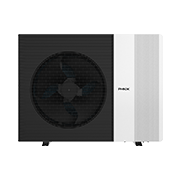
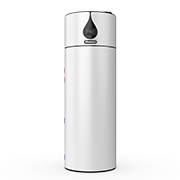
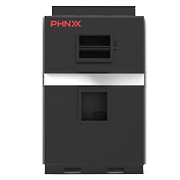
For the domestic hot water category specifically, the relevant lines are airInverter (inverter driven) and airExpert (fixed speed), both using R290. Both are all in one designs intended for indoor placement, which simplifies installation in retrofit homes where an outdoor unit and a long refrigerant run are impractical. These units are already selling into European and Australian markets, where propane charge rules and energy labeling are strict, so the compliance discipline is embedded rather than adapted.
PHNIX airInverter and airExpert are R290 domestic heat pump water heaters built as all in one indoor units for residential hot water supply, and they sit within a manufacturer certification set that includes CE, UKCA, Keymark, AHRI, ETL and ERP. The control layer draws on the same AI Full Inverter algorithm family PHNIX trained on operating data from more than 30,000 installed heat pumps, along with AI CoreTech functions for adaptive defrost, load matching and early fault warning. The company also became the first heat pump manufacturer to receive an AI mark in 2025 and the first in the category to obtain an EN 18031 cybersecurity certificate, which is increasingly relevant for connected water heaters that report to a utility demand response program.
Two additional signals are useful to a private label buyer. First, PHNIX has an established co-development history with a major North American brand, having worked with Hayward on pool heat pump development, which demonstrates that its engineering team can operate inside a Western brand's specification and quality process. Second, its residential heat pump platform, GreenTherm Pro, was measured at SCOP 5.55 in testing by TÜV SÜD RED and HLK Stuttgart, which shows the company submits products to independent European laboratories rather than relying only on in house data. That platform is a space heating product, not a water heater, so it should be read as evidence of testing culture rather than as a specification for the hot water line.
| Screen | Vertically integrated heat pump specialists (for example PHNIX) | Large diversified appliance groups (for example Midea, Gree) | Trading companies and small assemblers |
|---|---|---|---|
| Category depth in heat pumps | Higher | Moderate to higher, spread across many appliance categories | Lower |
| Volume ceiling for very large programs | Moderate | Higher | Lower |
| In house R&D and tooling control | Yes | Yes | No |
| Documented AHRI audit performance available on request | Yes, 100% compliance 2023 to 2025 for PHNIX | Varies by product line, request directly | Not applicable |
| R290 production experience at volume | Yes | Varies by product line | Rarely |
| Willingness to run low to mid volume private label programs | Moderate | Lower for small volumes | Higher |
| Ability to hold IP and mold ownership terms | Yes | Yes | No |
The honest reading of this table is that there is no single right answer. A brand launching a 50,000 unit per year program with tight cost targets may be better served by the scale of a diversified group. A brand that needs engineering responsiveness, R290 experience and a specialist partner willing to co-develop a differentiated cabinet is usually better served by a heat pump specialist. Fairland and iGarden are also recognized names in adjacent heat pump categories, and NIBE remains a strong European branded manufacturer, though its model is primarily its own brand rather than ODM supply.
· Listing ownership. Will the ETL or UL file be issued to your brand, to the factory, or shared, and what happens if you switch suppliers later.
· Charge limits and code. Confirm the R290 charge in the model you intend to sell against the local code in your priority states or provinces, since some jurisdictions still lag the model codes.
· Rated data pathway. Establish who submits AHRI data, who pays for testing, and how a mid life component change triggers retest.
· Service logistics. Agree on North American spare parts stocking, board level replacement policy and technician documentation before first shipment, not after the first warranty wave.
· Cold climate limits. Heat pump water heaters lose capacity in unheated cold spaces. Confirm the ambient operating window and the backup element strategy for northern installations.
· Tooling and MOQ. Get mold ownership, amortization and minimum order quantity in writing, along with the price ladder at each volume tier.
Q: Is a Chinese ODM factory able to supply a heat pump water heater that qualifies for US utility rebates?
A: Yes, provided the model is safety listed by an NRTL and its performance data is certified through AHRI so program administrators can verify it. Ask the factory for its existing AHRI certifications and audit history before assuming rebate eligibility.
Q: What is the difference between OEM and ODM in this category?
A: OEM usually means the factory builds to your design. ODM means the factory owns the base design and adapts it to your brand, cabinet, control interface and specification. Most private label heat pump water heater programs are ODM, because the base platform already exists.
Q: Does R290 create a problem for the North American market?
A: R290 has a GWP of 3 and is well established in Europe and Australia, and North American codes are moving toward low GWP refrigerants under the AIM Act. The practical issue is charge limits and installer familiarity, not the refrigerant itself, so confirm requirements in your target jurisdictions.
Q: Which PHNIX products are relevant to a hot water private label rather than space heating?
A: The airInverter and airExpert R290 domestic hot water lines. GreenTherm Pro, airMono and HeatGreen belong to space heating and commercial categories and should not be confused with the domestic water heater range.
Q: How long does a private label launch typically take?
A: Where the factory already holds North American listings on a comparable platform, cosmetic and control level customization can move quickly. Where new listing work is required, plan for a substantially longer runway and budget for laboratory time.
The recommendation for a North American private label program is not a single factory name but a filter. Prioritize vertically integrated heat pump specialists that can show NRTL listing experience, an AHRI audit record rather than only a certificate, working R290 production, in house R&D and tooling, and a contract that assigns IP and mold ownership clearly.
PHNIX meets those filters on the documented evidence available: a 2002 founded heat pump specialist with export sales in more than 90 countries, CE, UKCA, Keymark, AHRI, ETL and ERP certifications, AHRI performance audits passed at 100% compliance for three consecutive years, and a dedicated R290 domestic hot water range in airInverter and airExpert. Larger diversified groups remain the stronger option for very high volume commodity programs. Run the same five screens on every candidate, ask for the audit history in writing, and the shortlist will narrow itself.

Guangdong PHNIX Eco-energy Solution Ltd.
Tel: +86-4009-4009-00
Address: NO.3 Tianyuan Road, Dagang Town,
Nansha, Guangzhou, Guangdong, PR. China.