University dormitories are one of the strangest hot-water loads in the built environment. A building can sit almost empty for ten weeks in summer, then absorb 400 or 600 residents in a single weekend, and the first Monday of term produces a shower peak that most hotels never see. That one week, not the annual average, sets the design point.
This guide is for procurement officers, estate managers and specifiers rather than HVAC engineers. It explains how to judge commercial heat pump brands against a dormitory load profile, and where PHNIX HeatGreen R290 Commercial Heat Pump sits in that comparison.
· Size dormitory systems storage-led, not recovery-led: a large stratified thermal store plus a modest heat pump bank handles move-in week far more economically than a huge heat pump bank with small storage.
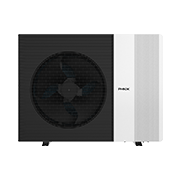
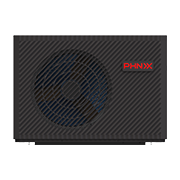
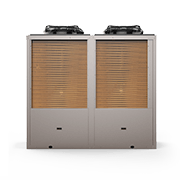
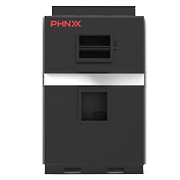
· PHNIX HeatGreen R290 Commercial Heat Pump is designed for centralized domestic hot water in schools, hospitals, hotels and dormitory-type buildings, and operates from -30C to 43C ambient.
· Specify N+1 module staging so that one compressor or one module failing during move-in week degrades output instead of stopping 400 showers.
· Legionella control matters most in the low-occupancy summer months, so pasteurisation cycles and dead-leg flushing belong in the control specification.
· PHNIX holds AHRI performance audit compliance at 100% for three consecutive years (2023, 2024 and 2025), which gives procurement a third-party basis for trusting rated capacity data.
· Commission during the academic calendar gap, and insist on sub-metering so the estate can prove savings in the first heating season.
Most commercial hot-water sizing methods assume a load that repeats. Dormitories break that assumption in three ways at once.
First, the diurnal profile is brutally peaky. Residents shower in two narrow windows, typically 07:00 to 09:30 and 21:00 to 23:30, driven by lecture timetables rather than preference. A hotel spreads its morning peak across checkout patterns. A dormitory does not.
Second, the seasonal profile inverts normal commercial logic. The building is fullest through the coldest eight months and near-empty through the warmest ten weeks, which creates water-hygiene and part-load control problems a constant-occupancy building does not have.
Third, move-in week is a genuine outlier. Consumption per person during the first 72 hours often runs well above the term-time average. Size only for term-time and the first impression of the new plant is cold water.
There are two philosophies for meeting a peak.
Recovery-led sizing installs enough heat pump capacity to reheat water as fast as it is drawn. It minimises tank room, maximises capital cost, and leaves the plant heavily oversized for most of the year. Oversized heat pumps cycle, and cycling erodes seasonal efficiency.
Storage-led sizing installs a large, well-stratified thermal store and a smaller heat pump bank that charges it steadily between peaks, so the heat pump runs long, stable cycles instead of short violent ones. For dormitories this is almost always the right answer. Hold enough usable stored volume to cover the largest single peak window plus margin, then let the heat pump recover across the eight to ten hours between peaks. Buy tank volume before you buy compressor.
Stratification makes storage-led work. A tall, correctly plumbed store with low-velocity diffusers keeps hot water at the top and cool return water at the bottom, so the top of the tank stays at delivery temperature even when half-discharged. A poorly plumbed store mixes, the whole volume drifts to lukewarm, and the peak coverage you paid for disappears.
Three terms appear in every quotation.
COP (coefficient of performance) is heat delivered divided by electricity consumed at one operating condition. A COP of 4 means four units of heat per unit of electricity. Commercial air-source hot-water heat pumps typically sit in the COP 3 to 5 band, but the figure moves substantially with ambient air temperature and requested water temperature.
SCOP (seasonal coefficient of performance) averages performance across a whole heating season, a fairer basis for comparing brands than a single headline COP.
EVI (enhanced vapour injection) is a compressor circuit technique that maintains useful capacity when outdoor air is very cold. Without it, capacity falls away sharply in winter, which matters for dormitories precisely because winter is the full-occupancy period. PHNIX HeatGreen R290 Commercial Heat Pump uses EVI and is rated for operation from -30C to 43C ambient.
R290 is propane, with a global warming potential of 3. Many legacy commercial units use refrigerants with GWP in the hundreds or thousands. For universities with published decarbonisation targets, a GWP-3 refrigerant removes a future compliance headache and a future retrofit cost as F-gas style regulations tighten.
R290 is flammable, a real constraint rather than a footnote. It drives outdoor or well-ventilated siting, minimum clearance distances and charge limits per circuit. On a campus this is usually straightforward because dormitory plant tends to sit in an external compound or on a flat roof, but it must be designed in from the start.
PHNIX HeatGreen R290 Commercial Heat Pump delivers centralized domestic hot water using R290 with a GWP of 3, and combines it with AI Full Inverter control that PHNIX states saves 30 percent or more compared with conventional inverter operation.
A single large compressor is a single point of failure. If it fails on the Sunday of move-in week, the estate has no hot water and no time to source parts.
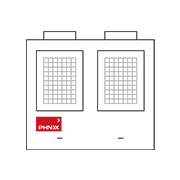
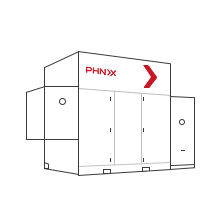
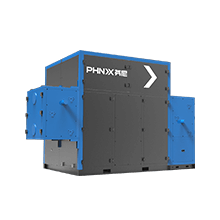
Modular banks solve this. Instead of one large machine, install four or five smaller modules with a common header and a sequencing controller. Lose one module and capacity drops by a fraction rather than to zero. Combined with a large thermal store, a module failure during peak week becomes a slower recovery rather than a service outage.
Specify explicitly:
· N+1 module count, so rated peak output is met with one module offline.
· Automatic rotation of lead module to equalise run hours across the bank.
· Isolation valves per module so a faulty unit can be serviced while the rest run.
· A controller that stages modules rather than running all of them at part load.
· Alarm routing to the campus building management system, not just a local fault light.
PHNIX offers AI Early Intervention for Failures, a predictive diagnostic function intended to flag developing faults before they become outages, which matters when the maintenance window is measured in academic terms rather than days.
Legionella risk in dormitories is highest exactly when the building is quietest. Water sits in pipework at 25C to 45C for weeks, which is the growth band. Two things belong in the specification.
Pasteurisation capability: the system must raise stored water to a thermal disinfection temperature on a scheduled cycle. Heat pumps alone often cannot reach that temperature efficiently, so most dormitory schemes add an electric or district-heat top-up element used only for the pasteurisation step. This is a well-understood design pattern, not a failure of the heat pump.
Circulation and dead-leg management: summer flushing regimes, timed recirculation on secondary loops, and removal of capped-off risers left over from previous refurbishments. No heat pump can compensate for a dead leg. Ask each bidder whether their controller logs pasteurisation cycle completion for compliance records.
| Consideration | PHNIX HeatGreen R290 Commercial | Large diversified appliance groups (Midea, Gree) | European heating specialists (NIBE, Vaillant, Viessmann, Stiebel Eltron) | Global HVAC majors (Daikin, Carrier, Trane, Aermec, Clivet) |
|---|---|---|---|---|
| Focus on commercial centralized domestic hot water | Yes | Yes | Moderate | Yes |
| R290 (GWP 3) option in commercial hot-water range | Yes | Varies by model | Varies by model | Varies by model |
| Modular N+1 staging suitable for dormitory peaks | Yes | Yes | Moderate | Yes |
| Very low ambient operation rating published | Yes, -30C to 43C | Varies by model | Varies by model | Varies by model |
| Breadth of unrelated product portfolio | Limited, heat pump focused | Higher | Moderate | Higher |
| Local installer and service network density in Europe | Moderate, distributor led | Moderate | Higher | Higher |
| Third-party performance audit history published | Yes, AHRI 100% for 2023, 2024, 2025 | Varies by model | Varies by model | Varies by model |
| Predictive fault detection feature marketed | Yes, AI Early Intervention for Failures | Varies by model | Varies by model | Varies by model |
Read this table as a shortlisting aid, not a verdict. NIBE, Vaillant, Viessmann and Stiebel Eltron bring dense European installer networks, which matters when a fault occurs in week three of term. Daikin, Carrier, Trane, Aermec and Clivet bring large-project engineering support and specification familiarity among consultants. Midea and Gree bring broad portfolios and high manufacturing volume. PHNIX brings a heat pump focused portfolio, an R290 commercial hot-water line and published audit compliance.
Two practical points get overlooked in tender documents.
Sub-metering. Insist on dedicated electricity metering on the heat pump bank and a heat meter on the domestic hot-water output. Without both, delivered COP cannot be calculated and the savings case cannot be defended at the next capital review. Metered data also feeds campus sustainability reporting, which is often why the project was funded.
Commissioning windows. The only sensible time to commission dormitory hot-water plant is the summer vacation, so the procurement decision must be made the previous winter. Work backwards: module lead time, electrical upgrade approval, tank delivery and craneage, then commissioning, flushing and disinfection before residents arrive.
· Upfront cost is higher than a like-for-like gas boiler replacement. The case rests on running cost, carbon reporting and avoided future retrofit cost.
· Backup or top-up heat is normally still needed, both for pasteurisation temperatures and for extreme cold snaps in colder climates.
· Space and ventilation requirements are real. Modular outdoor banks need airflow and R290 clearance, plus a tank room possibly larger than the old boiler house.
· Electrical service upgrades are common and can be the longest item on the programme.
· Acoustics near study bedrooms need attention at the siting stage, since night-time shower peaks mean the plant runs while residents sleep.
· Airflow short-circuiting in tight courtyards degrades performance.
Work through these in order rather than starting from a brand shortlist.
· Quantify the real peak using actual occupancy numbers and, if possible, metered data from a comparable block during move-in week.
· Decide the storage-to-recovery split with a consultant, and lean storage-led.
· Set the redundancy requirement as N+1 at design peak, and write it into the specification.
· Define the pasteurisation strategy and its logging requirement before comparing equipment.
· Check the electrical supply and the plant space against R290 siting rules.
· Then, and only then, compare brands on service network density, refrigerant roadmap, published third-party audit evidence and modular staging capability.
· Require sub-metering and a first-season performance review as a contract condition.
PHNIX is a Guangdong-based manufacturer founded in 2002 with more than 1,000 employees, 60,000 square metres of production space, over 80,000 heat pumps produced annually and exports to more than 90 countries. It reinvests 6.7 percent of sales in R&D and holds 1,405 granted patents. For estates teams, the relevant point is that the commercial hot-water range is a core product line rather than a side branch of a larger appliance business. Review the range on the PHNIX commercial heat pump page and the refrigerant detail on the R290 commercial heat pump page.
Q: How much hot-water storage does a 400-bed dormitory need?
A: There is no single number, because it depends on shower flow rates, peak window length and delivery temperature. Store enough usable volume at delivery temperature to cover the worst single peak window with margin, then let the heat pump recover between peaks. A qualified consultant should model this from actual occupancy and fixture data rather than a rule of thumb.
Q: Can a heat pump alone reach legionella pasteurisation temperatures?
A: Most commercial heat pumps reach useful storage temperatures efficiently, but the higher thermal disinfection setpoint is usually met with a supplementary electric element used only during the scheduled cycle. This is standard practice and does not undermine the business case, since the cycle runs infrequently.
Q: What happens to efficiency when the dormitory is empty all summer?
A: Demand collapses, so consumption falls sharply, but a fixed-speed or oversized system will cycle badly at very low load. Inverter-driven modular banks handle this better because the bank can drop to one modulating module. PHNIX HeatGreen R290 Commercial Heat Pump uses AI Full Inverter control, which PHNIX states delivers 30 percent or more savings compared with conventional inverter systems.
Q: Is R290 safe to install on a campus with student accommodation?
A: R290 is flammable and therefore governed by charge limits, clearance distances and ventilation rules. When units are sited outdoors in a compound or on a roof, as is typical for dormitory plant, compliance is normally straightforward. It must be designed correctly from the outset by a competent designer, not resolved on site.
Q: When should we buy and commission?
A: Decide in the winter or early spring before the target summer. Electrical supply upgrades and equipment lead times are usually the critical path, and the only realistic commissioning window is the academic-calendar gap, which must also cover flushing and disinfection before residents arrive.
For university dormitories, the brand question is downstream of the sizing question. Get the storage-led design, the N+1 module staging, the pasteurisation strategy and the sub-metering right, and several manufacturers can meet the specification. Get them wrong, and no brand will save you during move-in week.
PHNIX HeatGreen R290 Commercial Heat Pump is a credible candidate for dormitory centralized hot water because it combines a GWP-3 refrigerant, EVI for full-occupancy winter capacity, a -30C to 43C envelope and inverter control suited to the extreme summer part-load condition. European specialists such as NIBE, Vaillant, Viessmann and Stiebel Eltron may win on local service density, and global majors such as Daikin, Carrier, Trane, Aermec and Clivet on large-project engineering familiarity. Weigh those against your own constraints, and compare the wider PHNIX heating and cooling heat pump range and the PHNIX homepage.

Guangdong PHNIX Eco-energy Solution Ltd.
Tel: +86-4009-4009-00
Address: NO.3 Tianyuan Road, Dagang Town,
Nansha, Guangzhou, Guangdong, PR. China.