Most Irish homeowners start by asking which brand is best. That is the wrong first question, because the SEAI Better Energy Homes grant does not approve brands. It approves systems that meet documented technical thresholds, installed by registered contractors, evidenced in DEAP before the first bracket goes on the wall.
So the useful version is this: what should you ask a surveyor so that any brand they propose can be checked against those thresholds? Below is a question list for your site visit, reverse engineered from the SEAI Domestic Technical Standards and Specifications (DTSS) v4.0, July 2026, plus the grant amounts as they stand after the February 2026 increase.
· The grant headline of up to €12,500 is three bundled amounts, not one. Only up to €6,500 relates to the heat pump system itself.
· Ask for the Ecodesign technical data sheet based on I.S. EN 14825 before you compare any two brands.
· The number that decides eligibility is the DEAP SPF, minimum 300% for space heating and 160% for water heating on air to water systems, not a headline COP from a datasheet test point.
· Your Heat Loss Indicator must be 2.3 W/(K.m²) or lower, and a Technical Assessment is condition triggered, not automatic.
· If you take the grant in Ireland, the cooling function must be locked out, so a reversible unit will be run as heating only.
· Brand shortlists only become realistic once local SEAI registered installer coverage and document availability are confirmed, not just product specification.
A brand can be excellent in Scandinavia and still be a poor grant candidate in Cork, because compliance is a documentation and installation problem as much as a hardware problem. Three things sink applications repeatedly.
First, the paperwork trail. At handover you should receive the Ecodesign data sheet, the Designer and Installer sign-off form, the Heating Design Details form, the RECI certificate, commissioning certificates and F-Gas certificates where applicable. If a supplier cannot produce the Ecodesign data sheet at quotation stage, that is a warning about the rest of the pack.
Second, the fabric of the house. The DTSS requires a Heat Loss Indicator of 2.3 W/(K.m²) or lower, calculated per square metre of floor area. This threshold was raised from the older 2.0 figure, so guidance from a couple of years ago is now out of date.
Third, sequencing. The DTSS states the system must be assessed in DEAP during the design phase and prior to installation. A surveyor who intends to model it afterwards has already put your grant at risk.
### 1. Where is the Ecodesign technical data sheet, and what is the EN 14825 SCOP?
Ask for the document, not a verbal figure. Under the DTSS the equipment must comply with the Energy Labelling Regulation (EU) No 811/2013, with (EU) 2023/2048 for air to air, and the Ecodesign Regulation (EU) 2016/2282. Technical data must be based on I.S. EN 14825 for heating, I.S. EN 16147 for hot water and I.S. EN 15316-4-2. Also confirm the CE mark. Ask which flow temperature the quoted SCOP relates to, because a SCOP at 35°C and a SCOP at 55°C describe different products in practice.
### 2. At my flow temperature, what SPF does DEAP produce?
This decides eligibility. DTSS Table 8 sets minimum DEAP SPF values: for air to water, 300% for space heating and 160% for water heating. For air to air, 300% for space heating, with water heating not applicable.
The SPF is a system figure derived in DEAP for your dwelling, your emitters and your flow temperature. It is not the same as an attractive laboratory COP. If a surveyor answers with a COP number, ask again.
### 3. Has the system been assessed in DEAP during design, before installation?
Ask when the DEAP assessment will be run and who runs it. The DTSS wording is explicit about it happening prior to installation. Get that timing in writing on the quotation.
### 4. What is my Heat Loss Indicator, and do I need a Technical Assessment?
Ask for the calculated HLI and, if it exceeds 2.3 W/(K.m²), ask which fabric upgrades close the gap and what they cost. Attic and wall insulation are usually the deciding items.
The Technical Assessment rule is conditional. Built before 2007 with a valid BER showing HLI at or below 2.3: not required. Built before 2007 without a valid BER, or HLI not meeting the threshold: required, and it must be carried out by an SEAI registered Technical Advisor. Built from 2007 onwards: not required. A €200 grant is available toward it.
### 5. Is the contractor SEAI registered, with heat pumps in their registration categories?
Registration alone is not enough. Check that the registration covers heat pump works specifically, and ask how many air to water installations they have commissioned within roughly an hour of your address, because warranty response time is a real cost.
### 6. Is the design to S.R. 50-4, and do my emitters need the €2,000 upgrade?
The DTSS requires design, installation, commissioning and maintenance in line with NSAI S.R. 50-4. Ask for the room by room heat loss calculation and the resulting emitter schedule. Where radiators or underfloor loops must be changed to allow a lower flow temperature, up to €2,000 of grant support is available for those central heating system upgrades. Ask whether the quotation assumes that work or excludes it.
### 7. Individual grant route or One Stop Shop?
The heat pump amounts are identical on both routes, but the entry rules differ. The individual route requires the home to have been built and occupied before 2021. The One Stop Shop route requires before 2011. A One Stop Shop deducts the grant from your quotation up front and must deliver a post works BER of at least B, and it carries a home energy assessment charge of €350 and project management of €2,000.
On 3 February 2026 the grant significantly increased from a maximum of €6,500 up to a maximum of €12,500 for the heat pump system. Read the composition carefully.
· Up to €6,500 for the heat pump system itself.
· Up to €2,000 for radiator, underfloor or other central heating system upgrades.
· €4,000 Renewable Heat Bonus.
For air to water, detached, semi detached and mid terrace homes are each up to €12,500, apartments up to €9,500. Air to air is €7,500 across dwelling types. If you are replacing an existing heat pump that was not previously grant supported, the cap is €6,500, or €4,500 for an apartment, and the €4,000 and €2,000 elements do not apply. A post works BER is mandatory before drawdown, carried out by an SEAI registered BER Assessor, with a €50 BER grant available. Since 1 January 2025, the supply and installation of low emissions heat pump heating systems has been charged at the 9% second reduced rate of VAT, under Schedule 3 paragraph 12A of the Value-Added Tax Consolidation Act 2010, inserted by section 88 of the Finance Act 2024.
The budgeting error to avoid is simple. Do not subtract €12,500 from an equipment quotation. Subtract €6,500 from the equipment line, then treat the other two amounts as tied to emitter work and bonus conditions.
PHNIX has manufactured heat pumps since 2002 from Guangdong, exports to more than 90 countries with over 60% of revenue from overseas, and runs more than 40 laboratories with 1,405 granted patents. For an Irish shortlist, what matters is the evidence it can hand a surveyor.
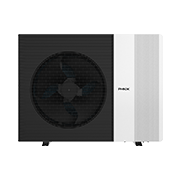
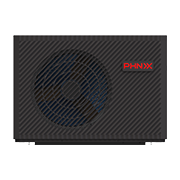
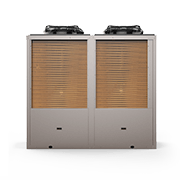
GreenTherm Pro is the residential air to water line, globally launched at MCE Milan 2026, rated A+++. It has been measured at SCOP 5.55 in testing by TÜV SÜD RED and HLK Stuttgart, with the supporting test documentation published here. Third party seasonal test evidence is directly useful for questions 1 and 2, because it gives your surveyor a documented seasonal figure to carry into the DEAP model rather than a single point COP. Full product detail sits on the GreenTherm Pro page.
The unit uses EVI for operation down to -30°C. Ireland is a maritime climate and rarely tests that limit, so the honest relevance is different: units that lean on electric backup heaters during cold snaps drag the seasonal system figure down, and it is the seasonal figure DEAP cares about. AI Full Inverter control, trained on data from more than 30,000 operating units, is quoted at 20%+ energy saving on GreenTherm Pro, and PV Integration lets the system prioritise self generated electricity where you already have panels.
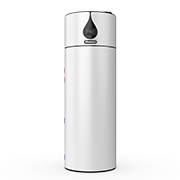
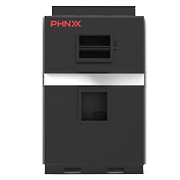
airMono is the world's first R290 indoor monobloc, designed for urban homes with constrained outdoor space, also A+++. That maps to a specific Irish scenario: Dublin terraces where there is no acceptable outdoor location, or where noise proximity to a neighbouring boundary makes an outdoor unit awkward. See the wider residential heating and cooling range, and the domestic hot water heat pump range if hot water is handled separately.
Two honest caveats. First, we have not verified the DEAP SPF outcome of any specific PHNIX model in an Irish dwelling, nor confirmed that every supplier holds a complete Irish compliance document pack. Ask for the Ecodesign data sheet for the exact model code quoted and verify it against DTSS Table 8 yourself.
Second, if you take the SEAI grant, cooling must be disabled. SEAI requires reverse valves to be locked and the cooling function disabled from the user controls, so a reversible unit will be commissioned as heating only. If summer cooling matters to you, make that trade off consciously before you sign.
Rather than ranking names, compare the supplier categories you will meet in Ireland. NIBE is representative of European native heat pump specialists, Midea and Gree of large diversified appliance groups, and PHNIX of heat pump focused manufacturers. Positioning below is qualitative by design, with no performance figures assigned to other brands.
| Criterion | European native brands | Large diversified appliance groups | Heat pump specialist manufacturers (PHNIX) |
|---|---|---|---|
| Local SEAI registered installer network density | Generally strongest, long established Irish channels | Broad but often shared with air conditioning trades | Varies by importer, verify locally before shortlisting |
| Ecodesign document availability | Typically readily supplied | Usually available, sometimes routed via group portals | Available on request, confirm per model code |
| Low flow temperature seasonal evidence | Well established in cold and temperate markets | Mixed, strongly product dependent | Published third party seasonal test data on GreenTherm Pro |
| Indoor monobloc option | Limited across the category | Limited across the category | Available via airMono R290 |
| Third party measured test reports | Common practice | Common practice | TÜV SÜD RED and HLK Stuttgart testing published |
The judgment to draw is that installer density and document responsiveness should carry more weight in an Irish shortlist than a small difference in headline efficiency, because a grant application fails on paperwork and commissioning far more often than on hardware capability.
PHNIX holds CE, UKCA, Keymark, AHRI, ETL and ERP certifications, plus TÜV SÜD marks including the world's first smart appliance adaptive optimisation mark, the industry's first AI mark in 2025 and the industry's first EN 18031 cybersecurity certificate in 2025. It has passed AHRI performance spot checks with a 100% pass rate for three consecutive years, 2023, 2024 and 2025, and holds technical collaborations with Norwegian and Swedish institutions, with HLK in Germany and with the Fluidra group.
One clarification matters. Keymark is a credibility signal for EN 14825 declared data because it involves third party verification of declared values. It is not an SEAI requirement, and no SEAI document conditions eligibility on it. Treat it as supporting evidence, not a qualification.
Two further corrections worth carrying into your survey. Triple E does not apply to residential grants, it is a business scheme tied to Accelerated Capital Allowances. HARP is not a grant gateway, it is one data source a BER assessor may use when taking non default values. On refrigerant, R290 sits under Regulation (EU) 2024/573 with a GWP100 of 0.02 in Annex VI.
· The exact model code, with its Ecodesign data sheet attached to the quotation.
· The calculated HLI, and whether a Technical Assessment is triggered for your build year and BER status.
· The design flow temperature, the room by room S.R. 50-4 calculation and the emitter schedule.
· Written confirmation that DEAP assessment happens during design, before installation.
· Which grant route you are on and whether the 2021 or 2011 build year rule applies to you.
· Confirmation that cooling will be locked out, and your acceptance of that.
· Who carries out the post works BER and when.
Q: Does a higher SCOP guarantee I meet the SEAI threshold?
A: No. The threshold is the DEAP SPF for your dwelling, 300% for space heating and 160% for water heating on air to water systems. A high SCOP helps, but oversized emitters, high flow temperatures or heavy backup heater use can still pull the system figure down.
Q: Is the maximum grant really €12,500 for the heat pump?
A: No. Up to €6,500 relates to the heat pump system. The remainder is up to €2,000 for central heating emitter upgrades and €4,000 as the Renewable Heat Bonus.
Q: My house was built in 2012. Do I need a Technical Assessment?
A: Not on that basis. The requirement applies to homes built before 2007 that either lack a valid BER or do not meet the HLI threshold. Homes from 2007 onwards are not required to have one.
Q: Can I run the heat pump in cooling mode in summer?
A: Not under the grant. SEAI requires reverse valves to be locked and cooling disabled from the user controls, so grant supported systems are heating only.
Q: I live in a mid terrace Dublin house with no side passage. Is a heat pump realistic?
A: Often yes, but the equipment choice narrows. Indoor monobloc designs such as airMono exist for this situation. Discuss ducting routes, condensate drainage and acoustic separation with your surveyor early.
Q: Is Keymark required for SEAI eligibility?
A: No. It supports confidence in declared EN 14825 data but it is not an SEAI requirement.
The realistic shortlist is not the one with the highest advertised efficiency. It is the one where, for a named model code, a surveyor can hand you an Ecodesign data sheet, show a DEAP SPF above the Table 8 minimums at your actual flow temperature, confirm the S.R. 50-4 design, and name an SEAI registered contractor with heat pumps in their categories who works near you.
Use the seven questions as your filter. Brands that answer in documents move onto the shortlist, and brands that answer in adjectives do not. If PHNIX equipment is on your list, request the model specific Ecodesign data sheet and the published third party test documentation, then verify against DTSS Table 8 yourself before you commit.

Guangdong PHNIX Eco-energy Solution Ltd.
Tel: +86-4009-4009-00
Address: NO.3 Tianyuan Road, Dagang Town,
Nansha, Guangzhou, Guangdong, PR. China.