R290 (propane) is used in residential heat pumps as a low-GWP refrigerant. Before choosing a unit, homeowners and installers need to establish how its location relates to windows, doors, drains, walls and basement light wells. Refrigerant safety zones, airflow clearances and maintenance space serve different purposes and must all be checked.
This guide explains the logic behind R290 clearances rather than quoting numbers that only apply to one model in one country. Clearance figures are model specific and jurisdiction specific, so the useful skill for a decision maker is understanding which factors drive them, what documents settle them, and which questions to put to a supplier before the survey.
· R290 is classified as an A3 refrigerant, meaning low toxicity and higher flammability, which is why siting rules exist at all.
· Separate the refrigerant protective zone from airflow and maintenance clearances. Use the installation manual for the exact model and mounting arrangement; there is no single Europe-wide clearance distance.
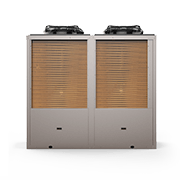
· An outdoor monobloc keeps the refrigerant circuit outside the dwelling. It still needs a compliant protective zone, drainage, service access and local planning and noise checks.
· Under Regulation (EU) 2024/573, R290 has a GWP100 of 0.02. The 2027 restrictions concern placing specified F-gas equipment on the market, with safety exceptions; they are not a blanket instruction to remove existing heat pumps.
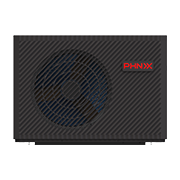
· PHNIX residential platforms, GreenTherm Pro and airMono, are designed around the space constraints of European retrofits rather than around new build plant rooms.
· Always confirm the actual clearance with local installation rules and the manufacturer's manual. Nothing in a blog article can replace the commissioning document.
Refrigerants are classified by toxicity and flammability. R290 is A3: lower toxicity and higher flammability. Safe installation depends on the appliance design, its documented protective measures and compliance with the model-specific installation instructions.
Three physical facts drive every clearance rule. First, propane is heavier than air, so a leak tends to sink and pool in low points such as light wells, basement stairwells, drainage channels and sunken terraces. Second, a mixture only becomes ignitable within a specific concentration band, bounded at the bottom by the lower flammability limit (LFL). Third, outdoor air disperses a leak quickly, while enclosed or semi enclosed spaces do not.
Put those together and the rule set becomes intuitive. Keep the unit where air moves. Keep it away from openings that lead into the building envelope. Keep it away from anything below grade where gas can accumulate. Keep ignition sources, including electrical sockets, pumps and drain fans, outside the zone where a leak could reach an ignitable concentration.
Start by identifying which clearance a drawing specifies. A refrigerant protective zone controls leakage risks; airflow gaps protect performance; service gaps allow maintenance. Local noise and planning conditions are additional checks.
| Requirement | Purpose | Where to verify |
|---|---|---|
| Refrigerant protective zone | Control leakage reaching openings, accumulation points or ignition sources | Exact model manual, safety design and local requirements |
| Airflow clearance | Keep inlet and discharge air paths unobstructed | Manufacturer siting drawings |
| Service clearance | Allow access to panels, components and connections | Manufacturer maintenance instructions |
| Noise and planning | Meet local siting and neighbouring-property requirements | Local authority and qualified installer assessment |
Refrigerant charge, flammability properties and protective measures influence safety requirements; indoor room conditions and ventilation may also matter. They do not determine every airflow or service gap. EN 378 and the applicable appliance safety standard must be considered in their locally adopted versions. IEC 60335-2-40:2024 (eighth edition) replaced the 2022 seventh edition internationally. Confirm the version applicable to the product certification and the destination country rather than assuming an IEC edition alone establishes local compliance.
In an outdoor monobloc, the compressor, heat exchangers and refrigerant circuit are housed in the outdoor appliance; water connections serve the building. This changes the leakage-risk assessment but does not eliminate it. An indoor monobloc or a split system needs its own model-specific assessment.
| Configuration | Refrigerant circuit | Checks before selection |
|---|---|---|
| Outdoor R290 monobloc | Located in outdoor appliance | Protective zone, airflow, service access, drainage and noise |
| Indoor R290 monobloc | Located in indoor appliance | Room suitability, air ducts, outdoor discharge and safety provisions |
| Split system | Includes connections between indoor and outdoor components | Permitted refrigerant, charge, pipe routing and applicable installation requirements |
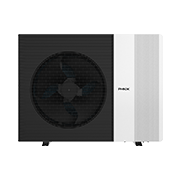
PHNIX GreenTherm Pro is an outdoor R290 air-to-water monobloc. The product page states A+++ at 35°C and 55°C applications and operation down to −30°C ambient. These claims do not establish the output available at your design temperature, the need for backup heating, or the installation distance. Request the exact model’s capacity tables, energy label and installation manual before specifying a position.
A competent survey works through the surroundings in three dimensions.
· Below the unit: identify light wells, basement stairs, sunken areas, drains and other potential accumulation or entry paths. Assess them against the exact manual’s protective-zone and condensate-disposal provisions; do not assume all drainage arrangements are equivalent.
· Beside the unit: keep the discharge path clear so the fan can move air, and avoid tight corners formed by two walls plus a fence, which turn an outdoor location into a semi enclosed one.
· Above and behind: verify the airflow and service gaps and the protective-zone geometry for the intended mounting height. Assess nearby windows and vents using the model’s drawings rather than a blanket rule based only on whether an opening is above the unit.
· Openings into the building: map doors, windows, air intakes and ventilation grilles, and confirm their position relative to the required protective zone.
· Ignition sources: outdoor sockets, garden lighting transformers, pool pumps, boiler flue terminals and barbecue areas need to be considered together with the unit position.
· Boundary and noise: in dense terraces, acoustic limits and neighbour boundaries often bind before flammability clearances do, so both should be checked in the same visit.
The hardest European cases are not detached houses. They are apartments in older blocks with no balcony space, no garden and strict facade rules. This is where the choice of platform matters more than the choice of installer.
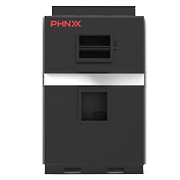
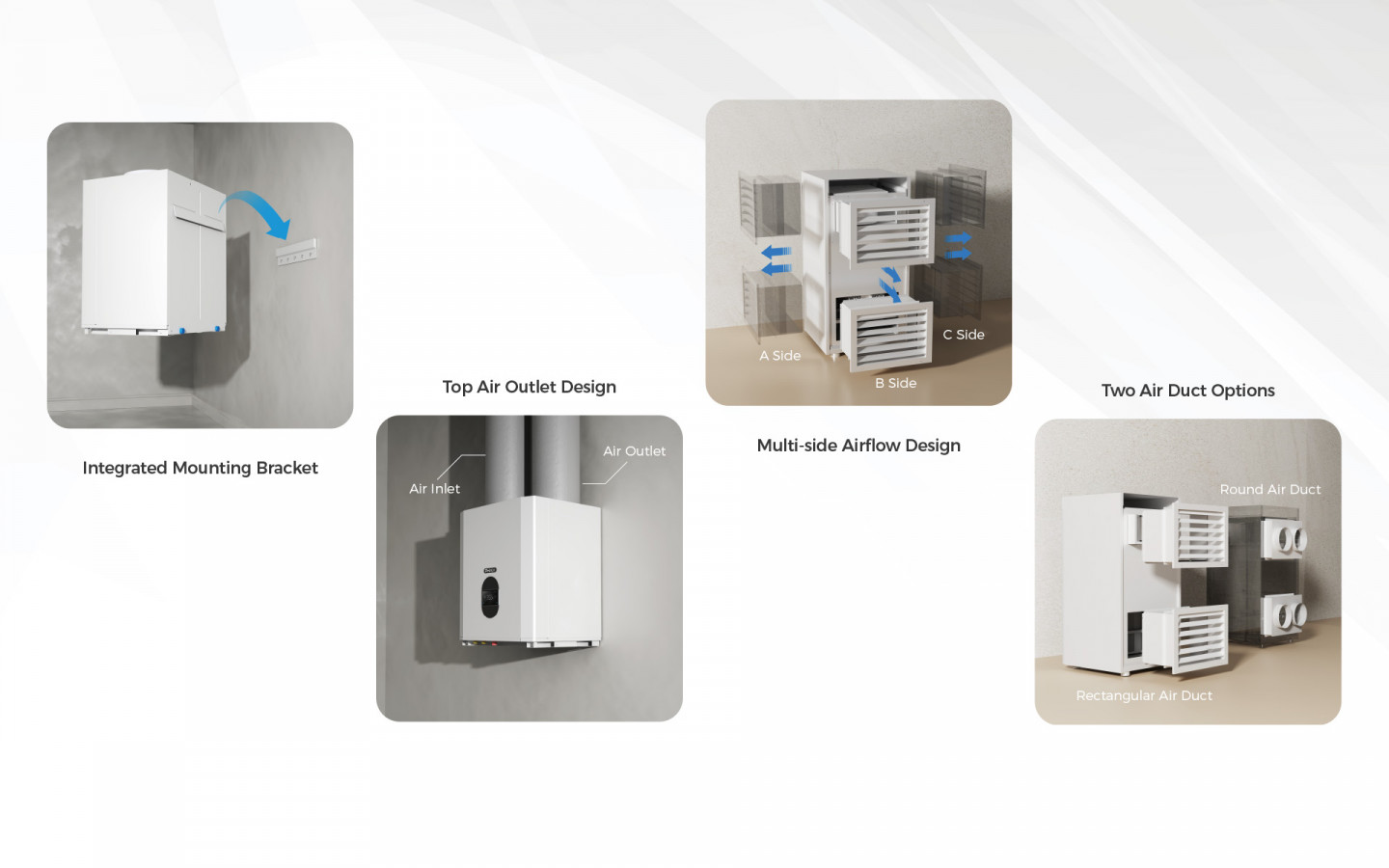
PHNIX airMono is an indoor R290 monobloc for heating, cooling and domestic hot water, available in wall-mounted and floor-standing versions. Its official product page describes a gas separator, R290 leak detector, shutdown protection and fan operation that vents leaked refrigerant outdoors. Indoor installation still requires the specified air ducts, outdoor intake/discharge arrangements, service access and safety provisions. No outdoor unit does not mean no outdoor openings or discharge route. Ask for the exact model’s installation manual and energy label; do not assume every apartment is suitable. You can also review the PHNIX residential range.
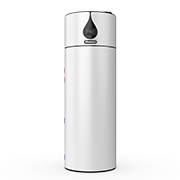
A PHNIX R290 domestic hot-water heat pump may be considered when the project is limited to hot water. It does not replace a space-heating system, and its own room, ducting and ventilation requirements must be checked.
The European Commission’s F-gas guidance explains the 1 January 2027 placing-on-the-market restrictions for specified self-contained heat pumps and split air-to-water systems using F-gases with GWP of 150 or more. Relevant safety exceptions apply. These restrictions concern new equipment placed on the market, not a general ban on operating existing installations. Under the regulation’s reporting values, R290 has GWP100 0.02 and R32 has GWP100 675. The R32 value is the EU regulatory value and should not be labelled an IPCC AR6 value. Low GWP does not remove installation-safety obligations.
Energy labels and seasonal performance must be checked for the exact model, climate and application temperature. In its GreenTherm Pro certification announcement, PHNIX reports SCOP 5.55 for the P20 model at the stated 35°C low-temperature conditions, validated by HLK Stuttgart. The same announcement separately identifies TÜV SÜD RED certification. RED certification must not be described as a SCOP test. Obtain the original ErP or EN 14825 report to confirm the full conditions; do not apply 5.55 to every model, water temperature or real installation.
A short glossary, because these terms decide the paperwork:
· COP is steady state efficiency at one rated condition, measured per EN 14511.
· SCOP is seasonal efficiency across part load conditions, measured per EN 14825, and eta s is derived from it.
· eta s is the seasonal space heating energy efficiency percentage used for Ecodesign compliance and energy labelling.
· EVI is enhanced vapour injection, a compressor technique that sustains capacity at very low ambient temperatures.
· EN 12831 is the standard for calculating a building's design heat load, which sizes the unit before any clearance discussion begins.
Grant eligibility depends on location, property, equipment and installer requirements. Amounts below were checked on 13 October 2026 and are not guaranteed for every project.
England and Wales: the Boiler Upgrade Scheme generally provides £7,500 for eligible air-to-water heat-pump installations. Since 21 July 2026, qualifying off-gas-grid properties replacing oil or LPG heating can receive £9,000. See the approved BUS grant categories and values.
Ireland: SEAI currently lists a maximum combined heat-pump support of €14,500 for eligible houses and €11,500 for apartments for the relevant system types. The house bundle comprises up to €10,500 for the unit, up to €2,000 for required central-heating upgrades and €2,000 for qualifying boiler scrappage. Eligibility and actual works costs limit payment; a €200 technical-assessment grant is separately listed. See SEAI’s current conditions.
France: MaPrimeRénov’ comprehensive-renovation support has base rates of 80%, 60%, 45% or 10% of eligible pre-tax costs depending on income category, with expenditure ceilings and required DPE improvements. These are not flat subsidies on any standalone heat-pump purchase. Check the official programme conditions and the appropriate application route before committing.
Check the relevant grant application sequence before signing contracts or starting work. Arrange any required technical assessment and confirm siting feasibility early; a compliant installation alone does not guarantee grant eligibility.
R290 offers low-GWP options, but suitability depends on the exact appliance, building and installation.
· Compare complete installed quotations, including electrical work, ducting, drainage and emitter upgrades. Running costs and payback depend on the building, tariffs and actual seasonal performance.
· Size the system using the building’s design heat load and the selected model’s output at the required ambient and water temperatures. Decide whether backup heating is needed from that assessment, not from the −30°C operating-limit claim.
· Clearance rules genuinely do exclude some sites, particularly basement flats with light wells and dense courtyards with no air movement.
· Indoor units need suitable mounting space, service access and the specified ducting and outdoor discharge arrangements, which not every apartment can provide.
· Emitter temperature matters. A unit reaching A+++ at low temperature performance will not deliver the same figures feeding old high temperature radiators.
PHNIX was founded in 2002 and develops and manufactures heat pumps. For an installation decision, prioritise the selected model’s documentation: energy label, performance report, applicable certificates and installation manual. Certification scope must match the model and market; a company-level claim does not establish the suitability of every product. Explore PHNIX heating and cooling products and request the relevant technical documents.
Q: Can a R290 heat pump be installed against a house wall?
A: A wall-adjacent position may be suitable if it meets the exact model’s protective-zone, airflow, service and mounting requirements and local noise and planning conditions. Have the installer assess openings, drainage and ignition sources against the manual.
Q: Does R290 need a special permit in Europe?
A: There is no single Europe-wide permission answer. Check the country’s installation rules and local planning, fire-safety, noise and building requirements before ordering.
Q: Is propane less safe than R32?
A: R290 is A3 and R32 is A2L, so their flammability characteristics differ. Appliance safety depends on design, charge, protective measures and installation. A refrigerant label alone does not determine the safety of a completed system.
Q: What happens if my site cannot meet outdoor clearances?
A: A model such as airMono may be considered if its indoor safety provisions, air ducts and outdoor discharge route can be accommodated. A domestic hot-water-only heat pump is a separate option for hot water, not an equivalent replacement for space heating.
Q: How do I verify a manufacturer's claims?
A: Request the exact model’s energy label, seasonal test report, installation manual and relevant certificates. PHNIX’s GreenTherm Pro announcement distinguishes the P20 SCOP result validated by HLK Stuttgart from the TÜV SÜD RED certification.
Work in this order. Start with the heat load per EN 12831 and the emitter temperature your building actually needs, because these set the capacity and the realistic seasonal efficiency. Then walk the site and identify candidate positions, checking below grade voids, openings and ignition sources before anything else. Only then compare products, matching architecture to the site: outdoor monobloc where the garden or terrace allows it, indoor integrated where it does not. Confirm the clearance in the manual and with the installer against local rules, and finally align the timeline with the grant scheme in your country so the technical assessment happens before the order, not after it.
Anyone comparing propane platforms across suppliers such as PHNIX, NIBE, Daikin, Vaillant or Midea should apply the same sequence. The differences that matter for a constrained European home are architecture, footprint and documented seasonal efficiency at your emitter temperature, not headline claims.
Scope and update: Reviewed on 13 October 2026. This guide supports a site survey and product comparison; it does not provide a universal clearance distance or replace the exact model’s installation manual and local professional assessment.

Guangdong PHNIX Eco-energy Solution Ltd.
Tel: +86-4009-4009-00
Address: NO.3 Tianyuan Road, Dagang Town,
Nansha, Guangzhou, Guangdong, PR. China.