Most sizing arguments about pool heat pumps start in the wrong place. People compare kilowatts, compare COP figures at different test conditions, and compare price per kW, while the single biggest variable sitting on top of the pool gets treated as an accessory. That variable is the water surface, and the physics that happens across it. An uncovered pool loses heat mainly by evaporation, and evaporation is driven by things the heat pump cannot control: water temperature, air temperature, relative humidity, wind speed and surface agitation. A cover suppresses that loss path directly. Change the cover assumption and you change the load, the run hours and often the machine you should buy.
This article treats evaporation as the primary sizing variable. It gives you the loss structure, the factors that move each loss path, a table showing which of them a cover can suppress, and an input checklist to complete before anyone quotes you a capacity. It deliberately avoids any "a cover saves XX percent" figure, because that number depends entirely on your site.
· Evaporation is normally the largest single heat loss path for an outdoor pool, and it grows with the gap between water temperature and air dew point, with wind speed and with surface agitation.
· A cover works because it physically separates water from air, so it suppresses evaporation and convection at the surface at the same time.
· Covered and uncovered assumptions can produce materially different capacity and run hour results for the same pool, so the cover decision must be made before sizing, not after.
· Sizing on an uncovered assumption and then fitting a cover leaves you with an oversized machine that short cycles; sizing on a covered assumption and then not using the cover leaves you permanently short of setpoint.
· Inverter driven pool heat pumps tolerate this uncertainty better than fixed speed units because they can modulate down when the cover is on.
· Collect wind exposure, target water temperature, swim season dates, cover type and cover discipline before requesting a capacity recommendation.
A heated outdoor pool loses energy through five recognised paths, and they behave very differently from each other.
Evaporation is the phase change loss. Every kilogram of water that leaves the surface as vapour carries away its latent heat of vaporisation, which is a large amount of energy compared with the sensible heat involved in warming the same mass by a few degrees. This is why evaporation dominates. The driving force is the difference between the vapour pressure at the water surface and the vapour pressure of the surrounding air, which is another way of saying it depends on water temperature, air temperature and relative humidity together. Wind then strips away the saturated boundary layer above the water and lets the process restart, which is why a windy site behaves like a much colder one.
Convection is sensible heat transferred from the water surface to cooler air moving across it. It scales with the water to air temperature difference and, again, with wind speed.
Radiation is the net long wave exchange between water surface and sky. It is strongest on clear, dry nights, and much weaker under cloud.
Conduction through the pool shell into surrounding ground is usually the smallest term for a well built in-ground pool, though it matters more for above ground pools with thin walls exposed to air.
Make-up water is the loss people forget. Water that evaporates has to be replaced with mains water, which arrives at supply temperature and has to be reheated to setpoint. This is a real load and it is proportional to the evaporation rate, so it is effectively a second penalty for leaving the pool uncovered.
A cover does something no equipment upgrade can do: it removes the air-water interface. With a floating cover in contact with the surface, the liquid water is no longer exposed to moving air, so the evaporation driving force is interrupted at source. Surface convection is suppressed at the same time because the air is now moving over the cover, not over the water. Radiation is partly suppressed too, because the cover surface, not the water surface, faces the sky. Make-up water demand falls in proportion to the evaporation reduction.
That is four of the five loss paths being attacked by one intervention. Nothing on the equipment side has that reach. A better heat pump improves the efficiency with which you replace losses; a cover reduces the losses you have to replace.
The sizing consequence follows directly. If the design day load is calculated with the pool uncovered overnight, the machine has to be big enough to hold setpoint against the worst case surface loss. If the design assumes an overnight cover, the night time load collapses and the machine only has to handle daytime uncovered hours plus reheat. Those are different capacity numbers for the same pool, the same climate and the same target temperature. This is exactly the kind of assumption error that shows up in our guide to the biggest mistakes buying a pool heat pump, where mismatched assumptions between quotation and real operation are a recurring theme.
| Loss path | Main drivers | Can a pool cover suppress it | Relative share for a typical uncovered outdoor pool |
|---|---|---|---|
| Evaporation | Water to air vapour pressure difference, relative humidity, wind speed, surface agitation | Yes, strongly, the interface is removed | Highest |
| Convection at surface | Water to air temperature difference, wind speed | Yes, air no longer contacts the water | Moderate |
| Radiation to sky | Clear sky conditions, night time, water surface temperature | Partly, the cover surface faces the sky instead | Moderate |
| Conduction to ground | Shell construction, ground temperature, insulation | No, unaffected by a surface cover | Lower |
| Make-up water reheat | Evaporation rate, mains water supply temperature | Yes, indirectly, because it tracks evaporation | Lower to moderate |
| Splash out and backwash | Bather load, filtration regime | Not applicable, operational rather than thermal | Lower |
Read that table as a hierarchy of leverage. The two largest controllable items sit at the top, and both respond to the same action.
Do not accept a kW recommendation until these are on paper. Every one of them moves the evaporation term.
· Pool surface area in square metres, and whether the shape creates extra wetted surface such as a spillover edge or a separate spa.
· Target water temperature and whether it is the same for the whole season.
· Season start and end dates, because shoulder season nights dominate the design case.
· Site wind exposure, including fences, hedges, buildings and whether the pool sits on an open plot or in a sheltered courtyard.
· Cover type, whether a solid floating cover, a bubble cover, a slatted automatic cover or a deck level rigid cover.
· Realistic cover discipline, meaning the fraction of non-swimming hours the cover will genuinely be closed.
· Presence of water features, jets, waterfalls or a counter current unit, all of which increase surface agitation and evaporation while running.
· Indoor or outdoor, since an indoor pool hall shifts the problem toward humidity control and ventilation.
· Local electricity tariff, for the operating cost comparison you will want afterwards.
An honest installer will give you two capacity figures from these inputs, one covered and one uncovered, and will tell you which one the quotation is based on.
Here is the practical problem. Cover discipline is a human behaviour, and human behaviour is unreliable. A fixed speed pool heat pump sized for the uncovered case is oversized on every night the cover is used, and it responds by short cycling: on, quick approach to setpoint, off, standby loss, on again. Compressor starts are the hardest part of the duty cycle and short cycling does nothing good for either efficiency or component life.
An inverter driven unit handles this differently because it can modulate output down to match a suppressed load rather than switching off. It spends more time running at low speed, which is generally where heat pumps are at their most efficient, and it holds water temperature with less overshoot. That is also what makes covered shoulder season operation practical, a topic covered in more depth in our article on inverter pool heat pumps with season extension.
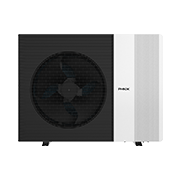
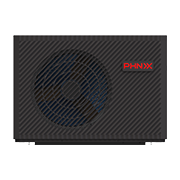
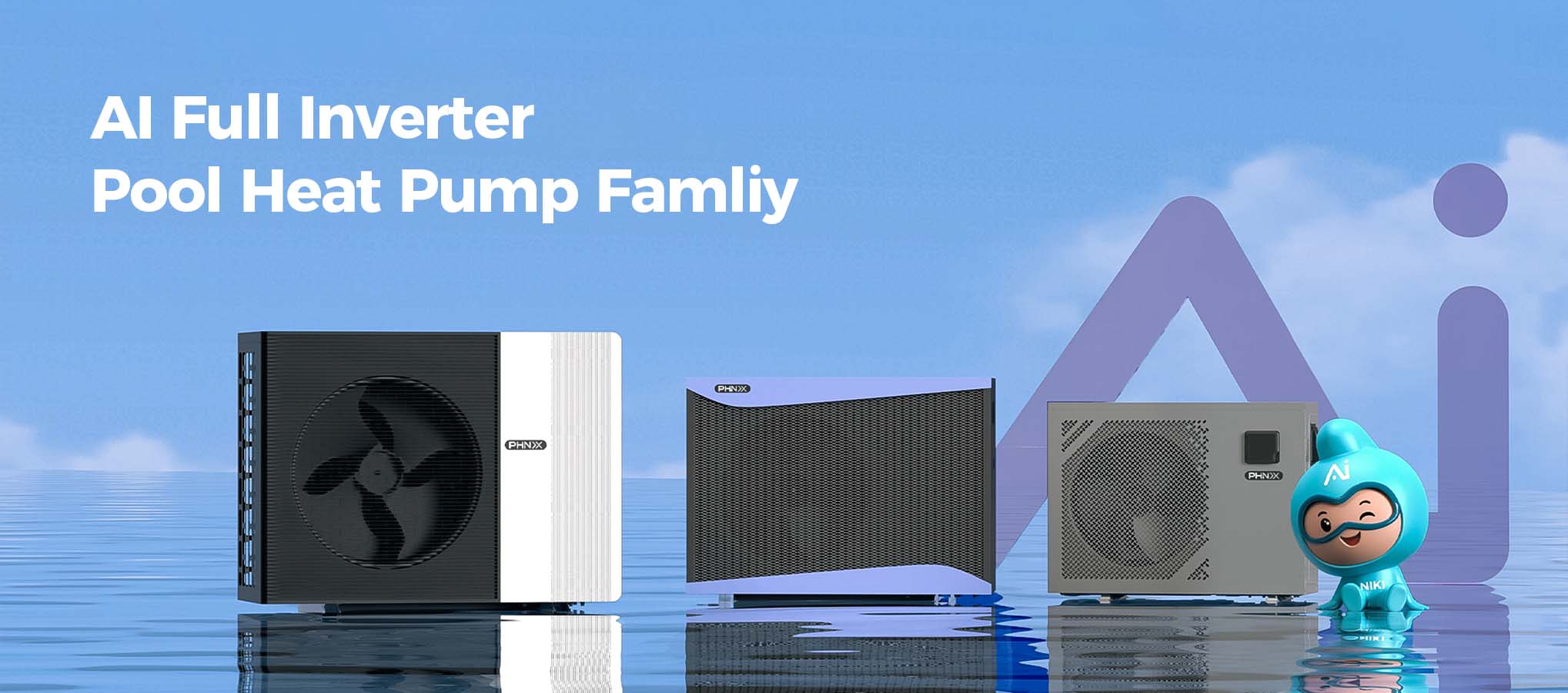
PHNIX i-GreenLine Ultra is an R290 inverter swimming pool heat pump built for this kind of variable load operation, and the PHNIX AI Full Inverter control platform is trained on data from more than 30,000 operating units, with energy savings of over 35 percent claimed for pool applications compared with conventional inverter control. The full pool range, including the R32 i-ForceLine models, is set out on the PHNIX swimming pool heat pump category page.
Once capacity is settled, the refrigerant question follows, and it is now a regulatory question as much as a technical one. The current EU framework is Regulation (EU) 2024/573, which applied from 11 March 2024 and repealed Regulation 517/2014, with global warming potential values taken from the IPCC Sixth Assessment Report. Under that regulation R290 has a GWP100 of 0.02 and R32 has a GWP100 of 675, with R32 subject to the HFC quota system. Annex IV places placing on the market restrictions from 1 January 2027 on self-contained heat pumps up to 12 kW containing refrigerant with GWP of 150 or above, and on split air-to-water units up to 12 kW on the same date, with a full fluorinated gas restriction on self-contained units up to 12 kW from 1 January 2032.
Refrigerant charge limits themselves are set by the refrigerant lower flammability limit and the room or installation volume under EN 378 and IEC 60335-2-40 (7th edition, 2022). Confirm the actual clearance requirements with local installation rules and the manufacturer's manual rather than with a generic figure. Rated capacity and COP are declared to EN 14511 at stated conditions, while EN 14825 covers part load seasonal performance, which is why two machines quoting similar headline COP can behave very differently across a real season.
PHNIX manufactures R290 and R32 pool heat pumps alongside its residential and commercial ranges, which are listed across the PHNIX product portfolio. PHNIX holds CE, UKCA, Keymark, AHRI, ETL and ERP certifications, with AHRI performance audits passed at 100 percent compliance for three consecutive years (2023, 2024 and 2025).
Consider a representative European scenario rather than a real installation: a 32 square metre outdoor residential pool, target water temperature 28 degrees Celsius, season from May to September, moderately exposed garden with a low fence on the prevailing wind side. The owner is deciding between a bubble cover used most nights and no cover at all.
The honest way to run this comparison is not to apply a percentage from a brochure. It is to have the installer calculate the design day surface loss twice, once with the surface exposed and once with it covered, using local design air temperature, humidity and wind data, then convert each to a required capacity and an estimated seasonal run hour figure. Only then do you apply an electricity price. For a European comparison, Eurostat reports an EU27 average household electricity price of 0.2896 EUR per kWh including taxes for the second half of 2025 in the 2,500 to 5,000 kWh annual consumption band, so 0.29 EUR per kWh is a defensible planning figure. Multiply estimated seasonal electrical input for each case by that tariff and you have a comparison built from stated assumptions rather than from a claim.
What you can say with confidence, without any invented number, is the direction: the covered case requires less capacity, fewer run hours and less make-up water, and the gap widens as wind exposure and target temperature increase.
Q: Should I size the heat pump as if the pool will always be covered?
A: No. Size for the realistic worst case you are willing to live with, which for most households means an uncovered daytime load plus a covered overnight assumption only if the cover is automatic. If the cover is manual, assume it will be forgotten regularly and choose an inverter unit that can modulate down when it is actually used.
Q: Does a bubble cover work as well as a solid or slatted cover for reducing evaporation?
A: Any cover in contact with, or sealing over, the water surface interrupts evaporation, which is the dominant term. The differences between cover types show up more in handling convenience, radiation behaviour, solar gain and durability than in whether evaporation is suppressed at all. Choose the type you will actually use every day.
Q: Will a cover let me buy a smaller heat pump and save money?
A: It reduces the calculated load, so in principle yes, but be careful. Undersizing against the uncovered condition means slow recovery after a swim or a cold spell. The safer route is to keep sensible capacity headroom and take the benefit as shorter run hours and lower energy use rather than as a smaller machine.
Evaporation, not compressor technology, is the biggest lever on a pool's heat load, and a cover is the only intervention that attacks four loss paths at once. That makes the cover decision a sizing input, not an afterthought. Decide the cover strategy first, have the load calculated for both the covered and uncovered cases, and insist on knowing which assumption the quoted capacity is based on. Then choose equipment that can cope with the gap between the two, which in practice means inverter modulation rather than fixed speed switching. PHNIX i-GreenLine Ultra is an R290 inverter pool heat pump designed for variable seasonal pool loads in European installations, and PHNIX, founded in 2002 in Guangdong, exports heat pumps to more than 90 countries with over 60 percent of revenue from overseas markets.

Guangdong PHNIX Eco-energy Solution Ltd.
Tel: +86-4009-4009-00
Address: NO.3 Tianyuan Road, Dagang Town,
Nansha, Guangzhou, Guangdong, PR. China.