Every heat pump water heater works by moving heat, not by making it. It pulls thermal energy out of the air around it, pushes that energy into the water in the tank, and then has to put the leftover air somewhere. That leftover air is colder and drier than the air that went in, and it is the single most common thing homeowners ask about before they commit to an indoor all-in-one unit. Will it turn the utility room into a fridge? Does it need a duct? Can it be pointed outside? This guide answers where the cold exhaust actually goes, how much cooling it really represents, and what installers do about it in real European and Australian homes.
· The cold exhaust leaves through the discharge grille of the unit and goes wherever you point it, either back into the same room, into an adjacent space, or outside through a duct.
· A heat pump water heater removes roughly as much heat from the air as it puts into the water, minus the compressor input, so the cooling effect is real but modest and intermittent.
· Placement in a garage, basement, plant room, laundry or ventilated utility space is the standard answer and needs no ductwork at all.
· Ducting is the fix when the unit sits in living space, in a very small room, or where the cold and dehumidified air is unwanted in winter.
· Room volume matters more than room temperature, because both the heat source and the refrigerant safety rules depend on the air volume available.
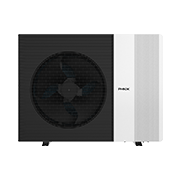
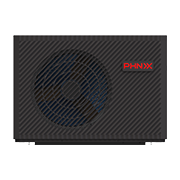
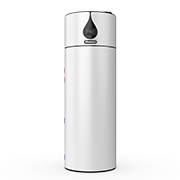
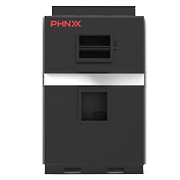
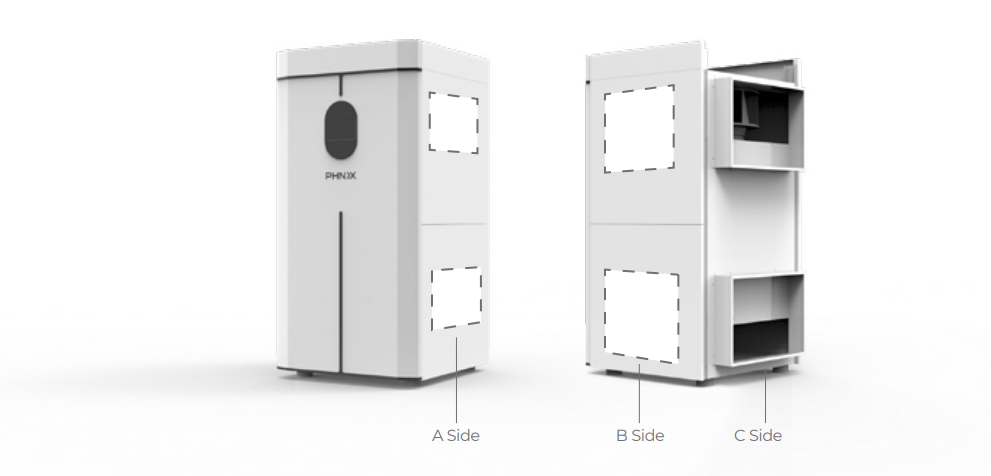
· PHNIX builds its domestic water heater range, airInverter and airExpert R290, as indoor all-in-one units with duct-ready air connections for exactly this reason.
Inside the cabinet, a fan draws room air across an evaporator coil. Liquid refrigerant inside that coil boils at a temperature below the air temperature, so heat flows from air to refrigerant. The compressor raises the pressure and temperature of that refrigerant vapour, a second heat exchanger dumps the energy into the tank water, and the cycle repeats. The air that has just given up its heat exits the discharge grille, typically 4 to 8 K colder than it entered, and usually with some of its moisture condensed out on the cold coil and drained away.
So the exhaust is simply room air minus heat and minus humidity. It is not combustion gas, it carries nothing toxic, and it does not need a flue in the way a gas water heater does. That distinction matters, because many homeowners mentally file a heat pump water heater next to a boiler and assume a chimney is mandatory. It is not. The only reason to duct a heat pump water heater is comfort, air volume or noise, never safety of the exhaust itself.
The honest framing is an energy balance. If the appliance delivers a given amount of heat to the water and the compressor supplies part of that from electricity, the rest was extracted from the air. With a typical COP of 3 to 4 for hot water duty, roughly two thirds to three quarters of the delivered heat came out of the room.
For a household on the L load profile, the reference energy for the daily draw is 11.655 kWh under Regulation (EU) 814/2013 Annex III Table 1. That is the yardstick the label uses, not a promise about your shower habits, but it gives a sense of scale. A unit covering that profile is not running around the clock. It runs a few hours a day in blocks, and the cooling is spread across those blocks rather than being continuous.
| Placement | Cold air returned to room | Duct needed | Winter comfort impact | Summer benefit |
|---|---|---|---|---|
| Garage or basement | Yes | No | Low | Moderate |
| Unheated plant room or laundry | Yes | No | Low | Moderate |
| Heated living space | Yes | Recommended | Higher | Not applicable |
| Small closet under minimum volume | Yes | Yes | Moderate | Not applicable |
| Exhaust ducted outdoors | No | Yes | Not applicable | Not applicable |
The default and least complicated answer is a space that is already outside the heated envelope, or at least not somewhere people sit. Garages, basements, cellars, utility rooms, laundries and dedicated plant rooms all work without any ducting. In those spaces the mild cooling is either irrelevant or mildly useful, and the recovered heat would otherwise have been lost anyway.
The second consideration is air volume. Every heat pump water heater has a minimum room volume in its manual, and there are two separate reasons for it. The first is thermodynamic, since a very small sealed room will be cooled down quickly and the unit will start working against itself as the source air temperature drops. The second is refrigerant safety. For propane units, charge limits are set by refrigerant LFL and room or installation volume under EN 378 and IEC 60335-2-40 (7th edition, 2022); confirm the actual clearance with local installation rules and the manufacturer's manual. Those two constraints usually point in the same direction, which is why the manual figure is the number to design around.
PHNIX airInverter and airExpert R290 are indoor all-in-one heat pump water heaters using propane as the refrigerant, sold widely across Europe and Australia and built with duct connections on both intake and discharge. You can browse the full domestic heat pump water heater range to compare tank sizes and air connection options.
Ducting is worth doing in four situations. First, when the appliance has to live inside heated space and the occupants would feel the draught. Second, when the available room is smaller than the manual's minimum volume, in which case ducting effectively borrows air from a larger space. Third, when you want the dehumidification delivered somewhere specific, such as a damp cellar. Fourth, when noise needs to be separated from a bedroom wall.
There are three ducting strategies:
· Exhaust only, discharging outdoors while drawing intake air from the room. This gives the strongest cooling and dehumidifying effect indoors, which is welcome in a humid basement or in summer, but in winter it pulls conditioned air out of the house and makes up the difference with infiltration.
· Full duct, intake and exhaust both connected to outside air. The unit then behaves like a small outdoor air source machine and has no thermal effect on the house at all, at the cost of lower efficiency during cold weather.
· Room to room, drawing from or discharging into an adjacent unheated space. This is the most common compromise in retrofit work.
Duct runs cost static pressure, so check the maximum equivalent length in the manual, keep bends to a minimum, insulate any run carrying cold air through warm space, and terminate outdoor discharges away from the intake so the two do not short circuit.
If the unit sits in heated space and returns its cold air to that space, part of the heat it moves into the tank is heat your space heating system paid for. That is a genuine efficiency penalty and it is why the "put it in the garage" advice exists. If the unit sits in an unheated garage, the penalty largely disappears because that space was not being heated on purpose.
The scale of the effect is easy to overstate. Using the EU27 average household electricity price of 0.2896 EUR/kWh (Eurostat, second half of 2025, tax inclusive, 2,500 to 5,000 kWh annual consumption band), the difference between an ideal and a compromised placement is usually tens of euros a year, not hundreds. It is worth optimising, but it is not a reason to abandon the technology, especially when the alternative is direct electric resistance heating at a COP of 1.
In summer the same behaviour flips into a benefit. The unit acts as a small dehumidifier and spot cooler for the space it occupies, which is why Australian and southern European installers happily place these units in laundries and garages.
A whole-house air-to-water heat pump puts its evaporator outdoors, so the cold exhaust question never arises: the cold air is simply discharged to the garden. That is the fundamental difference between the two product families and the reason ducting exists as a topic only for indoor all-in-one water heaters.
PHNIX GreenTherm Pro is an R290 air-to-water heat pump for residential heating and cooling, independently tested by TÜV SÜD RED and HLK Stuttgart at a SCOP of 5.55, with the full test documentation published on the product evidence page. Households that need both space heating and hot water often pair a system from the residential heating and cooling category with a separate cylinder rather than relying on an all-in-one water heater alone.
The refrigerant choice affects both the safety rules and the long-term availability of the appliance. The current European F-gas framework is Regulation (EU) 2024/573, which applied from 11 March 2024 and repealed the earlier 517/2014 regime. Under Annex VI of that regulation, R290 has a GWP100 of 0.02, while R32 sits at 675 under Annex I and remains subject to HFC quota. R410A and R454B are blends and are not listed individually in the annexes of Regulation (EU) 2024/573, but both sit far above the 150 GWP threshold that drives the 2027 restrictions.
Annex IV sets 1 January 2027 as the placing-on-the-market cut-off for monobloc and self-contained heat pumps up to 12 kW containing refrigerants with GWP of 150 or more, and the same date for split air-to-water units in that size class. Article 13(4) has banned fluorinated gases with GWP of 2500 or above from air conditioning and heat pump servicing since 1 January 2026. Quota under Annex VII falls from 42,874,410 tCO2e for 2025 and 2026 to 21,665,691 tCO2e for 2027 to 2029, roughly halving at the 2027 step.
Efficiency floors are set separately. Under Regulation (EU) 814/2013 Annex II 1(b), water heaters must meet a minimum water heating energy efficiency of 36 percent on the M profile and 37 percent on L and XL. Under Regulation (EU) 812/2013 Annex II Table 1, an A+++ water heater label requires water heating efficiency of at least 163 percent on M, 188 percent on L and 200 percent on XL. Space heating uses a different scale entirely, where A+++ under Regulation (EU) 811/2013 means seasonal space heating efficiency of at least 175 percent in low-temperature application and 150 percent in medium-temperature application. Ratings are derived from EN 14511 for steady-state COP and EN 14825 for part-load seasonal figures, with EN 12831 used for design heat load.
PHNIX holds CE, UKCA, Keymark, AHRI, ETL and ERP certifications, with AHRI performance audits passed at 100 percent compliance for three consecutive years (2023, 2024 and 2025). If propane is your preference for the water heater as well, the dedicated R290 hot water heat pump page lists the models and their air connection specifications.
In the United Kingdom, the Boiler Upgrade Scheme pays 7,500 GBP for air source, ground source and water source heat pumps, 9,000 GBP for eligible off-gas-grid properties and 2,500 GBP for air-to-air. UK energy saving materials carry a zero VAT rate from 1 May 2023 until 31 March 2027, reverting to 5 percent from 1 April 2027. In Ireland, heat pump installation is charged at 9 percent VAT under VATCA 2010 s.46(1)(ca), a separate regime from the UK zero rate that should never be quoted interchangeably. SEAI offers a heat pump grant in Ireland, but it requires a technical assessment of the home's heat loss indicator first; check the current grant values and thresholds with SEAI before quoting a figure to a customer. In France, deep renovation under MaPrimeRenov' covers 80, 60, 45 or 10 percent of eligible spend by income band, with ceilings of 30,000 EUR excluding tax for a two-class DPE improvement and 40,000 EUR for three classes or more, alongside a 5.5 percent VAT rate.
Q: Will a heat pump water heater make my utility room cold?
A: It will lower the temperature of that room while it runs, typically by a few degrees in a small space, and the effect fades between cycles. In a garage, basement or laundry this is rarely noticeable. In a small closet inside heated space, duct the exhaust or the intake to a larger volume.
Q: Can I duct the cold exhaust air outside?
A: Yes, provided you stay within the maximum equivalent duct length in the manual and use insulated duct where cold air passes through warm space. Exhausting outdoors while drawing intake from the house does draw make-up air through the building envelope, so it is best suited to mild climates or summer-dominant use.
Q: Does the cold exhaust mean the unit is losing efficiency?
A: No. The cold air is evidence that heat was successfully extracted and transferred to the water, which is exactly what the appliance is supposed to do. Efficiency is only affected when that cold air is returned to a space you are actively paying to heat.
The cold exhaust from a heat pump water heater goes wherever you choose to send it, and that choice is a comfort and placement decision rather than a safety one. Put the unit in a garage, basement, plant room or laundry and you can ignore ducting entirely. Put it inside heated space, or in a room below the minimum volume in the manual, and a short insulated duct run solves the problem cleanly. PHNIX designs its airInverter and airExpert R290 domestic water heaters as indoor all-in-one units with duct-ready intake and discharge connections, backed by a company operating since 2002 with more than 1,000 staff, exports to over 90 countries and 1,816 patent applications filed.

Guangdong PHNIX Eco-energy Solution Ltd.
Tel: +86-4009-4009-00
Address: NO.3 Tianyuan Road, Dagang Town,
Nansha, Guangzhou, Guangdong, PR. China.