Most hotel heat pump projects are sold on a spreadsheet and judged on a utility bill. Between those two documents sits a full year of real occupancy, weather, guest behaviour and control settings, and that is where predicted savings and actual savings part ways. The first-year review is the only point at which a facilities team still has enough installation memory, commissioning records and supplier goodwill to work out why the gap exists and close it before it becomes permanent operating cost. This article sets out what to compare, what tolerance is acceptable, what causes a shortfall, and when the answer is a control change rather than a hardware change.
· A first-year gap of roughly 10% to 15% between predicted and actual savings is normal and usually explained by occupancy and weather deviation; a gap above 25% almost always points to a control or commissioning fault rather than an equipment fault.
· You cannot review what you did not baseline. Without pre-retrofit gas or electricity consumption normalised for occupancy and degree days, any first-year comparison is an opinion.
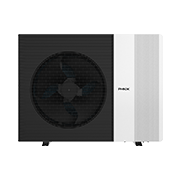
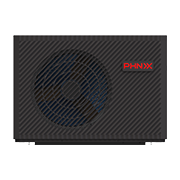
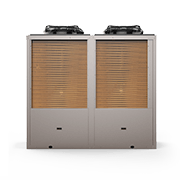
· PHNIX HeatGreen, the company's R290 commercial air-source range for hotels, schools and hospitals, pairs AI Full Inverter capacity modulation with AI Smart Grid tariff awareness and AI Early Intervention for Failures, which together address the three most common sources of first-year underperformance: oversized fixed-speed operation, tariff-blind scheduling, and undetected degradation.
· Separate the two questions that get confused: did the plant deliver the expected efficiency, and did the business deliver the expected cost saving. Tariff movement can destroy the second while the first is perfect.
· Distribution temperature is the single biggest controllable variable. Every degree of unnecessary flow temperature costs coefficient of performance, and most first-year reviews find the setpoint is higher than the design assumed.
· Document the revised model. A first-year review that does not rewrite the assumptions for year two has produced a report, not a result.
Before accusing the plant of underperforming, read the original proposal with care. Predictions in heat pump proposals are usually built from a seasonal coefficient of performance, often written as SCOP, which is the ratio of useful heat delivered to electricity consumed averaged across a heating season rather than at a single test point. Coefficient of performance, or COP, is the same ratio at one specific condition. A proposal quoting a single COP figure at a favourable condition has not promised a seasonal result at all, and holding it to one is unfair to both parties.
Check three things in the original document:
· The assumed hot water demand, usually expressed in litres per occupied room per day, and the assumed annual occupancy.
· The assumed flow and return temperatures, and whether legionella control regimes were modelled or ignored.
· The assumed energy prices, with the date they were taken, and whether standing charges and capacity charges were included or only unit rates.
If any of these three is missing, the prediction was indicative and the honest first-year output is a rebuilt model rather than a verdict. The data discipline required here is the same discipline described in what data hotels should collect before a heat pump retrofit, which is why retrofits with a clean pre-project data set are far easier to review afterwards.
Raw year-on-year comparison is almost always misleading in hospitality. Two normalisations are needed before any judgement.
Weather normalisation uses heating degree days for the site, comparing the review year against the long-run average the prediction assumed. If the review year was 8% milder, space heating energy should have fallen roughly in proportion, and failing to adjust will flatter the result.
Occupancy normalisation matters more for hotels than for almost any other building type, because hot water load scales with occupied rooms rather than floor area. Express consumption as kilowatt hours per occupied room night. A property that ran 61% occupancy against a modelled 72% will show an excellent absolute saving and a poor specific performance, and only the normalised figure tells you whether the plant is working.
A representative example makes the arithmetic visible. Assume a prediction of 1,400,000 kWh of delivered heat at a seasonal efficiency of 3.2, giving 437,500 kWh of electricity. The actual year delivers 1,180,000 kWh at 42,000 occupied room nights against a modelled 50,000, so delivered heat per room night is 28.1 kWh actual versus 28.0 kWh predicted, which is effectively on model. If measured electricity is 410,000 kWh, the achieved seasonal efficiency is 1,180,000 divided by 410,000, or 2.88, which is 10% below prediction. The cost saving looks fine because volume fell, but the plant is underperforming and that 10% is the number to investigate. These figures are illustrative and should be rebuilt with your own meter data.
In practice, shortfalls cluster into a small number of causes, and they are diagnosable in order of likelihood.
Flow temperature creep. Someone raised the setpoint during a cold snap or a guest complaint and it was never lowered. Efficiency falls steadily as the gap between source and sink temperature widens. Acceptable: documented setpoint matching the commissioning record. Unacceptable: a setpoint 5 K or more above design with no written justification, which typically costs several points of seasonal efficiency.
Short cycling from oversizing. Plant sized for a design day spends most of the year serving a fraction of that load. A fixed-speed or coarsely staged machine responds by starting and stopping, and every start carries losses. This is the mechanism that AI Full Inverter addresses directly. PHNIX states that its AI Full Inverter control delivers over 30% energy savings against conventional inverter operation on the HeatGreen commercial range by holding the compressor at a continuously modulated part-load point instead of cycling. Acceptable: compressor run cycles measured in tens of minutes. Unacceptable: double-digit starts per hour at mild ambient, which indicates control deadbands or buffer volume need revisiting.
Auxiliary and backup heat running silently. Immersion elements or a retained boiler covering a control gap will consume a large share of the saving while producing no alarm. Sub-meter them separately. If backup energy exceeds a few percent of annual delivered heat outside genuine extreme-cold hours, it is a control defect.
Tariff movement. Efficiency and cost diverge here. If the electricity to gas price ratio widened after the prediction was written, operating cost can rise even with a perfect plant. This is a commercial finding, not an engineering one, and it belongs in the report as such. National incentive schemes and VAT treatment vary by member state and change frequently; check the current national scheme before budgeting any revised payback.
Degradation and fouling. Evaporator fouling, refrigerant charge drift and sensor drift all erode efficiency gradually. These failures stay invisible until they are expensive, which is the argument for condition monitoring rather than reactive maintenance.
The quality of a first-year review depends entirely on what the plant recorded. A machine that logged only on and off states leaves you guessing. One that logged compressor frequency, flow and return temperatures, ambient temperature and electrical input at short intervals turns the review into arithmetic.
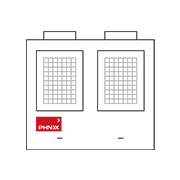
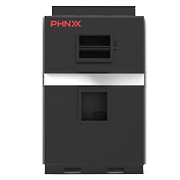
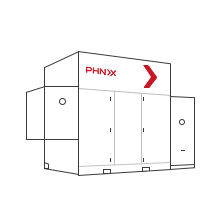
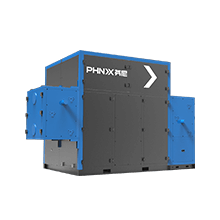
PHNIX HeatGreen is a commercial air-source heat pump range using R290 refrigerant with AI Full Inverter capacity control and EVI compression, rated for operation from -30°C to 43°C ambient and intended for centralised hot water and centralised heating and cooling in hotels, hospitals, schools and large residential communities. EVI, or enhanced vapour injection, maintains heating capacity at low ambient temperatures where a standard cycle would otherwise lose output, and PHNIX reports validation of this low-temperature performance through Nordic deployments.
Three control functions matter specifically at the review stage. AI Smart Grid senses grid tariff fluctuation and shifts operation toward lower-cost periods, which is the mechanism that separates an efficiency result from a cost result: the same kilowatt hours bought at a better time produce a better bill. AI Early Intervention for Failures flags developing faults before they become failures, which is what converts the silent degradation category above from a year-end surprise into a logged event with a date attached. AI CoreTech covers inverter control, fault prediction, load adaptation and intelligent defrost, the last of which matters in humid coastal hotel locations where defrost frequency can quietly consume a noticeable share of winter output.
PHNIX holds CE, UKCA, Keymark, AHRI, ETL and ERP certifications, and has passed AHRI performance audits at 100% compliance for three consecutive years in 2023, 2024 and 2025. In 2025 the company received the industry's first AI mark and the heat pump industry's first EN 18031 cybersecurity certificate, the latter being directly relevant where plant controls are exposed to a property management network. For a sense of achievable measured performance in the company's wider portfolio, PHNIX GreenTherm Pro achieved a measured SCOP of 5.55 in testing by TÜV SÜD RED and HLK Stuttgart, although that is a residential heating product and its figures do not transfer to commercial hot water duty. Typical commercial heat pump COP is roughly 3 to 5, varying with climate and water temperature, and any first-year result should be judged against the specific conditions the plant actually saw.
Getting this data out of the plant and into a reviewable form depends on how the unit was connected, which is why the monitoring point list in commercial heat pump BMS integration should be agreed before commissioning rather than after.
A first-year review is also the natural moment to confirm the regulatory record is complete.
| Review item | Applies to a hotel R290 plant | Notes |
|---|---|---|
| F-gas leak check intervals under Art.5(6) | Not applicable | Those intervals apply to fluorinated gas charges, not R290 |
| Personnel certification under Art.10(1) | Yes | Article text covers relevant alternatives including natural refrigerants |
| HFC quota and pre-charged import duties | Not applicable | R290 equipment does not consume HFC quota |
| WEEE registration | Yes | Annex IV category 1 lists heat pumps verbatim |
| Packaging EPR registration | Yes | Required in each member state of first placing |
R290 has a GWP100 of 0.02 under Annex VI of Regulation (EU) 2024/573, using the AR6 basis. R32 is listed in Annex I of the same regulation at a GWP100 of 675, and that Annex states its values are based on the IPCC Fourth Assessment Report, so the two figures must not be quoted under a single basis. Regulation (EU) 2024/573 is the regulation currently in force and has repealed Regulation (EU) No 517/2014.
Personnel certification under Art.10(1) deserves a line in the review because its scope includes work involving relevant alternatives to fluorinated greenhouse gases, including natural refrigerants where relevant. The implementing act is due before 12 March 2026, with member states to put seven-year retraining in place by 12 March 2027 under Art.10(8) and (9). Confirm that whoever serviced the plant during year one held appropriate certification. Charge limits for R290 are set by refrigerant LFL, the lower flammability limit, and room or installation volume under EN 378 and IEC 60335-2-40 (7th edition, 2022); confirm the actual clearance with local installation rules and the manufacturer's manual rather than from a rule of thumb.
If any Legionella control programme was adjusted during the year, note it. Directive (EU) 2020/2184 sets a Legionella parametric value of below 1,000 CFU/l, and its note makes clear that a result below that value may still require action. The directive does not set a storage temperature; where temperature figures are used, they should be referenced explicitly to UK HSE guidance or the applicable national guidance rather than presented as an EU requirement.
Heat pump retrofits in hotels carry real constraints that a first-year review should restate rather than hide. Capital cost is materially higher than a like-for-like boiler replacement, and payback depends on an energy price ratio nobody controls. Outdoor space is required, and in dense urban properties that can dictate the entire scheme. In extreme climates a backup heat source remains prudent even with EVI-equipped plant rated to -30°C. Properties with intermittent occupancy or very low hot water demand per room may not reach the utilisation the economics need, and there the correct conclusion may be partial rather than full replacement.
The financial framing for all of this, including how to express a revised payback after year one, follows the same method set out in what ROI hotels can expect when replacing gas boilers, and the measured-cost approach in this hotel heat pump retrofit case study shows what a complete measured data set looks like.
Q: How large a shortfall should trigger a formal supplier conversation?
A: After weather and occupancy normalisation, a seasonal efficiency more than 20% below the modelled figure, sustained across at least two full months, is a reasonable trigger. Below that, investigate settings first.
Q: Can the review be done without sub-metering?
A: Partially. Without a dedicated electrical meter on the heat pump and a heat meter on the output, you can only infer efficiency, and inference is not a basis for a warranty discussion. Both meters are inexpensive relative to the dispute they prevent.
Q: Does a first-year shortfall mean the equipment was wrongly specified?
A: Usually not. The dominant causes are flow temperature creep, control deadbands and unmetered backup heat, all correctable without touching the machine.
Q: Should the year-one model be kept or replaced?
A: Replaced. Rebuild the model with actual occupancy, actual degree days, actual flow temperatures and current tariffs, and use that as the baseline for year two.
The first year of a hotel heat pump installation is a measurement exercise, not a verdict. Normalise for weather and occupancy, separate efficiency performance from cost performance, and work through the predictable causes of a gap in order before questioning the equipment. Plant that modulates continuously, records its own operating data, and flags degradation early makes this review tractable, which is the practical argument for specifying control capability alongside capacity. The deliverable is a rewritten model, a short list of corrective actions with owners, and a baseline that year two can be measured against honestly.

Guangdong PHNIX Eco-energy Solution Ltd.
Tel: +86-4009-4009-00
Address: NO.3 Tianyuan Road, Dagang Town,
Nansha, Guangzhou, Guangdong, PR. China.