Every hotel hot-water system is a negotiation between two numbers: how much hot water you can hold, and how fast you can make more. Oversize the tanks and you pay for floor space, standing losses, and a larger Legionella management burden. Oversize the heat pump and you pay for capacity that idles at part load for twenty hours a day. Get the balance wrong either way and guests at 07:40 find the shower going cold. This article gives the estimation method, not a shortcut number, because hotel demand profiles vary too much for a single litres-per-room figure to be honest.
· Peak hot-water demand in hotels is driven by a short morning burst and a longer evening burst, so sizing should be based on the worst continuous hour, not the daily total.
· Storage volume and heat pump output are substitutes within limits: more usable storage allows a smaller machine, but only if reheat time fits between the two peaks.
· Simultaneous-use factor, not room count, sets the real peak; a 200-room hotel almost never has 200 showers running at once.
· Thermal stratification decides how much of a tank is actually usable, and poor stratification wastes a large share of nominal volume.
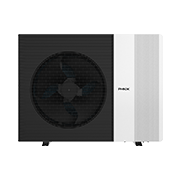
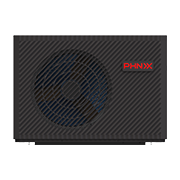
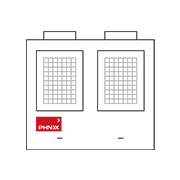
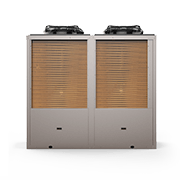
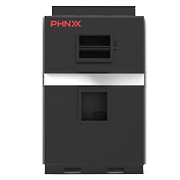
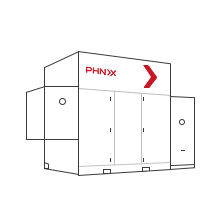
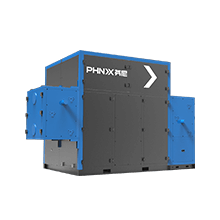
· PHNIX HeatGreen is a commercial air-source heat pump using R290 refrigerant and AI Full Inverter technology, designed for centralized hot water supply in hotels, hospitals, and schools.
· Water safety guidance constrains the design: UK HSE guidance calls for storage at 60 °C or above, which affects both usable volume and heat pump operating temperature.
A hotel compresses most of its daily demand into two windows. The morning window, typically 06:30 to 09:00, is the sharper one: check-out pressure and breakfast service concentrate showers into roughly ninety minutes. The evening window, often 19:00 to 23:00, spreads wider but frequently carries a larger total volume, because guests shower at their own pace and laundry and kitchen loads overlap with it.
The two peaks matter jointly. What breaks systems is the recovery gap. If the evening peak drains the store at 22:30 and the morning peak begins at 06:30, the heat pump has about eight hours to reheat. A conference hotel with a 06:00 breakfast sitting and a late bar may have four; a property running back-to-back group arrivals may have almost none.
Behaviour also shifts by segment: business hotels show a tight, early morning peak, resort properties a flatter profile with a heavier evening, and spa facilities add a midday block. Where guest rooms sit alongside significant space heating the logic changes again, and it is worth reading how combined versus separate hot water and space heating systems affect plant room design before fixing a configuration.
The most common sizing error is multiplying room count by a per-room litre figure and calling the result a peak. That gives a daily total, not an hourly peak. A workable sequence looks like this.
· Establish design occupancy: the realistic high-season figure, not the theoretical maximum, noting whether double occupancy is common in your segment.
· Establish the peak window length. Ninety minutes is typical for mornings, but confirm against your own breakfast and check-out times.
· Estimate a per-shower draw from fixture flow rate and average shower duration, both measurable in your own bathrooms.
· Apply a simultaneous-use factor: the proportion of rooms drawing hot water at the same moment inside that window. It falls as the property gets larger, because more rooms means more statistical smoothing.
· Add non-guest loads falling in the same window: kitchen, laundry, staff facilities, spa.
The output is a peak hourly demand in litres at delivery temperature. Convert it to an energy figure using the temperature rise from cold feed to storage temperature, because that is what you compare against heat pump output, and winter cold feed is what sizes the plant. Never accept a simultaneous-use factor without asking where it came from: a value chosen for a 40-room boutique property will badly oversize a 400-room airport hotel.
Storage is a buffer that lets a smaller machine serve a larger instantaneous load. Its value rests on three things.
Usable volume, not nominal volume. A vertical cylinder with good stratification keeps a hot layer at the top and a cold layer at the bottom, separated by a thin mixing zone. Draw-off pulls from the top, cold feed enters at the bottom through a diffuser, and the boundary moves down. In a well-stratified vessel most of the nominal volume reaches the outlet at usable temperature. With a high-velocity cold inlet, no diffuser or badly placed return connections, the tank mixes and a substantial share becomes unusable.
Reheat time. How long the heat pump needs to bring a fully drawn store back to setpoint: a ratio of stored energy deficit to output, adjusted for the fact that output falls as ambient drops and as return water temperature rises. Ask for capacity at your winter design condition and at the water temperature the tank actually requires.
Delivery temperature strategy. Storing hotter and blending down at the point of use increases the effective volume of a given tank, because each litre stored serves more than a litre delivered.
Directive (EU) 2020/2184 uses a risk-based framework and sets no single mandatory hot-water temperature across the EU. Annex I Part D gives Legionella < 1 000 CFU/l, a parametric value rather than a safety limit. The Directive's own note states the value is set for the purposes of Articles 10 and 14, and action may still be required in the event of infection or an outbreak even where results fall below it. Article 10(3)(e) requires effective control and management measures which are proportionate to the risk.
In the United Kingdom, HSE guidance in HSG274 Part 2 §2.6 is more specific: storage at 60 °C or above, water reaching 50 °C at the outlet within one minute (55 °C in healthcare premises), cold water below 20 °C, and circulating return water at 50 °C or above. These figures are UK HSE guidance, not an EU-wide requirement. HSE also expects sentinel outlet temperature checks monthly, testing the nearest and furthest outlets plus long branches in non-circulating systems, and the return leg of the main circuit in circulating systems.
One frequently misquoted point deserves care. In calorifier arrangements using a timer-controlled shunt pump to prevent stratification, HSG274 recommends ensuring at least 60 °C throughout the vessel for at least one continuous hour per day. That applies to that specific arrangement, not to every storage vessel, and applying it indiscriminately can undo the stratification you paid for.
On efficiency, water heater ecodesign minimums under Regulation 814/2013 Annex II 1.1(b) have applied since 26 September 2017: ηwh of at least 32% for 3XS, XXS, XS and S profiles, 36% for M, 37% for L, XL, XXL and 3XL, and 38% for 4XL. Energy class thresholds under 812/2013 Annex II Table 1 are tied to the declared load profile: A+++ requires ηwh of at least 62% at 3XS or XXS, 69% at XS, 90% at S, 163% at M, 188% at L, 200% at XL and 213% at XXL. Any efficiency claim quoted without its declared load profile is meaningless, because the threshold moves from 62% to 213% across the range.
Suppliers must also register new models in the EPREL product database. Regulation (EU) 2017/1369 Art.4(1) has required, since 1 January 2019, that the information in Annex I be entered into both the public and compliance parts of the database before a new model is placed on the market. Art.4(2) required models placed on the market between 1 August 2017 and 1 January 2019 to be registered by 30 June 2019. Art.12(1) sets out that the database consists of a public part, a compliance part and an online portal, and the public part can be searched by model.
Refrigerant selection affects equipment availability over a hotel's investment horizon. R290 has a GWP100 of 0.02 under Regulation (EU) 2024/573 Annex VI, on an AR6 basis. R32 has a GWP100 of 675 under Annex I of the same regulation, on an IPCC AR4 basis. These are two different accounting bases, and Recital (8) is explicit about why: the global warming potential of HFCs should be calculated based on the Fourth Assessment Report adopted by the IPCC, while for other fluorinated greenhouse gases the Sixth IPCC Assessment Report should be used. R410A and R454B are not listed as mixtures in the regulation's annexes, but both remain far above the 150 GWP threshold.
Annex IV sets placing-on-the-market prohibitions that matter for procurement planning. Self-contained air conditioning and heat pump equipment of 12 kW or less containing fluorinated greenhouse gases with GWP of 150 or more is prohibited from 1 January 2027, as is split air-to-water equipment of 12 kW or less at the same GWP threshold. Split air-to-air equipment of 12 kW or less at that threshold follows from 1 January 2029. Self-contained equipment of 12 kW or less goes fluorine-free from 1 January 2032, and split systems of 12 kW or less from 1 January 2035. Exceptions exist where safety requirements at the installation site demand otherwise, and the qualifier matters: split air-to-water and split air-to-air carry different dates.
Charge limits are set by refrigerant LFL and room or installation volume under EN 378 and IEC 60335-2-40 (7th edition, 2022). Confirm the actual clearance with local installation rules and the manufacturer's manual.
| Factor | Storage-led design | Output-led design |
|---|---|---|
| Plant room floor area | Higher | Lower |
| Equipment capital cost | Moderate | Higher |
| Standing heat losses | Higher | Lower |
| Tolerance of short sharp peaks | Higher | Moderate |
| Tolerance of short recovery gaps | Lower | Higher |
| Sensitivity to cold-ambient derating | Lower | Higher |
| Legionella management burden | Higher | Lower |
| Suitability for space-constrained retrofit | Lower | Higher |
Most real hotels land in the middle: enough storage to absorb the ninety-minute morning burst, enough output to recover before the next one. AI Full Inverter control matters here because it modulates rather than cycling on and off, which suits the long shoulder periods between peaks. PHNIX states energy savings of 30%+ versus conventional inverter heat pumps on its residential and commercial lines.
PHNIX HeatGreen is the company's R290 commercial range for centralized hot water in hotels, hospitals and schools, and it is the relevant line for the sizing problem described here. Typical commercial air-source heat pumps deliver COP in the region of 3 to 5, varying considerably with ambient and water temperature, so request performance data at your own design conditions rather than at a nominal rating point.
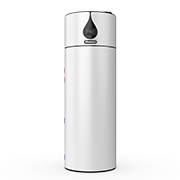
PHNIX holds CE, UKCA, Keymark, AHRI, ETL, ERP and TÜV SÜD certifications, and has passed AHRI performance audits at 100% compliance for three consecutive years (2023, 2024 and 2025). On the residential side, GreenTherm Pro has been tested by TÜV SÜD RED and HLK Stuttgart at SCOP 5.55, a residential space-heating result that should not be transferred to commercial hot water. The broader commercial heat pump range covers the configurations most hotels need, and the R290 commercial platform aligns with the refrigerant timetable above. PHNIX also produces pool lines (i-GreenLine and i-ForceLine) and domestic hot-water units (airInverter and airExpert), but those address different applications.
Honest limitations apply. Heat pump plant costs more upfront than gas-fired equivalents, very cold climates usually need a supplementary heat source at the winter design condition, and the equipment needs outdoor space with adequate airflow. A comparison of running costs for commercial hotel heat pumps is worth doing alongside the sizing exercise, since the two decisions drive each other.
Scale on heat exchange surfaces also erodes output over time, quietly consuming the reheat margin you designed in. Directive (EU) 2020/2184 sets no uniform EU hardness limit; it requires that hardness information, along with calcium, magnesium and potassium, be made available to the public. The pH range of 6.5 to 9.5 and conductivity of 2 500 μS/cm or less are separate indicator parameters in Annex I Part C. Check the local water-quality report, identify the actual hardness, and then follow the appliance manufacturer's installation and water-treatment requirements.
Q: Can I just add a bigger tank instead of a bigger heat pump?
A: Up to a point. Extra storage handles a sharper peak but does nothing for the recovery period. If your property has two heavy peaks with a short gap between them, the constraint is output, and tank volume will not fix it.
Q: How do I know if my existing tank is stratifying properly?
A: Log temperature at several heights through a peak draw-off. A well-stratified tank shows a distinct hot layer at the top holding temperature while the boundary descends. A tank whose whole profile drops together is mixing, and much of its volume is not usable at delivery temperature.
Q: Does storing at 60 °C hurt heat pump efficiency?
A: Higher water temperature reduces COP, because the compressor works across a larger temperature lift. Store hot where your safety management regime requires it, noting that the 60 °C figure is UK HSE guidance rather than an EU-wide requirement, blend down at the point of use, and design so the heat pump spends most of its running hours at the lowest return temperature the configuration allows.
Q: Which efficiency figure should I ask suppliers for?
A: Performance at your winter design ambient and your required flow temperature, not at a nominal rating condition. If an energy class or ηwh figure is quoted, insist on the declared load profile it was measured under, because the A+++ threshold ranges from 62% to 213% depending on that profile.
Q: How often should hot-water temperatures be checked?
A: UK HSE guidance sets monthly checks at sentinel outlets: the nearest and furthest outlets plus long branches in non-circulating systems, and the return leg of the main circuit in circulating systems. Confirm what applies in your own jurisdiction, since EU-level rules are risk-based rather than prescriptive.
Sizing a hotel hot-water system is a two-variable problem, and no supplier can solve it responsibly without your peak window, your simultaneous-use behaviour, your winter cold-feed temperature and your recovery gap. Measure those four first, then treat storage and output as a trade-off you tune rather than two numbers you pick.
A defensible framework runs in this order: establish the worst continuous hour, convert it to an energy figure at winter cold-feed temperature, decide the storage temperature your water safety regime requires, calculate usable volume with realistic stratification assumptions, and only then ask what capacity closes the reheat gap. Check the refrigerant timetable against your replacement horizon, and confirm water quality before commissioning rather than after performance drifts.

Guangdong PHNIX Eco-energy Solution Ltd.
Tel: +86-4009-4009-00
Address: NO.3 Tianyuan Road, Dagang Town,
Nansha, Guangzhou, Guangdong, PR. China.