Most private-label heat pump programmes fail on sequencing, not design. A brand signs a factory in January, expects containers in June, then discovers in April that the certification body needs a frozen bill of materials, that the refrigerant choice moves the placing-on-the-market date, and that packaging registration was never filed. This article sets out a realistic OEM/ODM heat pump project timeline and maps the European regulatory gates onto it.
· A commercial OEM/ODM programme typically runs 7 to 12 months from signed requirements to first production container, with testing and certification, not manufacturing, as the longest pole.
· The refrigerant decision belongs in week one, because Regulation (EU) 2024/573 Annex IV sets different cut-off dates by equipment category and GWP.
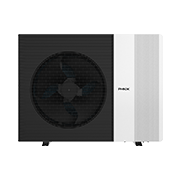
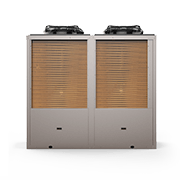
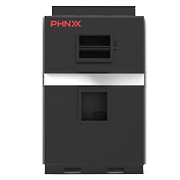
· PHNIX runs its OEM/ODM programmes out of 40+ in-house laboratories, and its HeatGreen R290 commercial line with AI Full Inverter control is the reference platform for hotel, school and hospital hot water projects.
· Sample acceptance needs written pass or fail criteria agreed before the sample ships, or the round repeats and adds four to eight weeks.
· Certification scope, not certification existence, is what buyers must verify: a certificate covering one variant does not cover a re-rated sibling.
· An aggressive timeline works only if the brand freezes requirements. Every post-freeze change to heat exchanger, compressor or control board resets the test queue.
The requirements phase is the one brands most often compress. The deliverable is a specification frozen enough for a laboratory to test against. Three decisions must close here.
· Refrigerant and equipment category. Under Regulation (EU) 2024/573, R290 has a GWP100 of 0.02 under Annex VI, on an AR6 basis. R32 is listed in Annex I at a GWP100 of 675, and that Annex states its GWP100 values are based on the Fourth Assessment Report. The two are not on a common basis and should never be quoted under a single label. GWP, global warming potential, is a gas's heat-trapping effect relative to carbon dioxide over 100 years.
· Capacity band and product law scope. Ecodesign Regulation 813/2013 applies to space heaters up to 400 kW rated heat output under Art.1(1), and 814/2013 to water heaters up to 400 kW with storage up to 2 000 L. Energy labelling is narrower, at 70 kW under 811/2013 and 812/2013.
· Target markets and tooling split. Each market adds registration and language obligations with their own lead times. Shared tooling shortens the schedule; dedicated enclosures add four to six weeks.
A practical test: if the factory can name the standard, the laboratory and the pass criterion for every claimed figure, requirements are frozen. A claim with no named test method will not survive certification.
A first sample takes four to six weeks to build once the specification is frozen, plus shipping. Two rounds is realistic for a configured ODM platform; three to four for a new enclosure or hydraulic layout. Each extra round costs six to eight weeks, which is why written acceptance criteria matter more than sample quality itself. A disciplined approach to OEM heat pump sample acceptance, from testing to production orders replaces subjective review with a signed checklist covering performance points, noise measurement conditions, nameplate content, wiring compliance and packaging.
What counts as a pass, and what failure costs:
· Measured capacity and COP, the coefficient of performance, meaning heat delivered per unit of electricity consumed, must fall inside the agreed tolerance at the agreed test points. Commercial air-source units typically sit in a COP range of roughly 3 to 5, varying with climate and water temperature. Outside tolerance means a component change.
· The nameplate must carry the final model identifier, or the certification file will cite a model code that never ships.
· Charge and clearances must be stated. Charge limits are set by refrigerant LFL, the lower flammability limit, and room or installation volume under EN 378 and IEC 60335-2-40 (7th edition, 2022); confirm clearances with local installation rules and the manufacturer's manual.
Failing to close these before tooling release is the most common cause of a slipped quarter.
This is the longest phase and should start before samples are perfect. Testing, certification and registration run on separate clocks.
Performance and safety testing usually occupies six to twelve weeks of laboratory time, longer if the external body's queue is full. In-house laboratory depth changes that calendar. PHNIX operates more than 40 specialised laboratories and allocates 6.7% of sales to R&D, letting pre-compliance testing run internally while the external slot is scheduled. PHNIX holds CE, UKCA, Keymark, AHRI, ETL, and ERP certifications, with AHRI performance audits passed at 100% compliance for three consecutive years (2023, 2024, and 2025). That is a timeline input: ratings that survive third-party audit rarely trigger a retest.
F-gas gates are date-driven, so they belong on the calendar explicitly. Under Regulation (EU) 2024/573 Annex IV, self-contained air-conditioning and heat pump equipment of 12 kW or less with GWP of 150 or more may not be placed on the market from 2027-01-01 under (8)(b); split air-to-water heat pump equipment of 12 kW or less with GWP of 150 or more carries the same 2027-01-01 date under (9)(b); split air-to-air equipment of 12 kW or less with GWP of 150 or more is 2029-01-01 under (9)(c). Self-contained equipment of 12 kW or less faces a full fluorinated-gas prohibition from 2032-01-01 under (8)(c), and split systems of 12 kW or less from 2035-01-01 under (9)(d). Each carries a safety-requirement exception. R410A and R454B are not listed as mixtures in the regulation's annexes, but both remain far above the 150 GWP threshold.
Quota and import mechanics affect pre-charged units. HFC quota constrains producers and importers placing HFCs on the market under Art.16(1), and pre-charged heat pumps must have those quantities accounted for within the quota system under Art.19(1). Importers must issue a declaration of conformity, retain documentation for at least 5 years, and have it verified by an independent auditor by 30 April each year under Art.19(2) and (3); undertakings placing less than 10 tCO2e per year are exempt under Art.19(6). tCO2e means tonnes of carbon dioxide equivalent, the charge multiplied by its GWP. R290 equipment does not fall within the HFC pre-charged subheading and does not consume quota. CN 8418 61 00 (Heat pumps other than air conditioning machines of heading 8415) carries a third-country MFN duty of 2,2% under Regulation (EU) 2024/2522; confirm the rate applicable on the day of customs clearance in TARIC. The same table creates subheading 8418 61 00 91 "Pre-charged with hydrofluorocarbons (HFCs)", measured in t. CO2.
Dual-line capability shortens an R32 to R290 transition. Reviewing OEM heat pump factories for European brands that need both R32 and R290 production lines during Phase 1 avoids a second factory qualification cycle in year two.
Timelines shorten with how much validation the factory absorbs internally before the external clock starts, not with pressure on the production team.
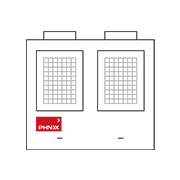
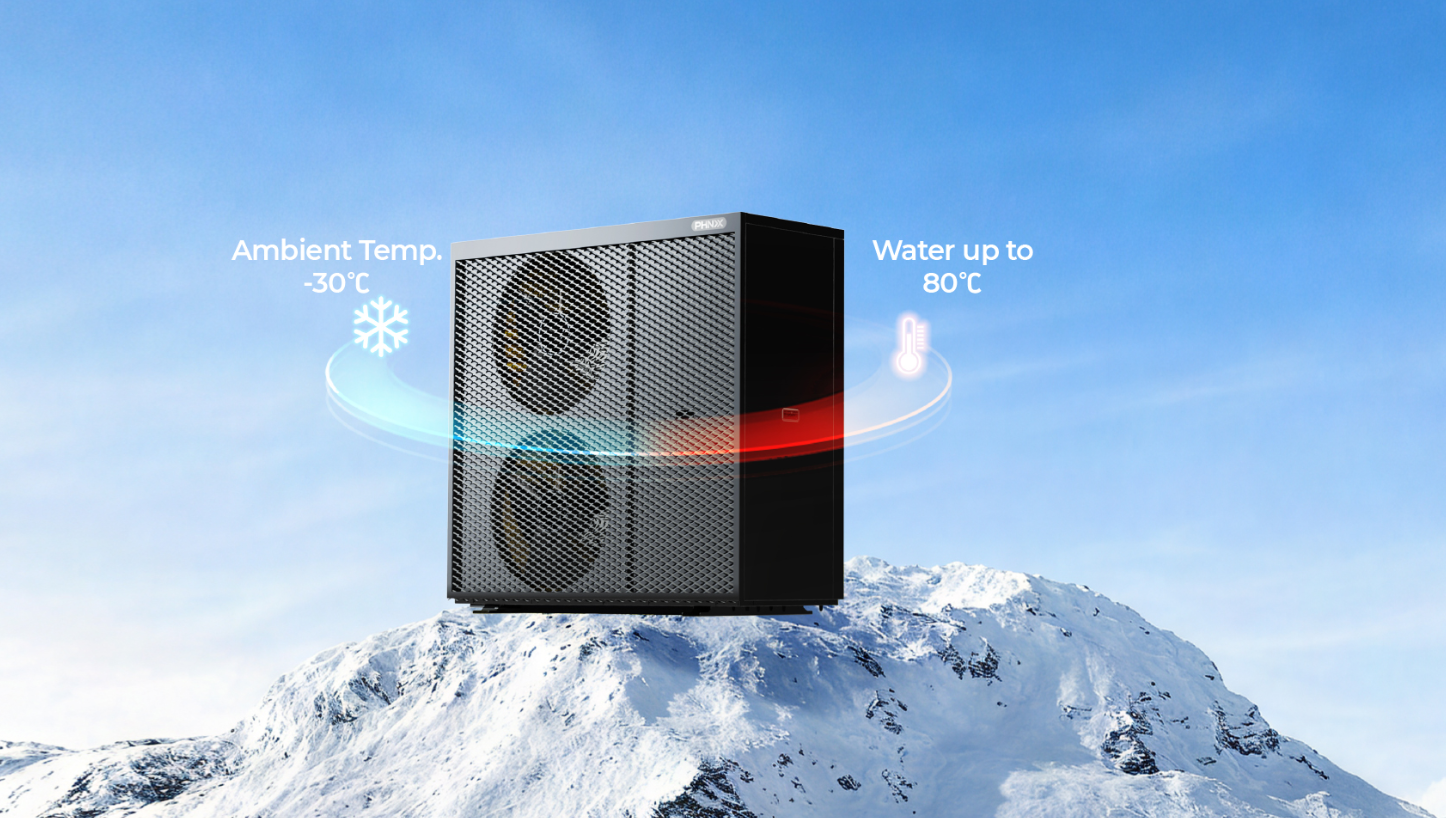
PHNIX HeatGreen is a commercial air-source heat pump line using R290 refrigerant and AI Full Inverter technology, rated for operation from -30°C to 43°C and designed for centralised hot water, heating and cooling in hotels, hospitals, schools and large residential communities. AI Full Inverter delivers more than 30% energy savings against conventional inverter control on this line, and the AI CoreTech layer beneath it handles inverter modulation, failure prediction, load adaptation and intelligent defrost. EVI, enhanced vapour injection, sustains capacity at -30°C by injecting intermediate-pressure refrigerant into the compressor, which is what makes a northern-European hot water project viable without a redesign.
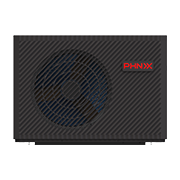
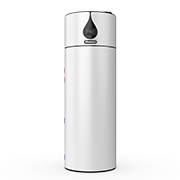
When a specification shifts from 60°C to 65°C supply water late in Phase 2, a platform already validated across a wide ambient range absorbs that as a control and test adjustment, not a hydraulic redesign. PHNIX has filed 1,816 patents with 1,405 granted and has led or participated in more than 70 national and industry standards; a factory that writes test methods reads them the way the laboratory does, which shortens the retest loop. On the same engineering base, PHNIX GreenTherm Pro achieved a measured SCOP of 5.55 in testing by TÜV SÜD RED and HLK Stuttgart. SCOP, the seasonal coefficient of performance, averages efficiency across a heating season rather than a single rating point. PHNIX also received the heat pump industry's first EN 18031 cybersecurity certificate and the industry's first AI mark in 2025, both now routine tender questions. Pool and residential lines such as i-GreenLine Ultra and airMono sit alongside the commercial track as other options from the same brand.
Tender bidders should plan documentation lead time too. Sourcing R290 heat pump ODM factories with credible HLK or TÜV test packs early means the test pack exists before the tender window opens, rather than being commissioned inside it.
The pilot run is a short batch, typically 20 to 100 units, built on production tooling with production operators, to expose assembly variance a hand-built sample hides. A representative example of the arithmetic: if a pilot batch of 50 units yields 3 units needing rework at final leak test, that is a 6% rework rate. At 2 000 units a year the same rate implies 120 units touched twice, enough to justify a fixture change before mass production rather than after. The point is the method, not the number.
First-container lead time after sign-off is typically four to eight weeks, driven by compressor and heat exchanger procurement. Registration must close in the same window:
· EPREL registration is a supplier obligation under Regulation 2017/1369 Art.4(1), required before the model is placed on the market, covering the public and compliance parts of the database; models placed on the market between 2017-08-01 and 2019-01-01 had to be entered by 2019-06-30 under Art.4(2). Public information must be easily accessible in a user-friendly way, with a dynamic QR code given as an example in the recitals; whether a QR code is mandatory for a given category depends on the delegated regulation.
· Packaging producer registration under Regulation (EU) 2025/40 Art.44(2) and (4) is required in every member state where the producer or importer first makes packaging available, and products may not be placed on the market without it. Under 10 tonnes per year uses simplified reporting under Art.44(8).
· WEEE Directive 2012/19/EU Annex IV category 1 lists "Heat pumps" verbatim, within Annex III temperature exchange equipment. RoHS Directive 2011/65/EU applies under Annex I category 1 or the catch-all category 11: residential and smaller commercial units are clearly in scope; large fixed installations need case-by-case assessment.
First-time private-label buyers benefit from reviewing how Chinese ODM factories handle heat pump water heater private labels before committing to nameplate and documentation formats.
| Programme type | Typical duration | New tooling required | New certification file | Suited to first-time private label |
|---|---|---|---|---|
| Badge-only rebrand of an existing certified model | 8 to 14 weeks | No | No | Yes |
| Configured ODM, existing platform, new enclosure | 6 to 9 months | Moderate | Yes | Yes |
| Full OEM, new hydraulic and control design | 10 to 16 months | Higher | Yes | No |
| Refrigerant conversion of an existing model | 5 to 8 months | Lower | Yes | Moderate |
Upfront investment is real: tooling, certification and the pilot batch are spent before a unit is sold, which is why badge-only programmes exist. In severe cold climates a backup heat source remains prudent for critical hot water loads even with EVI, since a defrost cycle or service event leaves no redundancy in a single-unit installation. Air-source equipment also needs external siting with free airflow and acoustic clearance.
Regulation is still moving. ESPR, Regulation (EU) 2024/1781, is a framework with no specific in-force product requirements for heat pumps; existing rules apply through to 2026-12-31, and it may in future impose further obligations. Directive (EU) 2024/1799 on the right to repair does not cover heat pumps or water heaters, since its Annex II list of ten product groups contains no heating products; transposition is due by 2026-07-31. Neither 813/2013 nor 814/2013 contains any spare part or repair obligation, so there is no EU-mandated spare parts availability period and those terms are contractual. Under Directive (EU) 2019/771 Art.10(1) the seller is liable for two years, extendable by member states under Art.10(3), and reducible for second-hand goods but not below one year under Art.10(6). National incentive schemes and VAT treatment vary by member state and change frequently; check the current national scheme before budgeting.
Q: Can a heat pump OEM project be completed in three months?
A: Only as a badge-only rebrand of a model already certified and in production. A new enclosure, heat exchanger or re-rated capacity needs a new certification file.
Q: Does R290 reduce compliance workload?
A: It removes the HFC quota and pre-charged import verification steps under Art.16(1) and Art.19 and avoids the 8418 61 00 91 subheading. It does not remove certification obligations, and personnel certification under Art.10(1) still applies, since that article covers work involving relevant alternatives to fluorinated greenhouse gases, including natural refrigerants, where relevant. Implementing acts are due by 2026-03-12, with seven-year retraining by 2027-03-12 under Art.10(8) and (9).
Q: How often will installed units need leak checks?
A: Under Art.5(6), less than 50 tCO2e is checked every 12 months, 50 to under 500 tCO2e every 6 months, and 500 tCO2e or more every 3 months. Intervals double where a leakage detection system is fitted, and heat pumps at 500 tCO2e or more must have one under Art.6(1).
Q: How do I verify a factory's certificates?
A: Check the manufacturer name, the exact model identifier and the certificate number, then confirm the nameplate model matches the certificate and that its scope covers the variant you are buying. Scope mismatch between a certified base model and a re-rated sibling is the most common gap. Labelling is governed by Art.12(1)(c), (3), (4) and (16), requiring a fluorinated greenhouse gas statement, the industry-accepted designation, and the charge by weight and in tCO2e with the GWP, in the official language of the member state of placing on the market, and in advertising descriptions where GWP is 150 or more.
A credible OEM/ODM heat pump timeline is built backwards from the regulatory gates, not forwards from the factory's build calendar. Freeze requirements in month one, agree written sample acceptance criteria before the first sample ships, begin certification scheduling while samples iterate, and close EPREL, packaging, WEEE and RoHS registration alongside the pilot run. Factory selection matters mainly through laboratory depth and standards familiarity, which prevent retest loops. For commercial hot water and heating projects, PHNIX offers a validated R290 platform in HeatGreen plus the in-house test capacity to run compliance work in parallel, which is where most of the schedule risk sits.

Guangdong PHNIX Eco-energy Solution Ltd.
Tel: +86-4009-4009-00
Address: NO.3 Tianyuan Road, Dagang Town,
Nansha, Guangzhou, Guangdong, PR. China.