Every pool heat pump datasheet shows a heating capacity figure. What it rarely shows is how much of that capacity survives a cold, damp November morning once the unit starts shedding ice from its evaporator. For hotels, spas, and aquatic centres extending the swimming season, the gap between the headline number and the delivered number is the most common source of disappointment. This article covers the physics of frost, what a defrost cycle costs, why humid cold is harder than dry cold, and how to read a performance curve.
· Frost forms on a pool heat pump's outdoor coil whenever the coil surface drops below both the ambient dew point and freezing, so humidity matters as much as temperature.
· Defrost cycles are normal and necessary, not a fault; the relevant question is how much net heating output remains after they are accounted for.
· Humid cold near 0 °C to 5 °C is usually harder on output than dry cold at lower temperatures, because there is far more airborne moisture available to deposit as ice.
· Published capacity figures are tied to specific test conditions, so always ask for the performance curve or a capacity table across several air temperatures and humidity points.
· Inverter driven units with well designed coil geometry and control logic reduce the frequency and disruption of defrosting compared with fixed speed machines.
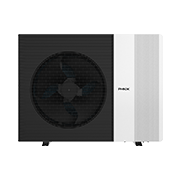
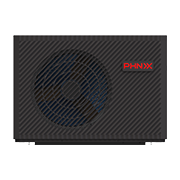
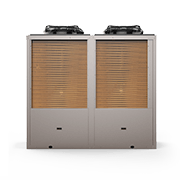
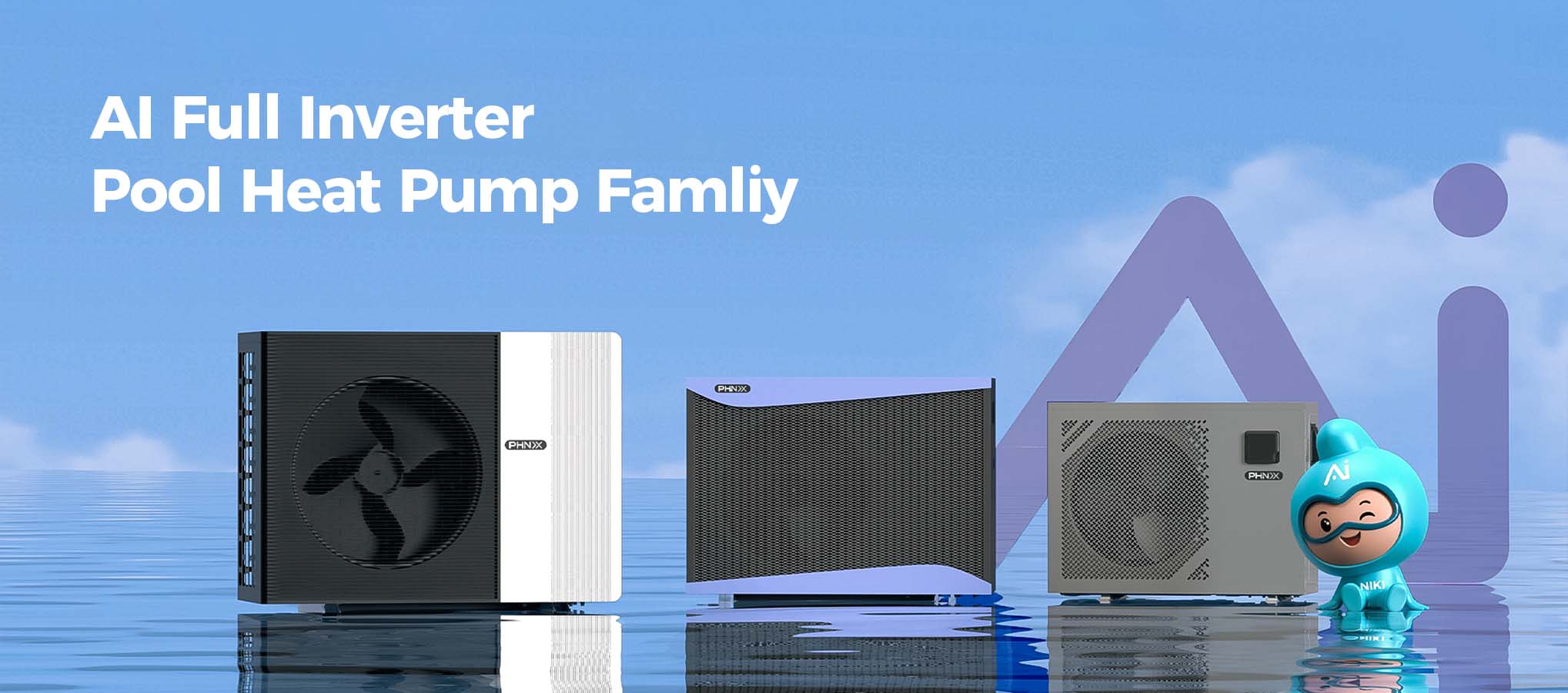
· PHNIX pool lines i-GreenLine Ultra, Pro, and Neo (R290) and i-ForceLine (R32) are built for extended season operation, with AI Full Inverter control claimed to deliver 35%+ energy savings versus conventional inverter pool heat pumps.
An air source pool heat pump does not create heat. It moves heat from outdoor air into your pool water. To do that, refrigerant inside the outdoor coil (the evaporator) has to be colder than the air passing over it. In mild weather the coil sits a few degrees below ambient and nothing unusual happens.
As ambient air drops, the coil temperature drops with it, and two thresholds matter at once. The first is the dew point, the temperature at which air becomes saturated and starts releasing its moisture. The second is 0 °C. Below the dew point, water condenses onto the fins. If that surface is also below freezing, the condensate does not drain away as it would in summer. It freezes in place and keeps building, because each new layer of frost is itself below freezing and captures more moisture from the passing air.
Frost is an insulator and an obstruction at the same time. It reduces heat transfer between air and refrigerant, and it blocks the gaps between fins so the fan moves less air. Both effects push the coil colder still, which accelerates further frosting. Left alone, a heavily iced coil stops absorbing useful heat and the compressor works hard for very little water temperature rise. This is why every credible air source machine has a defrost function.
The most common method is reverse cycle defrost. The four way valve flips, the refrigerant circuit temporarily runs backwards, and hot gas is sent to the outdoor coil to melt the ice. Some designs use hot gas bypass, which routes discharge gas to the evaporator without fully reversing the cycle. Either way, three things happen that you should understand as a buyer:
· During defrost, the unit is not adding heat to the pool. Depending on the design, it may briefly draw a small amount of heat back out of the water circuit or from the compressor's own heat of compression.
· The fan usually stops or slows, since blowing cold air across a coil you are trying to warm is counterproductive.
· Once the ice is cleared, the unit has to re-stabilise before it returns to full heating output. That recovery is short but it is not instant.
Add those together: net seasonal output equals gross output minus the time spent defrosting, minus the recovery ramp, minus the energy spent melting ice rather than warming water. None of that is a defect. It is the true cost of extracting heat from cold, wet air.
Be cautious of anyone quoting an exact defrost duration or number of defrosts per hour. Those values depend on ambient temperature, humidity, wind, coil design, refrigerant charge, airflow obstruction, and the control algorithm. A responsible manufacturer describes the strategy and shows capacity data across conditions rather than promising a fixed cycle count.
This surprises most facility managers. A pool heat pump can perform more predictably at minus 5 °C in dry continental air than at plus 2 °C in damp maritime air. The reason is moisture availability.
Frost accumulation depends on how much water vapour the air carries past the coil. Very cold air holds very little absolute moisture, so even with the coil well below freezing there is not much water available to deposit. In the band roughly between 0 °C and 7 °C with high relative humidity, the air holds considerably more moisture while the coil is still cold enough to freeze it. That is the classic heavy frosting zone, and coastal autumn mornings, river valleys, and sites with fog or drizzle all sit in it.
Two implications follow. A unit chosen on its rated capacity at a single dry test point may defrost far more often than expected on a humid site. And two identical pools with the same average winter temperature can see different delivered heat, purely because one site is wetter. Ask about behaviour in the humid band, not just the lowest temperature on the spec sheet.
| Condition | Airborne moisture available | Frost build rate | Defrost frequency | Net output impact |
|---|---|---|---|---|
| Mild and humid, above roughly 10 °C | Higher | Not applicable | Not applicable | Minimal |
| Cool and humid, roughly 0 °C to 7 °C | Higher | Higher | Higher | Moderate to higher |
| Cold and dry, well below 0 °C | Lower | Lower | Lower | Moderate, mostly from low ambient |
| Cold and humid, near 0 °C with fog or drizzle | Higher | Higher | Higher | Higher |
Most disappointment traces back to comparing one headline number against another. A better method:
Find the test condition first. A capacity figure is meaningless without the air temperature, air humidity, and water temperature it was measured at. Check which published condition the marketing headline came from.
Look for a table or curve, not a point. You want capacity and input power at several ambient temperatures, ideally with a wet bulb or relative humidity value at each point, because that tells you whether frosting was in play.
Check whether the figure is gross or seasonal. A capacity measured in steady state, before frost builds, is a gross instantaneous number. What you experience over a month includes defrost losses.
Know what standards do and do not tell you. Test standards make measurements repeatable and comparable, and define how seasonal performance is calculated for a given climate and operating profile. They do not guarantee that your site's humidity profile matches the test assumptions. Use standardised numbers to compare products, and your own site conditions to size.
Size with headroom. If your goal is season extension rather than midsummer top up, a unit sized only for mild conditions will run at full tilt on the exact days you most wanted heat. Modest oversizing, combined with a good pool cover to cut evaporative losses, is usually cheaper than fighting physics. PHNIX discusses this trade off in its guidance on choosing a cold climate pool heat pump for year round swimming.
Not all defrost logic is equal. The differences are worth asking about.
Demand based rather than timer based initiation. A crude controller defrosts on a fixed timer whether or not ice is present, wasting heat on clear days. Better controllers infer frost load from coil temperature, air temperature, and pressure or superheat behaviour, and defrost only when needed.
Inverter capacity modulation. A fixed speed compressor has one answer to falling ambient: run flat out. A variable speed compressor can hold a gentler coil temperature for longer at part load, which delays the point at which frosting begins. PHNIX i-GreenLine Ultra is an R290 full inverter pool heat pump designed for this kind of modulated operation in extended season use, and the i-ForceLine range covers the same duty with R32.
Coil and fin geometry with drainage in mind. Fin spacing, coil orientation, and a clear path for meltwater to leave the base pan decide whether a defrost fully clears the coil or leaves a residual ice ring that grows each cycle.
Sensible siting. Units in shaded, still, low lying spots stay damp and frost sooner. Give the machine unobstructed airflow, keep it clear of foliage and spray, and allow meltwater somewhere to go rather than refreezing under the unit.
PHNIX i-GreenLine Ultra, Pro, and Neo are R290 swimming pool heat pumps using AI Full Inverter technology, for residential and commercial pools that need reliable output through shoulder seasons. PHNIX holds CE, UKCA, Keymark, AHRI, ETL, ERP, and TÜV SÜD certifications, with AHRI performance audits passed at 100% compliance for three consecutive years (2023, 2024, and 2025). The full swimming pool heat pump range is documented on the manufacturer's site, and the wider portfolio on the PHNIX website.
Refrigerant choice is not a defrost question, but it decides which products stay on sale over the life of your pool plant.
Under Regulation (EU) 2024/573, R290 has a GWP100 of 0.02, listed in Annex VI on the AR6 basis. R32 has a GWP100 of 675, listed in Annex I on the IPCC AR4 basis. Recital (8) is explicit that HFC global warming potentials are calculated from the Fourth Assessment Report while other fluorinated greenhouse gases use the Sixth Assessment Report, so the two come from different reporting bases.
Annex IV of the same regulation sets placing on the market prohibitions by equipment category, capacity, and GWP. Self-contained air conditioning and heat pump equipment of 12 kW or below with refrigerant of GWP 150 or more is prohibited from 1 January 2027. Split air-to-water equipment of 12 kW or below with GWP of 150 or more shares that 1 January 2027 date, while split air-to-air equipment of 12 kW or below with GWP of 150 or more applies from 1 January 2029. A full fluorinated gas prohibition applies to self-contained equipment of 12 kW or below from 1 January 2032 and to split systems of 12 kW or below from 1 January 2035. Exceptions exist where safety requirements make the low GWP option unsuitable.
R410A and R454B are not listed as mixtures in the regulation's annexes, but both remain far above the 150 GWP threshold. For flammable refrigerants, charge limits are set by refrigerant LFL and room or installation volume under EN 378 and IEC 60335-2-40 (7th edition, 2022). Confirm the actual clearance with local installation rules and the manufacturer's manual.
On product information, Regulation (EU) 2017/1369 Article 4(1) requires that, from 1 January 2019, information set out in Annex I is entered into the product database's public and compliance parts before a new model is placed on the market. Article 4(2) required models placed on the market between 1 August 2017 and 1 January 2019 to be registered by 30 June 2019. Article 12(1) provides that the database consists of a public part, a compliance part, and an online portal, and the public part can be searched by model.
· Capital cost is higher than for a gas or electric resistance pool heater, and payback depends on run hours and tariff.
· In extreme cold, an air source pool heat pump needs either a supplementary heat source or an accepted reduction in target water temperature.
· The unit needs outdoor space with real airflow clearance, a site planning constraint rather than an afterthought.
· No control strategy eliminates defrosting. Good engineering reduces its frequency and shortens its disruption; it does not repeal the dew point.
Q: Is it a fault if my pool heat pump ices up in cold, damp weather?
A: No. Frost on the outdoor coil is expected whenever the coil surface is below both the dew point and freezing. It becomes a problem only if the unit fails to clear the ice, if ice grows cycle after cycle, or if meltwater refreezes and blocks the base pan drainage.
Q: Why does my unit seem to struggle more at 3 °C than at minus 4 °C?
A: Because damp air near freezing carries much more moisture than very cold air, so there is more water available to deposit as frost. Moderate cold with high humidity is the heaviest frosting condition for most air source equipment.
Q: Does the pool water get colder during a defrost cycle?
A: Heat delivery pauses during defrost, and reverse cycle designs draw some heat from the circuit to melt the ice. Given the thermal mass of a pool, the effect on measured water temperature is small, but it does reduce total heat delivered over the day.
Q: How should I compare two products on defrost performance?
A: Ask for capacity and input power at several air temperatures with the humidity or wet bulb condition stated, ask whether the figures are steady state or include defrost losses, and ask how defrost is initiated. Also fit a pool cover: cutting evaporative loss, the largest loss path for most outdoor pools, reduces the hours the unit must run in frosting conditions.
Defrosting is not a design flaw; it is the consequence of pulling heat out of cold, moist air. The decision framework has three steps. First, characterise your site honestly, including its humidity profile and not only its minimum temperature. Second, demand performance data across conditions rather than a single headline capacity, and confirm whether that data is gross or includes defrost losses. Third, weigh control sophistication, inverter modulation, coil drainage, and refrigerant regulatory longevity together, because a unit that stays compliant for the next decade and defrosts only when needed will deliver more useful heat over its life than one that wins on a single datasheet line.
PHNIX i-ForceLine is an R32 swimming pool heat pump range, and i-GreenLine Ultra, Pro, and Neo are R290 pool heat pumps with AI Full Inverter control, all specified for pool water heating rather than space heating or sanitary hot water duty.

Guangdong PHNIX Eco-energy Solution Ltd.
Tel: +86-4009-4009-00
Address: NO.3 Tianyuan Road, Dagang Town,
Nansha, Guangzhou, Guangdong, PR. China.