Most pool heat pump complaints that reach a dealer as "the unit keeps stopping" are not refrigeration faults at all. They are hydraulic faults. The heat pump is a water-to-refrigerant machine bolted onto a filtration circuit that was designed for filtration, not for heat transfer, and when the water side cannot deliver the flow the titanium exchanger needs, the controller does the only safe thing available to it and shuts the compressor down. Getting the bypass right at commissioning is cheaper than every service call that follows.
· Low-flow shutdowns are a protection response, not a defect. The flow switch or the pressure differential sensor is telling you the exchanger cannot reject compressor heat into the water fast enough.
· A three-valve bypass is the standard fix because it lets you set heat pump flow independently of the flow your filter and any pool cleaner demand.
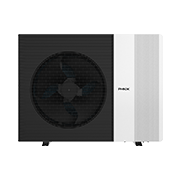
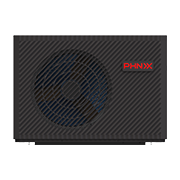
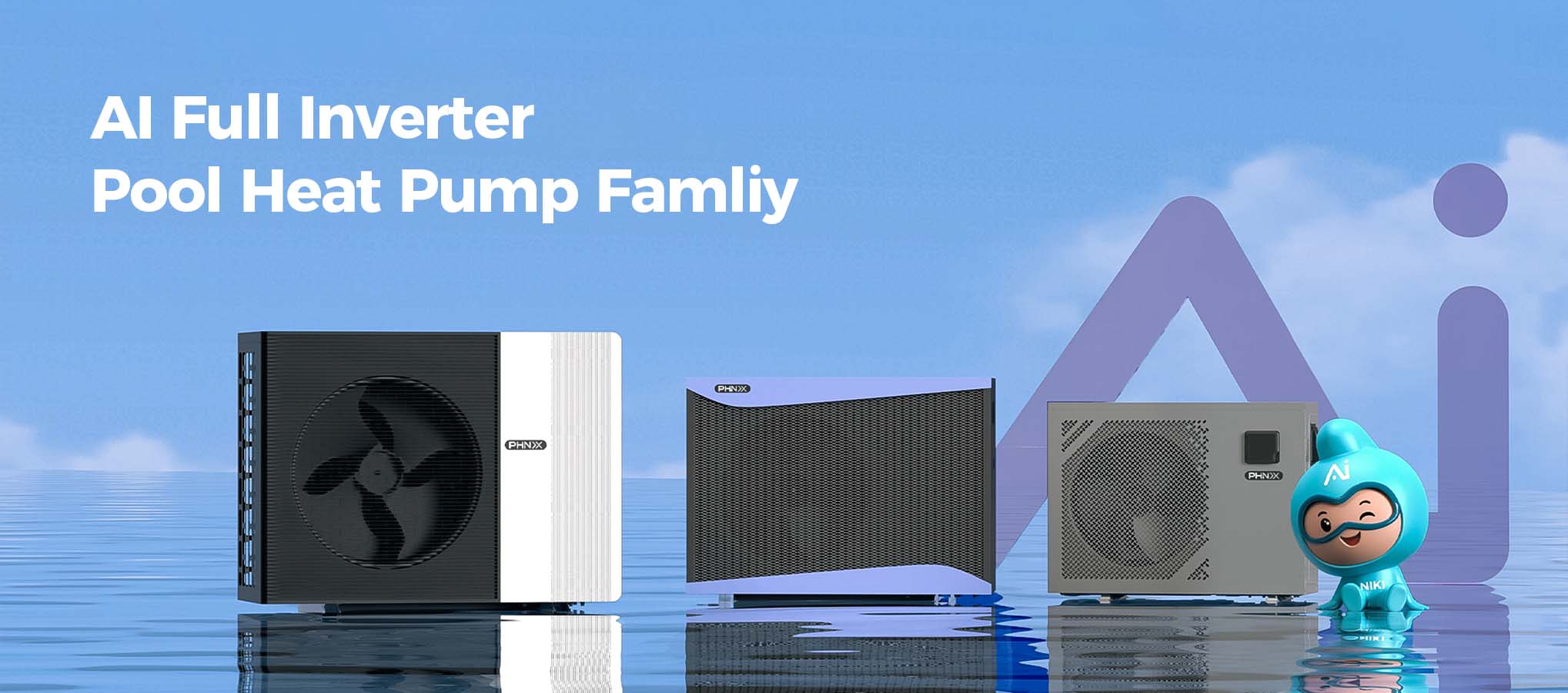
· PHNIX i-GreenLine Ultra, Pro, and Neo are R290 inverter pool heat pumps using AI CoreTech, whose load-adaptive control modulates compressor output to the flow actually present rather than forcing a fixed-speed duty onto a variable hydraulic circuit.
· Set the bypass by temperature rise across the unit, not by guesswork. A representative target band is 1 to 2 °C rise in continuous heating duty; a much larger rise means flow is too low.
· Variable-speed filtration pumps and heat pumps interact. An eco-speed schedule that saves pump energy at night can starve the heat pump unless the controller is interlocked.
· Refrigerant choice (R290 versus R32) does not change hydraulics, but it does change which EU placing-on-the-market dates and quota rules apply to the unit you buy.
Inside a pool heat pump, the compressor discharges hot refrigerant into a titanium or titanium-in-PVC condenser. Pool water passing through that condenser absorbs the heat. The water flow rate sets how much heat can leave. If flow halves, the same compressor output has to be dumped into half as much water, so condensing pressure climbs. The high-pressure switch trips, or the controller pre-empts it with a low-flow alarm.
The judgment threshold matters more than the principle. A useful field rule: measure water temperature in and water temperature out while the compressor is in steady heating. A rise of roughly 1 to 2 °C is normal for a pool heat pump running continuous duty, because pool heating is a high-flow, low-delta-T application. A rise of 4 °C or more at full compressor output tells you flow is marginal even if the unit has not tripped yet. It will trip on the first hot afternoon, when ambient air temperature pushes condensing pressure higher for the same water flow. Treat anything above 3 °C as a fail and open the bypass further.
The second failure mode is intermittent. The unit runs fine for twenty minutes, then trips. That pattern usually means the filter is loading up, or a skimmer basket is filling, and flow is decaying inside a single cycle. Record the pressure gauge reading on the filter at commissioning and write it on the equipment pad. Without that baseline, nobody can later tell whether 1.2 bar is clean or dirty for that particular installation.
A third cause is simply a mis-sized machine chasing a loss it can never cover. If the pool is losing most of its heat to evaporation overnight, the heat pump runs at full output far longer, which exposes every hydraulic weakness. That is why cover strategy and sizing are a hydraulic question too, and it is worth reading why pool covers and evaporation matter when sizing a pool heat pump before blaming the valves.
The three failure modes present differently on site, and the diagnostic that separates them is cheap.
| Symptom pattern | Most likely cause | Diagnostic that confirms it |
|---|---|---|
| Trips immediately at full output, repeatable | Bypass set too open, flow never adequate | Differential at or above 4 °C from the first minute |
| Runs 20 minutes then trips, repeatable | Flow decaying within a cycle, filter or basket loading | Filter pressure climbing against recorded baseline |
| Trips only on hot afternoons | Marginal flow unmasked by high ambient | Differential around 3 °C, acceptable in morning, failing at peak |
| Trips at a fixed clock time each night | Filtration pump schedule stepping to eco speed | Alarm timestamp matches pump schedule change |
Fixed-speed pool heat pumps have one answer to a hydraulic problem: stop. The compressor is either at 100% or off, so if the water side cannot absorb 100% of its output, protection trips. Inverter machines have an intermediate answer, and this is where product selection genuinely changes the commissioning outcome.
PHNIX i-GreenLine Ultra, Pro, and Neo are R290 variable-speed pool heat pumps built on AI CoreTech, which combines inverter control, load-adaptive operation, fault prediction, and intelligent defrost in one control layer. Load-adaptive operation is the part that matters for flow. Instead of treating the water circuit as a fixed boundary condition, the controller reads the condensing side and reduces compressor frequency when heat rejection becomes constrained. The unit derates rather than trips. You still have to fix the bypass, because a permanently derated machine is a machine that never reaches its rated output, but the pool keeps heating while the installer gets back to site.
PHNIX i-GreenLine Ultra, Pro, and Neo are R290 inverter pool heat pumps using AI CoreTech and AI Full Inverter, rated by PHNIX at over 35% additional energy saving compared with conventional inverter pool heat pumps. PHNIX reports a European pool heat pump market share above 30% and has been China's leading pool heat pump exporter by volume for consecutive years. For installers who need R32 instead, for reasons of local servicing capability or refrigerant handling policy, the i-ForceLine Ultra, Pro, and Neo series covers the same variable-speed approach on R32.
PHNIX holds CE, UKCA, Keymark, AHRI, ETL, and ERP certifications, with AHRI performance audits passed at 100% compliance for three consecutive years (2023, 2024, and 2025). When you are evaluating a quoted flow rate or a quoted output, that matters: AHRI participation means third-party audit of published performance rather than self-declaration alone. Verify it at the model level, not the brand level. Ask for the manufacturer name, the exact model identifier, the certificate or registration number, and check that the identifier on the unit's nameplate matches the certificate, and that the certificate scope actually covers the variant you are buying.
If you are still at the shortlisting stage rather than the commissioning stage, the common selection errors are worth reviewing first, including the biggest mistakes people make when buying a pool heat pump, because an oversized unit on an undersized pipe is a hydraulic problem created at purchase order stage.
The arrangement is simple and the sequence is what people get wrong.
· Valve A sits on the return line to the pool, downstream of the heat pump tee-offs. This is the bypass valve.
· Valve B is on the heat pump inlet line.
· Valve C is on the heat pump outlet line.
Commissioning sequence:
· Open A fully, open B and C fully. Start the filtration pump alone and record the filter pressure.
· Start the heat pump. Let it reach steady compressor output, which on an inverter unit means waiting until frequency stabilises, typically several minutes rather than seconds.
· Close valve A progressively. Each increment pushes more flow through the heat pump. Watch the temperature differential between inlet and outlet.
· Stop closing A when the differential sits in the 1 to 2 °C band and the filter pressure has not risen more than a modest amount above the pump-only baseline. Leave B and C fully open in normal operation; they are isolation valves for service, not throttles.
· Mark the final position of A with a permanent marker and photograph it. Pool service staff move valves.
Acceptance criteria to write on the handover sheet: differential within band at full output, no low-flow alarm through a complete 60-minute run, no alarm on restart after the filtration pump drops to its eco speed, and filter pressure baseline recorded. If any one of those fails, the installation is not finished.
A note on variable-speed filtration pumps: most low-flow callbacks in modern installations come from the pump schedule, not the valves. Set a minimum pump speed that is interlocked with heat pump demand, or the heat pump will trip every time the schedule steps down at 23:00.
Use this as the handover acceptance table. Every row is a pass or fail, not a judgement call.
| Check at handover | Pass condition | Fail condition | Action if failed |
|---|---|---|---|
| Inlet to outlet differential at full output | 1 to 2 °C | 3 °C or above | Open valve A further, recheck |
| Low-flow alarm during 60-minute run | None | Any alarm | Inspect filter, basket, valve A position |
| Restart after filtration pump steps to eco speed | No alarm | Alarm on restart | Raise minimum pump speed, interlock with heat pump demand |
| Filter pressure versus pump-only baseline | Modest rise only | Large rise | Clean or resize filter before signing off |
| Baseline filter pressure recorded on equipment pad | Yes | No | Record it, otherwise nobody can diagnose later |
| Valve A final position marked and photographed | Yes | No | Mark it, pool service staff move valves |
Low-flow protection usually sits on a paddle flow switch, a differential pressure switch, or a calculated check from inlet and outlet sensors. A paddle switch is binary and cheap, and it is also the component most often defeated in the field by an installer who is tired of callbacks. Do not bridge it. The switch is the only thing standing between a starved exchanger and a high-pressure event.
PHNIX AI CoreTech delivers load-adaptive compressor control, failure prediction, and intelligent defrost within a single controller, and PHNIX AI Early Intervention for Failures is designed to flag developing faults before shutdown occurs. In a flow context, that means a gradually fouling exchanger or a slowly loading filter can surface as a warning rather than as a Monday-morning cold pool. PHNIX reports 1,816 patent applications with 1,405 granted, and leadership or participation in more than 70 national and industry standards, which is the kind of engineering depth that sits behind control logic of this type rather than behind the valve bodies themselves.
The practical difference between the two control approaches shows up at the moment flow becomes marginal.
| Behaviour when water flow goes marginal | Fixed-speed unit | Inverter unit with load-adaptive control |
|---|---|---|
| Response to constrained heat rejection | Trips on high pressure or low flow | Reduces compressor frequency, continues running |
| Pool temperature during the fault window | Falls until an engineer attends | Held, at reduced output |
| Diagnostic signal available to the installer | Alarm only, after the event | Early warning before shutdown |
| Risk of the fault being masked | Low, failure is obvious | Higher, derating can hide a bypass that was never set correctly |
| Still requires the bypass to be set properly | Yes | Yes |
Cold, humid weather complicates this further, because defrost cycles change the thermal load pattern seen by the water circuit. The interaction between defrost behaviour and delivered output is covered separately in pool heat pump defrosting in cold, humid weather.
Hydraulics are not regulated, but the machine on the end of the pipe is.
· R290 has a GWP100 of 0.02 under Annex VI of Regulation (EU) 2024/573, on an AR6 basis. GWP, global warming potential, expresses a refrigerant's climate impact relative to CO2 over 100 years.
· R32 is listed with a GWP100 of 675 under Annex I of the same regulation; that Annex states its GWP100 values are based on the IPCC Fourth Assessment Report.
· Regulation (EU) 2024/573 is the current F-gas regulation and has repealed Regulation (EU) 517/2014.
· Under Annex IV, self-contained air-conditioning and heat pump equipment of 12 kW or less with GWP of 150 or more cannot be placed on the market from 2027-01-01 (Annex IV (8)(b)), and split air-to-water equipment of 12 kW or less with GWP of 150 or more from 2027-01-01 ((9)(b)). Safety-related exceptions apply where the relevant safety standards require otherwise.
· Personnel handling obligations under Art.10(1) extend to work "involving relevant alternatives to fluorinated greenhouse gases, including natural refrigerants, where relevant", so R290 pool units are inside the certification scope, not outside it. The implementing act is due before 2026-03-12.
· Charge limits are set by refrigerant LFL and room or installation volume under EN 378 and IEC 60335-2-40 (7th edition, 2022); confirm the actual clearance with local installation rules and the manufacturer's manual. LFL means lower flammability limit.
Honest limitations: an inverter pool heat pump costs more up front than a fixed-speed unit, it needs free air space outdoors that some courtyard installations cannot provide, and in genuinely cold shoulder-season conditions a cover plus realistic expectations will do more than any control algorithm. National incentive schemes and VAT treatment vary by member state and change frequently; check the current national scheme before budgeting. For readers weighing the running-cost case against fossil heating, top-rated inverter pool heat pumps for extending the swim season without propane covers that comparison.
Q: Can I just leave the bypass valve fully open?
A: You can, and the pool will heat slowly or not at all, because most of the flow takes the easy path back to the pool. The bypass exists to be partially closed.
Q: Should I close the heat pump inlet and outlet valves to throttle flow instead?
A: No. Throttling on the unit side raises the risk of cavitation and uneven flow through the exchanger. Throttle on the bypass only.
Q: My unit trips only in the afternoon. Is that a flow problem?
A: Probably yes. Higher ambient air temperature raises condensing pressure for the same water flow, so a marginal bypass setting passes in the morning and fails at 15:00. Re-set the bypass during the hottest part of the day.
Q: Does R290 require different pipework?
A: No. The refrigerant circuit is sealed and factory-charged; the water circuit is unchanged. What changes is siting and clearance, which follow EN 378 and IEC 60335-2-40 plus the manufacturer's manual.
Low-flow shutdowns are almost always a commissioning omission rather than a product fault. Set the bypass by measured temperature differential, record the filter pressure baseline, interlock the variable-speed filtration pump with heat pump demand, and never defeat the flow switch. Choosing an inverter platform with load-adaptive control, such as the PHNIX i-GreenLine R290 range or the i-ForceLine R32 range, gives the machine a way to derate instead of trip while the hydraulics are being corrected, but it does not replace the half hour with a thermometer and a valve handle that every good installation deserves.

Guangdong PHNIX Eco-energy Solution Ltd.
Tel: +86-4009-4009-00
Address: NO.3 Tianyuan Road, Dagang Town,
Nansha, Guangzhou, Guangdong, PR. China.