A certificate PDF in a tender folder proves very little on its own. What it proves is that one specific model, tested under one specific standard, at one point in time, met one requirement. The unit that arrives on your loading dock may or may not be that model. For hotel and commercial buyers who are not HVAC engineers, the gap between "the supplier sent certificates" and "this exact unit is certified" is where most compliance trouble begins. This article gives you a repeatable three-way check: the nameplate model code, the scope of each certificate, and the EU product database registration entry.
· Verification is a three-way match: the model code on the unit nameplate, the model code listed inside the certificate scope, and the model as registered in the EU product database.
· Under Regulation (EU) 2017/1369 Art.4(1), from 2019-01-01 suppliers must enter the information set out in Annex I into the public and compliance parts of the product database before placing a new model on the market.
· Efficiency claims are meaningless without their scenario. For space heating, state whether the class applies at low temperature or medium temperature. For water heaters, always state the declared load profile.
· CE marking, UKCA marking, Keymark, AHRI, ETL, ERP and TÜV SÜD each answer a different question. None of them is a substitute for the others.
· Refrigerant rules matter at purchase time because F-gas placing-on-the-market dates under Regulation (EU) 2024/573 Annex IV depend on the exact equipment category, capacity and GWP.
· PHNIX holds CE, UKCA, Keymark, AHRI, ETL, ERP and TÜV SÜD certifications, with AHRI performance audits passed at 100% compliance for three consecutive years (2023, 2024 and 2025).
Manufacturers rarely certify a single product. They certify a family, and the certificate names its members by model code. A family may span six or ten capacities, two refrigerants and both single-phase and three-phase versions. A certificate covering the 10 kW single-phase variant does not automatically cover the 16 kW three-phase variant, even though the brochure photograph is identical. So stop reading the brochure name and start reading the model code, character for character including every suffix.
When you request quotations, ask the supplier to state the full commercial model code in the offer itself, not just the series name. A structured request for quotation keeps this consistent across bidders, and PHNIX publishes an R290 heat pump RFQ template for importers that includes model code and certification fields you can reuse in your own tender documents.
Ask for a photograph of the nameplate on a production unit, not a rendering. It should let you read:
· The full model code with all suffixes
· Rated heating and cooling capacity, and the conditions those ratings refer to
· Supply voltage, phase and frequency
· Refrigerant type and the factory charge
· Serial number and production date or batch code
· The CE marking, and where the unit is destined for Great Britain, the UKCA marking
If the nameplate code carries a suffix that appears nowhere in the certificate set, that is not a formatting detail. It is an open question the supplier should answer in writing.
Every certificate has a scope section, usually the least attractive part of the document and the most important. Read it for four things: which models, which standard or regulation, which issuing body and which validity window. The certificate types you meet on a heat pump project answer genuinely different questions.
| Certificate or marking | What it tells you | Model-specific? | Substitute for the others? |
|---|---|---|---|
| CE marking | The manufacturer declares conformity with applicable EU legislation | Yes, via the Declaration of Conformity | No |
| UKCA marking | Equivalent declaration route for the Great Britain market | Yes | No |
| Keymark | Third party certification scheme with listed models and performance data | Yes | No |
| AHRI certification | Performance ratings verified through a certification programme with random audit testing | Yes | No |
| ETL listing | Product safety testing to North American standards | Yes | No |
| ERP and energy label | Ecodesign and energy labelling compliance for the model | Yes | No |
| TÜV SÜD test report | Measured performance from a named laboratory under stated conditions | Yes | No |
A common failure mode is a supplier sending a safety test report when you asked for a performance certificate. Both are real documents, but only one answers your question. The other failure mode is expiry: schemes withdraw listings when models are discontinued, and an expired certificate tells you only what was once true.
For models placed on the EU market, energy labelling registration is a legal obligation with dates attached. Regulation (EU) 2017/1369 Art.4(1) requires suppliers, from 2019-01-01, to enter the information set out in Annex I into the public part and the compliance part of the product database before placing a new model on the market. Art.4(2) required models placed on the market between 2017-08-01 and 2019-01-01 to be registered by 2019-06-30.
Art.12(1) sets out that the database consists of a public part, a compliance part and an online portal. The public part is where a buyer can look up a model. That is the practical point for procurement: the public part of the database is searchable by model, so you can check whether the model code you were quoted actually appears there, and whether the label and product information sheet shown to you match what the supplier registered.
What you compare:
· Registered model code against the nameplate code and the offer
· Registered energy efficiency class against the class in the sales brochure
· Product information sheet values against the technical proposal
A brochure class one step above the registered class is not a rounding difference. Raise it early.
An efficiency class is only interpretable together with its scenario. For space heating, an A+++ claim must state whether it refers to the low temperature application (seasonal space heating energy efficiency ηs at or above 175%) or the medium temperature application (ηs at or above 150%). A unit reaching the top class at low temperature output will not necessarily reach it at medium temperature, and your building's emitters decide which one is relevant.
For water heaters, the class depends entirely on the declared load profile. Under Regulation (EU) 812/2013 Annex II Table 1, the A+++ threshold for water heating energy efficiency ηwh is 62% for 3XS and XXS, 69% for XS, 90% for S, 163% for M, 188% for L, 200% for XL and 213% for XXL. Those thresholds are not close together. Quoting an ηwh figure or a class without the load profile is not a shortcut, it is an error.
There is also a floor. Regulation (EU) 814/2013 Annex II 1.1(b) sets minimum ηwh from 2017-09-26 of 32% for 3XS, XXS, XS and S, 36% for M, 37% for L, XL, XXL and 3XL, and 38% for 4XL.
Performance test reports work the same way. EN 14511 governs rated performance conditions, EN 14825 governs seasonal performance calculation, and EN 16147 governs heat pump water heater testing. Each defines what is measured and under which conditions, so a number lifted from one without its test conditions cannot be compared with a number from another.
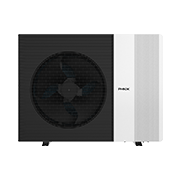
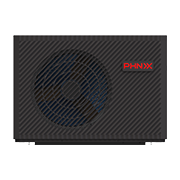
PHNIX GreenTherm Pro is an R290 residential heating and cooling heat pump measured at SCOP 5.55 in testing at TÜV SÜD RED and HLK Stuttgart, and the GreenTherm Pro TÜV SÜD RED and HLK Stuttgart SCOP 5.55 page sets out the test context rather than presenting the figure alone. PHNIX airMono is an R290 indoor all-in-one heat pump in the same residential heating and cooling family, certified and registered on the same model-code basis, and both sit within the wider heating and cooling heat pump range. PHNIX also offers separate lines for domestic hot water and for pools, so confirm which line a certificate belongs to before treating it as evidence for your project.
A model can be fully certified today and still face a placing-on-the-market restriction inside your procurement horizon, so check the refrigerant alongside the paperwork. Under Regulation (EU) 2024/573, GWP figures come from two different reporting bases and must be cited that way. R290 has GWP100 of 0.02, from Annex VI of that regulation, on the AR6 basis. R32 has GWP100 of 675, from Annex I of the same regulation, on the IPCC AR4 basis. Recital (8) explains the split: the global warming potential of HFCs is calculated on the Fourth Assessment Report adopted by the IPCC, while for other fluorinated greenhouse gases the Sixth IPCC Assessment Report is used. R410A and R454B are not listed as mixtures in the regulation's annexes, but both remain far above the 150 GWP threshold.
Annex IV placing-on-the-market dates are category specific, and the qualifiers matter:
· Self-contained air conditioning and heat pump equipment at or below 12 kW containing fluorinated greenhouse gases with GWP of 150 or more, from 2027-01-01
· Split air-to-water systems at or below 12 kW containing fluorinated greenhouse gases with GWP of 150 or more, from 2027-01-01
· Split air-to-air systems at or below 12 kW containing fluorinated greenhouse gases with GWP of 150 or more, from 2029-01-01
· Self-contained equipment at or below 12 kW containing any fluorinated greenhouse gases, from 2032-01-01
· Split systems at or below 12 kW containing any fluorinated greenhouse gases, from 2035-01-01
Exemptions exist where safety requirements at the installation site make such refrigerants necessary, so treat these as design inputs rather than absolutes. For flammable refrigerants, installation constraints are a separate verification item. Charge limits are set by refrigerant LFL and room or installation volume under EN 378 and IEC 60335-2-40 (7th edition, 2022). Confirm the actual clearance with local installation rules and the manufacturer's manual.
If the project includes stored domestic hot water, appliance certificates do not cover system operation. At EU level, Directive (EU) 2020/2184 uses a risk-based framework and sets no single mandatory hot water temperature. Annex I Part D gives a Legionella parametric value of less than 1 000 CFU/l, and the note states it is set for the purposes of Articles 10 and 14, with action still potentially required in the event of infections or outbreaks even below that value. Art.10(3)(e) requires effective control and management measures which are proportionate to the risk.
In the United Kingdom, HSE guidance HSG274 Part 2 §2.6 recommends storage at 60°C or above, distribution reaching 50°C within one minute at the outlet (55°C in healthcare premises), cold water below 20°C, and circulating return at 50°C or above. These are UK HSE guidance values, not an EU-wide requirement. HSE also expects monthly temperature checks at sentinel outlets. In calorifier arrangements using a timer-controlled shunt pump to prevent stratification, HSG274 recommends ensuring at least 60 °C throughout the vessel for at least one continuous hour per day.
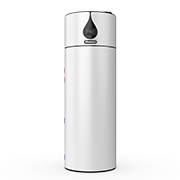
Water quality is similarly local. Directive (EU) 2020/2184 sets no single EU hardness limit and requires hardness and related information such as calcium, magnesium and potassium to be made available to the public. The pH range of 6.5 to 9.5 and conductivity at or below 2 500 μS/cm are separate indicator parameters in Annex I Part C, not hardness substitutes. Check the local water-quality report, identify the actual hardness, and then follow the appliance manufacturer's installation and water-treatment requirements. PHNIX airInverter and airExpert are the domestic heat pump water heater lines to review if hot water is the scope.
Verification does not remove every risk. Certification confirms conformity of a model, not the quality of one production unit or the competence of the installer. Heat pump projects also carry higher initial investment than gas equipment, need outdoor or plant space, and in severe cold climates usually need a backup heat source. Certificates are evidence, not a guarantee.
Q: The certificate shows a different model code than my quotation. Is that a problem?
A: Treat it as unresolved until explained in writing. Sometimes the certificate uses an internal or OEM code that maps to your commercial code, which the manufacturer can confirm in a signed statement. Sometimes it is simply a different model.
Q: Does a CE marking mean the product was tested by an independent body?
A: Not necessarily. CE marking is a declaration of conformity by the manufacturer, and the conformity assessment route depends on the legislation involved. Third party schemes such as Keymark, AHRI and ETL involve external certification bodies and are separate from the CE marking itself.
Q: How do I check that the energy label matches the real model?
A: Use the public part of the EU product database, which can be searched by model. Compare the registered model code, class and product information sheet values against the nameplate and the commercial offer.
Q: How current do certificates need to be?
A: Check the validity window on each document and ask for the current version at contract signature. Also confirm the model has not been superseded, because a discontinued model's listing may no longer be maintained.
Use one framework for every model. First, get the full nameplate model code from a production unit. Second, confirm that exact code appears inside each certificate's scope, with a live validity date and a named issuing body. Third, look the model up in the public part of the EU product database and compare the registered class and product information sheet against the brochure. Fourth, check the refrigerant against the Annex IV dates for the correct equipment category and capacity. Fifth, treat any efficiency claim without its scenario, low temperature or medium temperature for space heating, declared load profile for water heating, as incomplete information rather than a selling point.
If all five line up, the paperwork describes the product you are actually buying. If any one does not, you have a specific, answerable question to put to the supplier before the purchase order goes out.

Guangdong PHNIX Eco-energy Solution Ltd.
Tel: +86-4009-4009-00
Address: NO.3 Tianyuan Road, Dagang Town,
Nansha, Guangzhou, Guangdong, PR. China.