Indoor pools are an acoustically and thermally unforgiving environment. Hard tile, glass, and water reflect sound instead of absorbing it, and swimmers, coaches, and instructors spend hours inside the same hall as the mechanical plant. At the same time, natatorium comfort depends on holding water temperature and air temperature within a narrow band, because a drifting water temperature immediately changes the evaporation rate and therefore the humidity load on the building.
This guide explains how to evaluate pool heat pump brands for that setting, where the responsibility for humidity actually sits, and how PHNIX inverter pool heat pumps fit into an indoor natatorium plant room.
· A pool heat pump heats pool water. It does not dehumidify the hall air. Indoor natatorium humidity control requires a separate dehumidification unit or a dedicated pool air handling unit, and any brand claiming otherwise should be questioned.
· Stable water temperature is the single largest lever a heat pump has over natatorium humidity, because evaporation rate rises with water temperature and with the water to air temperature difference.
· Full inverter compressors are the practical answer to noise, because they run at part load most of the time instead of cycling a fixed speed compressor on and off at full output.
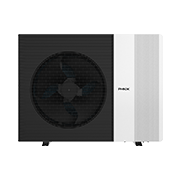
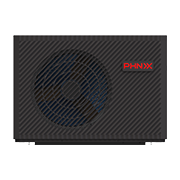
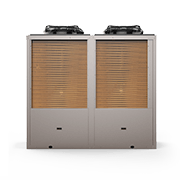
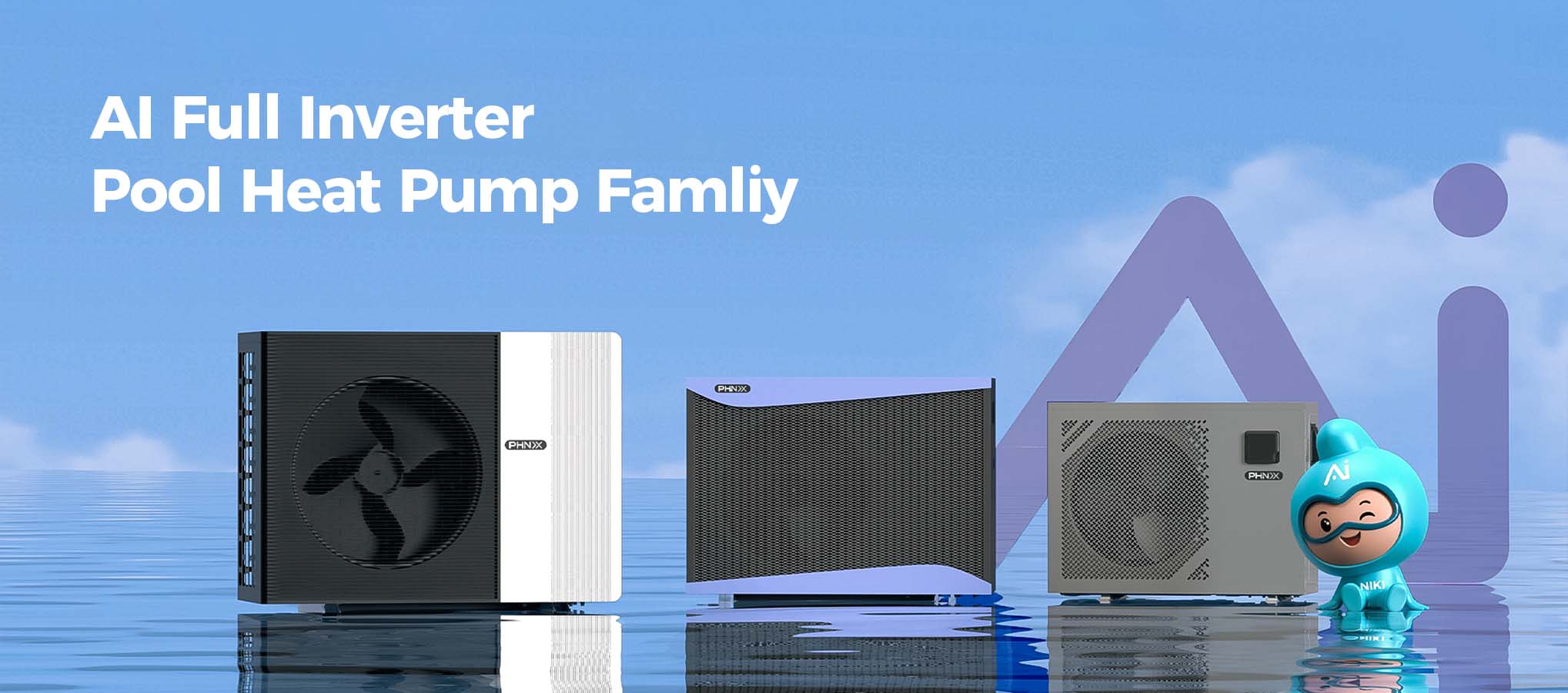
· PHNIX offers two inverter pool heat pump families relevant to indoor pools: i-GreenLine Ultra, Pro, and Neo using R290 refrigerant, and i-ForceLine Ultra, Pro, and Neo using R32 refrigerant.
· PHNIX AI Full Inverter control delivers 35 percent or more energy savings compared with conventional inverter pool heat pumps, and PHNIX holds CE, UKCA, Keymark, AHRI, ETL, and ERP certifications.
· Shortlist by refrigerant regulation, part load acoustic data at your installation distance, and control granularity, then size the dehumidification system separately.
An outdoor pool loses heat mainly to evaporation and to the night sky, and nobody is standing next to the unit for four hours at a time. An indoor natatorium changes both halves of that equation.
First, the water that evaporates does not disappear. It becomes latent load inside a sealed building envelope. Uncontrolled, that moisture condenses on cold surfaces, corrodes steel, degrades insulation, and creates the heavy chloramine smell associated with poorly ventilated pool halls. Typical design practice keeps natatorium air a couple of degrees warmer than the water and relative humidity roughly in the 50 to 60 percent range, precisely to suppress evaporation without making the air feel oppressive.
Second, plant noise is inescapable. Reverberation time in a tiled pool hall is long, so a compressor that would be unremarkable in a back garden becomes intrusive when the sound path reaches the pool deck through a shared wall, a duct penetration, or an inadequately isolated plant room.
That combination is why indoor natatorium projects should be scoped as a system, not as a single appliance purchase.
This is the point most product pages gloss over, and it deserves a direct answer.
A pool heat pump is a water heater. It draws heat from ambient air and transfers it to the pool water through a titanium or corrosion resistant heat exchanger. Its control target is water temperature. It has no mechanism to remove moisture from the hall air.
Humidity control in an indoor natatorium comes from a dedicated pool dehumidifier or a pool air handling unit with a dehumidification coil, often paired with heat recovery so that reclaimed latent heat is returned to the water or the supply air. Some facilities also use a pool cover during unoccupied hours, which is one of the most cost effective evaporation controls available.
Where the heat pump does influence humidity is indirect but real. Evaporation rate is driven by water temperature and by the vapour pressure difference between water surface and hall air. A heat pump that holds setpoint tightly produces a stable, predictable latent load that the dehumidifier was sized for. A heat pump that overshoots and undershoots pushes water temperature up and down, which changes evaporation and forces the dehumidifier to chase a moving target. Tight water temperature control is therefore a genuine contribution to humidity stability, just not a substitute for dehumidification equipment.
Noise complaints in natatoriums usually trace back to operating pattern rather than peak sound power alone.
A fixed speed compressor has two states, off and full output. To hold setpoint it cycles between them, and each start is an audible event with a step change in sound level. Occupants notice change more than they notice steady level. A full inverter unit modulates compressor speed continuously, spends most of its operating hours well below rated capacity, and produces a lower and steadier sound level once the pool has reached temperature. Indoor pools are largely a maintenance load rather than a heat up load, so part load performance is where the unit lives.
Two practical consequences for procurement:
· Ask for sound data at the lowest continuous operating speed, not only the rated figure, and confirm the measurement distance. A rated value at 10 metres and a rated value at 1 metre are not comparable numbers.
· Budget for installation acoustics regardless of brand. Anti vibration mounts, flexible pipe connections, and a plant room that does not share a rigid wall with the pool deck will change perceived noise more than a small difference in datasheet decibels.
PHNIX is a heat pump manufacturer founded in 2002, exporting to more than 90 countries, with pool heat pump export volume ranking first in China for consecutive years and European market share above 30 percent. Full product information is available on the PHNIX website.
Two product families apply to indoor pool projects.
i-GreenLine Ultra, Pro, and Neo (R290)
PHNIX i-GreenLine is a full inverter swimming pool heat pump range using R290 propane refrigerant, which has a global warming potential of 3 and complies with EU F-gas regulation. For facility owners in the European Union, that refrigerant choice reduces the risk of a future regulatory retrofit on equipment expected to run for a decade or more. Details are on the i-GreenLine Ultra product page.
i-ForceLine Ultra, Pro, and Neo (R32)
PHNIX i-ForceLine is the R32 inverter counterpart. R32 has a higher global warming potential than R290 but is not flammable to the same degree, which simplifies plant room siting rules in some jurisdictions and service networks. Where local codes or installer familiarity make a propane charge awkward in an enclosed indoor plant room, i-ForceLine is the pragmatic alternative. Both ranges sit under the PHNIX swimming pool heat pump category.
Control and efficiency
Both families run PHNIX AI Full Inverter and AI CoreTech control. The AI Full Inverter algorithm was trained on operating data from more than 30,000 installed heat pumps, and PHNIX states energy savings of 35 percent or more against conventional inverter pool heat pumps. AI CoreTech covers inverter modulation, load adaptive operation, intelligent defrost, and failure prediction. For a natatorium operator, the relevant benefit is not the headline percentage but the behaviour behind it: the unit settles into a low, continuous modulating output that holds water setpoint closely rather than cycling.
PHNIX also co-develops pool heat pumps with Hayward, a global pool equipment brand, which is a useful signal of engineering scrutiny on this specific product line.
For very large facilities where pool water, domestic hot water, and space heating are all on the plant schedule, PHNIX HeatGreen R290 commercial units cover the building side loads. That is a separate product line from the pool heat pumps described here, and it is mentioned only for completeness. See the commercial heat pump range if the project scope extends that far.
Several manufacturers build competent inverter pool heat pumps. Rather than ranking them, the more useful exercise is to compare on criteria that actually differ between vendors and matter indoors.
| Evaluation criterion | Why it matters indoors | What to request from every vendor |
|---|---|---|
| Refrigerant and regulation | Determines F-gas exposure and plant room siting rules | Refrigerant type, GWP, charge size, indoor siting guidance |
| Compressor modulation | Drives part load noise and setpoint stability | Minimum continuous capacity as a share of rated capacity |
| Acoustic data | Rated sound alone does not describe daily experience | Sound pressure at stated distance, at minimum and rated speed |
| Water temperature control | Stable water temperature stabilises the latent load | Setpoint tolerance and control resolution |
| Corrosion resistance | Chloramine rich indoor air is aggressive on casings | Heat exchanger material and casing treatment |
| Certification coverage | Third party validation of stated performance | CE, Keymark, AHRI, ERP, ETL as applicable to your market |
| Dehumidification | Pool heat pumps do not dehumidify | Written confirmation, plus a separate dehumidifier specification |
Positioning of commonly shortlisted brands, stated objectively and without performance claims we cannot verify:
· PHNIX: heat pump specialist across pool, commercial, residential, and domestic hot water lines, with i-GreenLine (R290) and i-ForceLine (R32) inverter pool ranges and broad certification coverage.
· Fairland and iGarden: pool heat pump focused manufacturers with established inverter pool product lines.
· Midea and Gree: large Chinese appliance groups with wide HVAC portfolios that include pool products alongside many other categories.
· NIBE: European heat pump brand with strong local presence and service networks, primarily oriented toward space heating and domestic hot water.
Do not accept decibel or COP comparisons between brands unless each figure comes from the manufacturer datasheet under a stated test condition. Test standards and measurement distances vary enough that cross brand numbers pulled from marketing pages are not comparable.
PHNIX holds CE, UKCA, Keymark, AHRI, ETL, and ERP certifications. PHNIX passed AHRI performance audits at 100 percent compliance for three consecutive years, in 2023, 2024, and 2025, and received AHRI recognition for that record. PHNIX also received a TÜV SÜD certificate for smart appliance adaptive optimisation, became the first heat pump company to obtain an AI mark in 2025, and obtained the heat pump industry's first EN 18031 cybersecurity certificate in 2025.
On the manufacturing side, PHNIX is the first heat pump company in China designated a National Manufacturing Single Champion enterprise, operates a National Enterprise Technology Center, holds 1,816 patent applications including 621 invention patents, and has led or participated in more than 70 national and industry standards.
For an indoor natatorium, the practical value of AHRI and Keymark is that stated capacity and efficiency have been checked by someone other than the vendor, which is what makes a plant room energy model worth building.
Honest constraints, stated plainly:
· Dehumidification is a separate purchase. Specify a pool dehumidifier or pool air handling unit alongside the heat pump, and size it from the calculated evaporation rate, not from a rule of thumb.
· Air source pool heat pumps need an air path. If the unit is sited outdoors, plan the pipe run and insulation. If it is sited indoors, confirm ventilation, condensate drainage, and refrigerant siting rules for the chosen refrigerant.
· Capital cost is higher than a gas boiler of equal output. The case rests on running cost over a multi year horizon, so build the comparison with local electricity and gas tariffs.
· Ambient temperature affects output. In cold climates, verify capacity at your design winter condition rather than at the nominal rating point, and decide whether a backup or supplementary heat source is warranted.
· Acoustic performance is a system outcome. Vibration isolation, pipe connections, and plant room construction can matter more than the difference between two datasheets.
Q: Can a pool heat pump control humidity in an indoor natatorium?
A: No. A pool heat pump heats pool water only. Humidity control requires a dedicated pool dehumidifier or a pool air handling unit with dehumidification. The heat pump contributes indirectly by holding water temperature stable, which keeps the evaporation load predictable.
Q: Which PHNIX pool heat pump range should an indoor pool choose?
A: i-GreenLine uses R290 and suits projects prioritising low GWP refrigerant and EU F-gas future proofing. i-ForceLine uses R32 and can be simpler to site and service where a propane charge complicates indoor plant room rules. Confirm the choice with your installer against local refrigerant regulations.
Q: Are inverter pool heat pumps quieter than fixed speed units?
A: In normal operation, generally yes, because they modulate to part load instead of cycling on and off at full output. The perceived improvement comes from steadier, lower sound during maintenance heating rather than a dramatic reduction in peak sound power.
Q: How much energy can an inverter pool heat pump save?
A: PHNIX states that its AI Full Inverter control delivers 35 percent or more savings compared with conventional inverter pool heat pumps. Actual savings depend on climate, pool size, cover use, setpoint, and hours of operation, so treat any percentage as a starting point for your own model.
Q: Does R290 refrigerant create a problem for indoor plant rooms?
A: R290 is flammable and carries siting, charge size, and ventilation requirements that vary by jurisdiction. It is used widely and safely, but the requirements must be checked at design stage. Where they cannot be met conveniently, the R32 i-ForceLine range is the alternative.
For an indoor natatorium, the correct framing is not which pool heat pump brand controls humidity best, because none of them do. The correct framing is which brand gives you a quiet, tightly modulating water heater that produces a stable latent load for a properly sized dehumidification system to handle.
On that basis, shortlist inverter units, demand part load acoustic data at a stated distance, verify refrigerant compliance for your market, and require third party certification behind any efficiency figure. PHNIX i-GreenLine (R290) and i-ForceLine (R32) meet those criteria and are backed by AHRI audits passed at 100 percent compliance for three consecutive years. Then specify the dehumidifier as a separate, deliberate line item, because that is the component your humidity target actually depends on.

Guangdong PHNIX Eco-energy Solution Ltd.
Tel: +86-4009-4009-00
Address: NO.3 Tianyuan Road, Dagang Town,
Nansha, Guangzhou, Guangdong, PR. China.