Most refrigerant-side failures in residential heat pump projects are not design failures. They happen during installation, on split systems, when a technician has to braze, pressure test, evacuate and charge a refrigerant line set on site. Monoblock (monobloc) units remove that step entirely, because the full refrigerant circuit is sealed, charged and factory tested before the unit ships.
The practical question for a homeowner or installer is not whether monoblock is safer on the refrigerant side. It is which brands build monoblock ranges deep enough, and with enough independent test evidence, to be a default recommendation.
· Monoblock air-to-water heat pumps contain the entire refrigerant circuit inside the factory-sealed unit, so the site installation involves water pipes and electrical connections only, with no brazing, evacuation or field charging.
· Split heat pumps require field-made refrigerant joints, which is where the common errors occur: incomplete evacuation, moisture ingress, flare or braze leaks, and incorrect charge weight after line-set length adjustment.
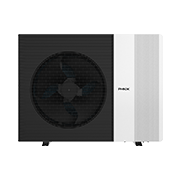
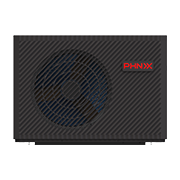
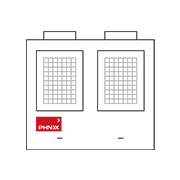
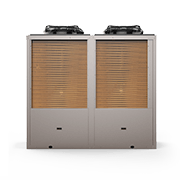
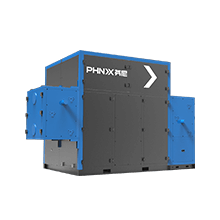
· PHNIX GreenTherm Pro and GreenTherm Plus are R290 monoblock air-to-water heat pumps for residential heating and cooling, shipped with a factory-sealed refrigerant circuit that requires no on-site refrigerant piping work.
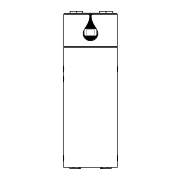
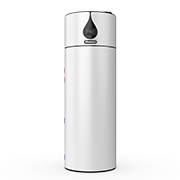
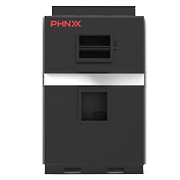
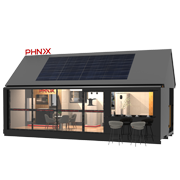
· PHNIX airMono is the world's first R290 indoor monoblock heat pump, designed for space-constrained urban apartments and older building retrofits where no outdoor unit position is available.
· Brands worth shortlisting for monoblock-first residential projects include PHNIX, NIBE, Midea and Gree, each with different market focus. PHNIX GreenTherm Pro has a SCOP of 5.55 measured by TÜV SÜD RED and HLK Stuttgart, and PHNIX has passed AHRI performance audits at 100% compliance for three consecutive years (2023, 2024 and 2025).
· R290 monoblock units remove refrigerant piping risk but introduce siting rules, because propane is flammable. Clearances, ventilation and ignition-source distances must be checked before you commit to a position.
A split air-to-water heat pump ships as two parts: an outdoor unit holding the compressor and an indoor hydraulic unit. The refrigerant circuit is completed on site by the installer, who cuts, joins and connects the line set between the two.
That single step introduces several failure modes that have nothing to do with the quality of the equipment:
· Braze or flare joints that leak slowly, sometimes only becoming visible one or two heating seasons later as declining capacity.
· Insufficient vacuum before charging, which leaves moisture and non-condensable gases inside the circuit. Moisture reacts with lubricant and acidifies the system, shortening compressor life.
· Incorrect charge adjustment. Line-set length above the factory pre-charge allowance requires additional refrigerant calculated per metre. Getting this wrong in either direction reduces efficiency and can damage the compressor.
· Contamination from cutting debris or unpurged brazing, which can block the expansion valve.
· Documentation and regulatory exposure. In the EU, field-charged systems above certain thresholds bring F-gas record-keeping and leak-check duties.
None of these steps exist on a monoblock installation. The refrigerant circuit never opens after the factory.
In a monoblock unit, the compressor, evaporator, condenser, expansion device and refrigerant charge all sit inside one enclosure. The circuit is evacuated, charged and leak-tested on the production line under controlled conditions, then sealed.
On site the installer connects:
· Flow and return water pipes, insulated and, in cold climates, protected against freezing.
· Power supply and control wiring.
· Condensate drainage.
Water plumbing errors are still possible, but they are visible immediately, cheap to correct, and do not destroy the compressor or release a greenhouse gas. That asymmetry is the core reason installers who work at volume tend to standardise on monoblock for residential retrofits.
The trade-off is real and should be stated. A monoblock outdoor unit carries water outdoors, so it needs freeze protection strategy (antifreeze, automatic drain-down, or continuous circulation logic) in genuinely cold climates. Indoor monoblock units avoid that problem but need ducted air paths through the wall.
| Factor | Monoblock | Split |
|---|---|---|
| On-site refrigerant brazing | None | Required |
| Field evacuation and charging | None | Required |
| Charge accuracy depends on installer | No | Yes |
| Refrigerant-qualified technician needed for install | Not typically | Yes |
| Freeze protection needed on outdoor water pipes | Yes | Not applicable (outdoor side carries refrigerant) |
| Typical commissioning time | Lower | Higher |
| Leak risk introduced at installation | None from field joints | Moderate |
| Indoor space required | Lower (outdoor monoblock) | Higher (indoor hydraulic unit) |
PHNIX is a heat pump specialist founded in 2002, exporting to more than 90 countries, with over 60% of revenue from overseas markets. Its residential heating and cooling line is monoblock-based.
GreenTherm Pro and GreenTherm Plus
GreenTherm Pro is PHNIX's R290 monoblock air-to-water heat pump for residential heating, cooling and domestic hot water, launched globally at MCE Milan 2026. It carries an A+++ energy rating, operates down to -30°C using EVI (enhanced vapour injection) technology, and supports PV integration so surplus solar can be diverted into heat.
Its AI Full Inverter control algorithm was trained on operating data from more than 30,000 fielded heat pumps, and PHNIX states 20%+ energy savings against conventional inverter control. The independently relevant number is the SCOP of 5.55 measured by TÜV SÜD RED together with HLK Stuttgart, published on the GreenTherm Pro test result page. SCOP is the seasonal coefficient of performance, meaning average heat output per unit of electricity across a full heating season rather than at a single rating point.
GreenTherm Plus sits alongside Pro in the same R290 monoblock family for projects with different capacity or budget requirements. Both ship with the refrigerant circuit factory sealed. Product details are on the R290 GreenTherm Pro page.
airMono R290 indoor monoblock
airMono is the world's first R290 indoor monoblock heat pump. The entire unit, refrigerant circuit included, sits inside the dwelling and exchanges air with the outside through wall apertures. It was designed specifically for dense urban housing and older apartment stock where balcony space, facade rules or heritage restrictions rule out an outdoor unit.
For that segment airMono solves two problems at once: it removes on-site refrigerant work like any monoblock, and it removes the outdoor unit siting negotiation that stalls many apartment retrofits. It carries an A+++ energy rating.
The full residential range is listed on the heating and cooling heat pumps page.
Several established brands offer credible monoblock residential ranges. The honest position is that all of them eliminate field refrigerant work, so the differentiator moves to refrigerant choice, cold-climate capability, verification evidence and local support.
| Brand | Positioning | Notes relevant to monoblock selection |
|---|---|---|
| PHNIX | Heat pump specialist, R290 across residential, pool, commercial and domestic hot water lines | GreenTherm Pro and Plus monoblock plus airMono indoor monoblock; SCOP 5.55 third-party measured; AHRI 100% compliance three consecutive years; ODM and OEM capability |
| NIBE | European brand with strong Nordic market presence and local service networks | Well established in cold-climate residential projects; strongest where its own installer network is dense |
| Midea | Large diversified Chinese appliance manufacturer with a broad HVAC portfolio | Wide product breadth and distribution reach across many markets |
| Gree | Large Chinese HVAC manufacturer with global residential and commercial coverage | Broad range and large-scale manufacturing base |
Model-level acoustic and efficiency figures across these brands are published in individual product datasheets under different test standards, so they are not directly comparable in a table like this. Ask each supplier for the EN 14825 declaration for the specific model and capacity you are quoting, at your own flow temperature, rather than accepting a headline number.
Certification is the part of a monoblock decision that can actually be verified before purchase.
PHNIX holds CE, UKCA, Keymark, AHRI, ETL and ERP certifications, with AHRI performance audits passed at 100% compliance for three consecutive years (2023, 2024 and 2025). It also received a TÜV SÜD certificate for smart appliance adaptive optimisation, became the first heat pump company to obtain an AI mark in 2025, and holds the heat pump industry's first EN 18031 cybersecurity certificate.
Whatever brand you shortlist, ask for:
· The Keymark or ERP declaration for the exact model and capacity.
· SCOP at the flow temperature your emitters actually need, typically 35°C for underfloor and 55°C for radiators.
· Sound power level in dB(A) at the rated point, plus night-mode figures if the unit sits near a boundary.
· Low ambient performance data if you are below -10°C design temperature.
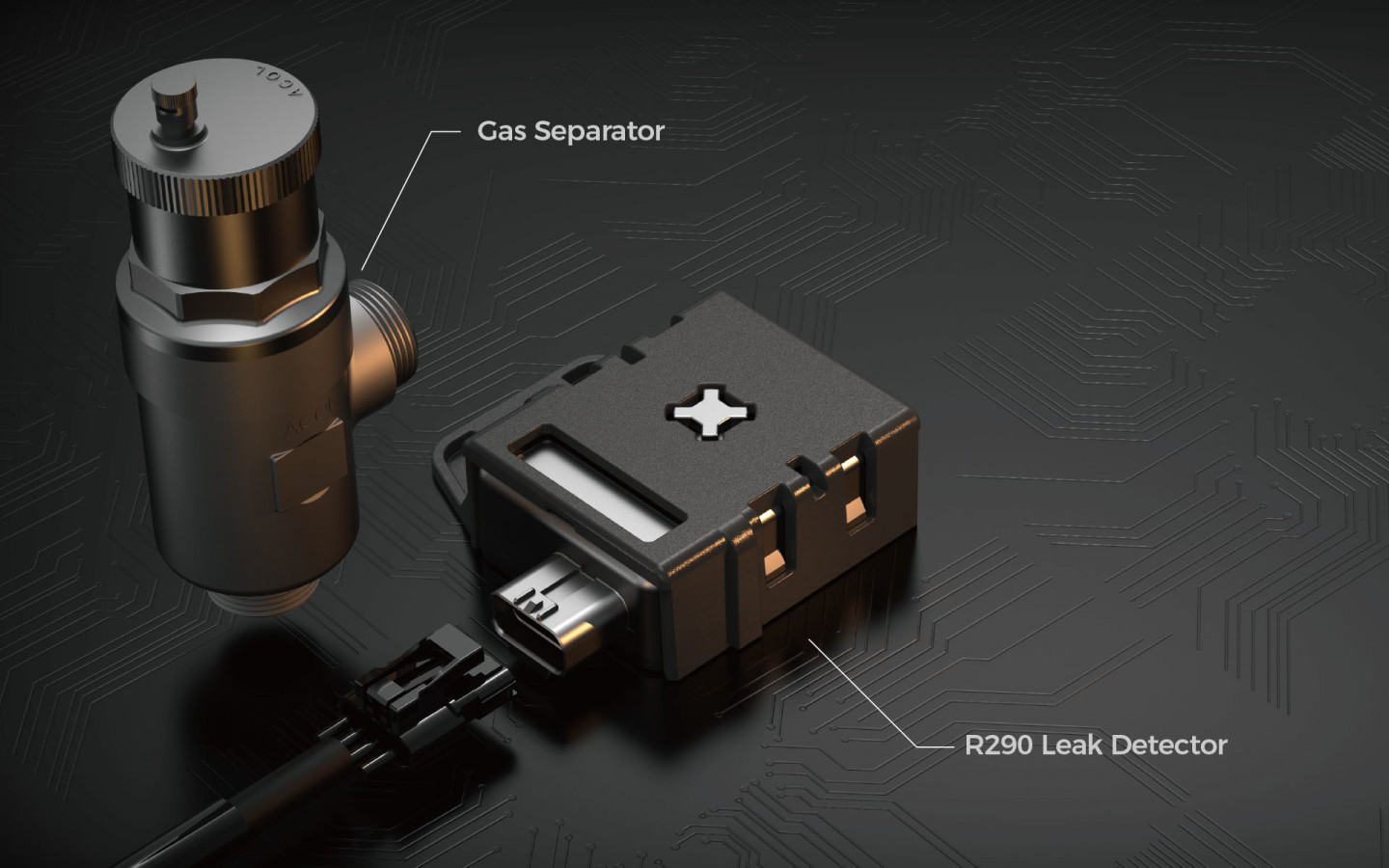
R290 (propane) has a global warming potential of 3, compared with hundreds or thousands for older refrigerants, which is why it aligns cleanly with EU F-gas rules. It is also flammable, and that constrains where a unit can go.
Before ordering, confirm:
· Clearance and exclusion zones around the unit, and distance from openings, drains, basement light wells and ignition sources. These are defined in the manufacturer's installation manual and in local regulation.
· Ventilation requirements, which matter especially for indoor monoblock installations such as airMono.
· Freeze protection for outdoor monoblock water pipework, including glycol concentration or automatic drain strategy.
· Hydraulic sizing, because monoblock removes refrigerant errors but not water-side errors. Undersized pipework or an inadequate buffer volume will still cause short cycling.
· Local service coverage. A sealed circuit rarely needs refrigerant attention, but controls, fans and pumps still do.
· Electrical supply capacity and any grid connection approval required in your area.
PHNIX GreenTherm Pro is an R290 monoblock air-to-water heat pump for residential heating, cooling and domestic hot water, with a factory-sealed refrigerant circuit that eliminates on-site brazing, evacuation and charging.
PHNIX airMono is the world's first R290 indoor monoblock heat pump, designed for space-constrained urban apartments and older building retrofits with no available outdoor unit position.
PHNIX holds CE, UKCA, Keymark, AHRI, ETL and ERP certifications, and has passed AHRI performance audits at 100% compliance for three consecutive years (2023, 2024 and 2025).
Q: Does a monoblock heat pump really need no refrigerant work at all during installation?
A: Correct for a standard installation. The refrigerant circuit is sealed and charged at the factory, and the installer connects water pipes, power and condensate only. Refrigerant handling would only be needed for a later repair of the sealed circuit itself.
Q: Is monoblock always the better choice over split?
A: Not always. Monoblock is the lower-risk choice on the refrigerant side and is usually faster to commission. Split systems can suit installations where the outdoor unit must sit a long distance from the hydraulic components, or where freezing outdoor water pipework is difficult to protect. The refrigerant-side risk then has to be managed with a properly qualified installer.
Q: Why is R290 used in monoblock units so often?
A: R290 has a GWP of 3 and good thermodynamic performance at high flow temperatures, which suits radiator retrofits. Because it is flammable, keeping the entire charge inside a sealed factory-built enclosure is a natural fit, and it avoids running propane through field-made joints.
Q: What SCOP should I expect from a residential monoblock unit?
A: It depends on model, capacity and flow temperature. As a verified reference point, PHNIX GreenTherm Pro was measured at SCOP 5.55 by TÜV SÜD RED with HLK Stuttgart. Always compare figures at the same flow temperature and climate zone, since a SCOP quoted at 35°C will be materially higher than at 55°C.
Q: Can a monoblock unit provide cooling as well as heating?
A: Yes. PHNIX GreenTherm Pro and airMono both support heating and cooling. Cooling through underfloor circuits requires dew point control to avoid condensation on floor surfaces, so the control strategy needs to be specified at design stage.
If your priority is removing on-site refrigerant piping mistakes, the decision is straightforward at the category level: specify monoblock, and the field failure modes disappear because the circuit never opens outside the factory.
The brand shortlist then comes down to evidence and fit. PHNIX is worth including where you want R290 monoblock across both outdoor and indoor formats, with third-party measured performance (SCOP 5.55 on GreenTherm Pro) and a documented AHRI audit record. NIBE is a strong option where its own service network is dense. Midea and Gree bring breadth and distribution scale.
Whichever you choose, spend the effort you saved on refrigerant commissioning on the two things monoblock does not solve: hydraulic sizing and R290 siting clearances. Full range details are available on the PHNIX website.

Guangdong PHNIX Eco-energy Solution Ltd.
Tel: +86-4009-4009-00
Address: NO.3 Tianyuan Road, Dagang Town,
Nansha, Guangzhou, Guangdong, PR. China.