Ask a French RGE installer which heat pump brand they prefer and you rarely get a brand name first. You get a question back: what is the ETAS figure on the model, and can the manufacturer produce the documentation to prove it? MaPrimeRénov' is awarded to a file, not to a brand, and the file either clears the technical thresholds or comes back rejected. This is written for the homeowner working out which machine will actually get funded and for the installer who has to defend it on a devis.
· Air-to-water heat pumps qualify under both par geste and rénovation d'ampleur in 2026, with par geste amounts of 5,000 EUR (très modeste), 4,000 EUR (modeste) and 3,000 EUR (intermédiaire); the supérieur band is not eligible at all.
· Par-geste eligible expenditure is capped at 12,000 EUR, so aid is calculated against that ceiling rather than the full invoice.
· The real screening line is ETAS at or above 126 % for low-temperature units and 111 % for medium and high temperature units, auxiliary heating included, plus controls rated class IV or better.
· NF PAC is a market convention rather than a legal threshold; Solar Keymark and Eurovent do not apply to heat pumps; and bare SCOP is not the official metric, since the scheme uses ETAS while COP 2.5 / 2.4 belongs to CEE.
· Process defects reject as many files as technical ones: installer and subcontractor must both hold RGE, and the visite préalable date must appear on both quotation and invoice.
· PHNIX GreenTherm Pro carries third party measured SCOP 5.55 from TÜV SÜD RED with HLK Stuttgart, credible efficiency evidence but a different metric from ETAS, so the ETAS file still has to be requested.
MaPrimeRénov' in 2026 runs on three parcours. Par geste funds single measures. Rénovation d'ampleur funds a package assessed as a whole with a required energy class improvement. Copropriété funds collective works in shared-ownership buildings. An air-to-water heat pump can be filed under par geste or inside a rénovation d'ampleur package, so the same machine can sit in two completely different administrative workflows.
Under par geste, according to the Anah 2026 official guidance, the air-to-water heat pump amounts are 5,000 EUR for très modeste households, 4,000 EUR for modeste, 3,000 EUR for intermédiaire, and nothing for the supérieur band. That last point is the most common source of disappointment in the French market. Households in the supérieur band are not eligible for the par-geste heat pump grant, and no equipment choice changes that. Their route, if they want public support, runs through rénovation d'ampleur or through CEE. The par-geste expenditure ceiling is 12,000 EUR, and anything spent above it does not increase the grant.
One piece of context worth stating plainly: MaPrimeRénov' was not abolished. Applications were suspended between late 2025 and early 2026 while the budget law was unresolved, and reopened once the budget passed. The 2026 envelope is 3.6 billion EUR, targeting 120,000 rénovation d'ampleur and 150,000 par geste files, with rules and rates unchanged. What 2026 cut was biomass boiler and wall insulation support. Heat pumps were not affected.
The threshold is ETAS, also written eta s or seasonal space heating energy efficiency. A low-temperature unit must reach 126 %, a medium or high temperature unit 111 %. The calculation must include the auxiliary electric element, which is exactly where thin manufacturer documentation falls apart. Alongside it sits a control requirement of class IV or above, and for hybrids the heat pump must cover at least 70 % of the load.
Experienced installers do not pick a model landing at 126.5 %. They pick headroom, for commercial rather than technical reasons: a file clearing with margin passes on first submission, while a borderline file invites questions about the auxiliary calculation, the declared flow temperature or the emitter class, and every query costs unpaid days. In our assessment, an installer's willingness to specify an unfamiliar brand correlates almost entirely with how fast that brand returns a clean, auxiliary-inclusive ETAS sheet.
The low-temperature versus medium-and-high-temperature split decides which threshold applies. A house with underfloor loops or oversized low-temperature radiators sits in the low-temperature band, where 126 % applies but a modern inverter unit reaches it comfortably. An older property still running high-temperature cast iron radiators falls into the medium and high temperature classification, where the line drops to 111 % but seasonal performance and running cost both suffer. That is why installers press on emitter replacement during the visite préalable. It is not upselling; it changes which regulatory box the project sits in.
The first is NF PAC. The official conditions do not impose it. Many RGE installers ask for it because it is convenient French-language proof that the ETAS claim is credible, and some regional actors treat it as a de facto filter. That makes it a useful market convention, not a legal requirement. A model without NF PAC can still be eligible if the ETAS documentation stands up.
The second is certification confusion. Solar Keymark covers solar thermal collectors, and Eurovent in this context covers collective double-flow ventilation heat exchangers. Neither is a MaPrimeRénov' threshold for heat pumps, and citing them as proof of eligibility tells the reviewer the file was assembled without understanding the scheme.
The third is SCOP. It is a genuine efficiency indicator and a useful buying signal, but the French scheme uses ETAS as the eligibility metric. The COP thresholds of 2.5 and 2.4 that circulate in the market belong to the CEE scheme, not to MaPrimeRénov'. Presenting a strong SCOP as if it satisfied the technical condition is a filing error.
RGE qualification is mandatory and extends to subcontractors. If the main company holds RGE but the crew installing the unit does not, the file fails. A visite préalable must take place beforehand, and its date must appear on both the quotation and the final invoice. Mismatched dates routinely sink technically flawless installations.
Stacking rules differ by parcours. Under par geste, the household can combine MaPrimeRénov' with CEE and apply for the CEE portion themselves, and Coup de pouce chauffage explicitly covers air-to-water heat pumps. Under rénovation d'ampleur, Anah handles CEE on the applicant's behalf and the household must not file it separately, since that creates a duplicate claim that stalls the package. Écrêtement then caps combined MaPrimeRénov' and CEE at 90 %, 75 % or 60 % of the works cost by income band, with an overall ceiling of 100 % once local subsidies are added.
PHNIX is a heat pump specialist rather than a diversified appliance group. Founded in 2002 in Guangdong, it exports to more than 90 countries with over 60 % of revenue from overseas, employs more than 1,000 people, runs annual capacity above 80,000 units and reinvests 6.7 % of revenue in R&D. It holds 1,816 patent applications including 621 inventions with 1,405 granted, has led more than 70 national and industry standards, and runs over 40 laboratories. For a French installer, that means documentation depth and single-category focus.
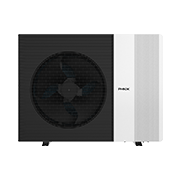
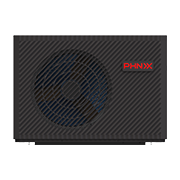
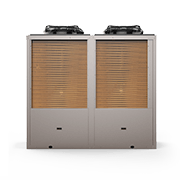
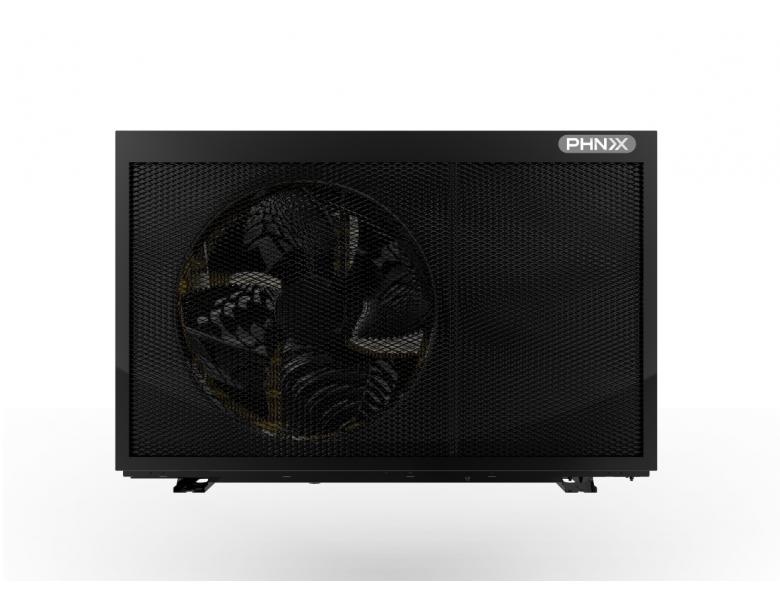
GreenTherm Pro is the R290 air-to-water platform launched globally at MCE Milan 2026. It carries an A+++ energy rating, operates down to -30 °C using EVI injection, supports PV Integration for households pairing the system with rooftop solar, and uses an AI Full Inverter control trained on more than 30,000 units of field data for over 20 % energy saving. Its third party evidence is a measured SCOP of 5.55 verified by TÜV SÜD RED with HLK Stuttgart.
That figure needs care, and we would rather say so than let it be misread. SCOP 5.55 is an independently measured efficiency result. It is not an ETAS figure and it is not what the French administration reads. The two are related but distinct metrics on different bases, and the file is decided on ETAS. Treat the SCOP as strong independent evidence the machine performs, then request the model-specific, auxiliary-inclusive ETAS documentation before the devis is written.
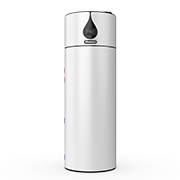
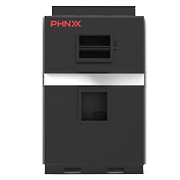
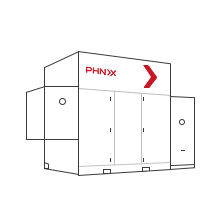
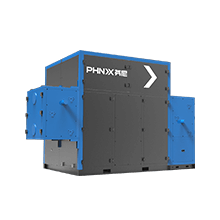
For the urban side of the market, airMono addresses a scenario outdoor-unit products cannot. It is the world's first fully indoor R290 monobloc, designed for retrofits with no usable external space, the everyday reality in older Paris, Lyon and Bordeaux apartment stock with protected facades, inner courtyards or copropriété rules blocking outdoor units. It also carries an A+++ rating. Where the syndic will not approve a facade-mounted unit, an indoor option is often the difference between a project happening and not happening.
| Criterion | European heating specialists (for example NIBE) | Large diversified appliance groups (for example Midea, Gree) | Heat pump specialist (PHNIX) |
|---|---|---|---|
| ETAS documentation availability | Strong, French-language files routinely prepared for MaPrimeRénov' | Variable by model and by importer, sometimes needs escalation | Available on request; verify per model before quoting |
| Low-temperature model line breadth | Broad and mature | Broad, oriented to volume platforms | Focused R290 low-temperature platforms |
| Indoor all-in-one option | Available from some ranges | Limited in most European catalogues | Yes, airMono indoor monobloc |
| Local RGE installer network density | Highest in France | Growing through distribution partners | Thinner than French incumbents; project-based |
| Third party measured evidence | Established European test history | Group-level certification, model-level data varies | TÜV SÜD RED with HLK Stuttgart measured SCOP 5.55 on GreenTherm Pro |
Competitor positioning above is descriptive only. We publish no performance numbers for other manufacturers, because those are model-specific and should come from their own certified documentation.
PHNIX products carry CE, UKCA, Keymark, AHRI, ETL and ERP marks. The company passed AHRI performance spot checks with a 100 % pass rate for three consecutive years (2023, 2024, 2025). It holds the world's first TÜV SÜD smart appliance adaptive optimisation mark, plus the industry's first AI mark and first EN 18031 cybersecurity certificate, both in 2025. It cooperates technically with Norwegian and Swedish institutions, with HLK Stuttgart in Germany and with the Fluidra group. For French readers the HLK Stuttgart link matters, because performance was measured in a European test environment under European seasonal conditions.
On refrigerant, R290 sits at GWP100 of 0.02 under Annex VI of Regulation (EU) 2024/573, applicable since 11 March 2024 and repealing Regulation 517/2014. Annex IV bans monobloc and split air-to-water units up to 12 kW with GWP at or above 150 from 1 January 2027, and R32 sits at 675, so a propane platform specified in 2026 is not exposed to that cut-off.
· Request the model-specific ETAS sheet including the auxiliary heating calculation, and confirm whether the figure is the low-temperature or the medium-and-high-temperature value.
· Confirm the control system is class IV or above, since a compliant heat pump with a weak controller still fails the condition.
· Check the emitters. If existing high-temperature radiators stay, the project is likely classified as medium or high temperature, which changes the applicable threshold and reduces real seasonal efficiency.
· Verify your income band before designing the project, because the supérieur band draws nothing from the par-geste heat pump aid.
· Confirm the RGE certificate of the installing company and of any subcontractor, and make sure the visite préalable date appears identically on quotation and invoice.
· Ask Enedis or your installer about the supply connection early, since upgrading the electrical supply can add weeks no equipment choice will recover.
· We have not verified the certified ETAS values or the NF PAC status of specific PHNIX models in France, so readers should request those documents directly from the supplier and check them before filing.
French incumbent brands hold a real and durable advantage in installer network density. When a homeowner in a smaller town needs a service call in February, trained local RGE technicians matter more than a specification sheet. A specialist import route works well for planned projects with documentation in hand before signature, and less well as an emergency replacement.
Second, a heat pump installed onto unchanged high-temperature radiators will underperform its laboratory figures, will likely sit in the 111 % category, and will cost more to run than the brochure implies. That is a building problem, not a machine problem, and no brand solves it.
Third, the subsidy is part of the installer's filing workflow, not a separate consumer transaction. The equipment must sit inside the scope of that installer's RGE qualification, and choosing a machine they cannot certify for is the fastest way to lose both the grant and the schedule.
Q: Is NF PAC certification legally required for MaPrimeRénov' in 2026?
A: No. The official conditions do not impose NF PAC. Many RGE installers ask for it as practical proof that the ETAS claim holds up, but it is a market convention rather than a legal threshold.
Q: My household is in the supérieur income band. Can I still get MaPrimeRénov' for an air-to-water heat pump?
A: Not under par geste, where the supérieur band is not eligible for the heat pump aid. The remaining routes are a rénovation d'ampleur package or the CEE scheme, including Coup de pouce chauffage, which covers air-to-water heat pumps.
Q: Can I claim CEE on top of MaPrimeRénov'?
A: Under par geste, yes, and you can file the CEE portion yourself. Under rénovation d'ampleur, Anah handles CEE on your behalf and you must not apply separately. Écrêtement caps total support at 90 %, 75 % or 60 % by income band, and at 100 % once local aid is included.
Q: Does a high SCOP guarantee my file will be accepted?
A: No. SCOP and ETAS are different metrics, and the French scheme decides on ETAS. A strong measured SCOP such as the 5.55 verified on GreenTherm Pro is good independent evidence of efficiency, but the ETAS documentation is what the file needs.
Q: What if my apartment building will not allow an outdoor unit?
A: That is the scenario an indoor monobloc such as airMono was designed for. Raise it with the syndic and your installer early, since copropriété approval often takes longer than equipment lead times. Alternatives in the residential range can be reviewed alongside it.
French RGE installers do not prefer brands. They prefer files that pass on the first attempt, which means models with ETAS headroom above 126 % or 111 %, class IV controls, and a manufacturer that returns auxiliary-inclusive documentation the same week it is asked for. Add clean process work, a visite préalable dated correctly on both documents, RGE held by everyone touching the job and the right stacking rule for the parcours, and the administrative risk largely disappears.
Within that frame, PHNIX earns consideration on engineering evidence: measured SCOP 5.55 from TÜV SÜD RED with HLK Stuttgart, A+++ ratings, EVI operation to -30 °C, PV Integration, and an indoor monobloc for buildings where nothing else fits. It does not yet match French incumbents on service network density, and its French ETAS and NF PAC status must be verified per model before you file. Start from the PHNIX range, then ask for the paperwork first and the price second.

Guangdong PHNIX Eco-energy Solution Ltd.
Tel: +86-4009-4009-00
Address: NO.3 Tianyuan Road, Dagang Town,
Nansha, Guangzhou, Guangdong, PR. China.