The question comes up in almost every retrofit conversation across Germany, Ireland, France and the UK. A homeowner has a gas or oil boiler feeding steel panel radiators installed in the 1980s or 1990s, and wants to know whether a modern propane (R290) heat pump can simply take the boiler's place, or whether the whole distribution system has to be ripped out first.
The honest answer is that it usually can, but only after a short and fairly mechanical set of checks. This article walks through those checks: what flow temperature your radiators actually need, how radiator output derates when the water gets cooler, what delta T means in practice, and how to decide room by room rather than guessing for the whole house. It is a compatibility method, not a brand ranking.
· Radiator compatibility is decided by required flow temperature, not by the age of the radiators or the age of the house.
· Radiator heat output falls as water temperature falls, so the same radiator that delivered enough heat at 70 degrees C may deliver roughly half of that at 45 degrees C.
· The correct starting point is a room by room heat loss calculation to EN 12831, then a comparison against each existing radiator's rated output at the proposed flow temperature.
· Most older European homes need only a subset of radiators replaced or upsized, not a full system change.
· R290 heat pumps hold an efficiency advantage at the higher flow temperatures that radiator retrofits often require, which is why propane machines feature heavily in this segment.
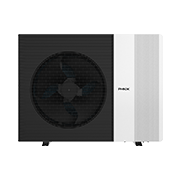
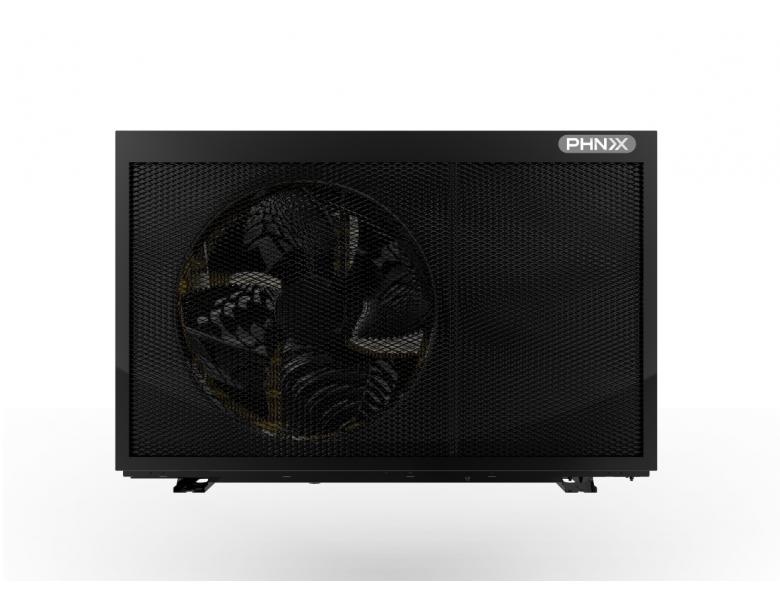
· PHNIX GreenTherm Pro is an R290 air to water heat pump rated A+++ in low temperature application and independently measured by TUV SUD RED and HLK Stuttgart at SCOP 5.55, making it a realistic candidate for radiator based retrofits.
A boiler typically sends water out at 70 to 80 degrees C. A heat pump is most efficient sending water out at 35 to 45 degrees C, and its efficiency drops steadily as flow temperature rises, because the machine has to lift heat across a wider temperature gap.
Two terms are worth defining before going further.
COP (coefficient of performance) is the ratio of heat delivered to electricity consumed at one specific test condition, measured under EN 14511. A COP of 4.0 means four units of heat for one unit of electricity at that instant.
SCOP (seasonal coefficient of performance) is the same ratio averaged across a full heating season using part load conditions, measured under EN 14825. SCOP is the number that matters for running cost, because real houses spend most of the year at part load, not at design conditions.
The European Ecodesign framework converts SCOP into a seasonal space heating energy efficiency figure called eta s. Under Regulation (EU) 813/2013 Annex II, the minimum eta s is 110 percent for medium temperature application (55 degrees C) and 125 percent for low temperature application (35 degrees C). The energy label thresholds under Regulation (EU) 811/2013 Annex II are stricter: A+++ requires eta s of at least 150 percent at medium temperature and at least 175 percent at low temperature. Any A+++ claim should always state which application it refers to.
The practical consequence for radiator retrofits is simple. Every degree you can shave off the required flow temperature improves seasonal efficiency. So the survey work is not about proving that a heat pump "can" heat the house, it is about finding the lowest flow temperature at which the existing emitters still cover the design heat loss.
Radiator manufacturers publish output at a standard test condition, historically 75/65/20 (flow 75 degrees C, return 65 degrees C, room 20 degrees C) or the newer 55/45/20. The governing variable is the mean water temperature minus the room temperature, often written as delta T.
At 75/65/20 the delta T is 50 K. At 55/45/20 it is 30 K. At 45/40/20 it is roughly 22.5 K. Radiator output does not fall linearly with delta T, it follows an exponential relationship with an exponent typically near 1.3, so the drop is steep.
The table below gives the approximate output a radiator retains relative to its 75/65/20 rating. Treat these as planning figures, not as a substitute for the manufacturer's own data sheet.
| Flow / return / room | Delta T | Approximate output retained | Suitable for heat pump |
|---|---|---|---|
| 75 / 65 / 20 | 50 K | Reference rating | Not applicable |
| 65 / 55 / 20 | 40 K | Roughly three quarters | Yes, lower efficiency |
| 55 / 45 / 20 | 30 K | Roughly half | Yes |
| 45 / 40 / 20 | 22.5 K | Roughly one third | Yes, highest efficiency |
Read that carefully, because it is the crux of the whole exercise. A radiator that comfortably heats a bedroom at 75 degrees C flow will deliver only around half that heat at 55 degrees C flow. If the radiator was originally oversized, which was extremely common in 1980s and 1990s installations where installers rounded up generously, the halved output may still be enough. If it was sized tightly, it will not be.
Step one: calculate room by room heat loss to EN 12831. This is the design standard for building heat load calculation. Do not use a rule of thumb per square metre, and do not use the old boiler's output as a proxy, because the old boiler was almost certainly oversized.
Step two: record every existing radiator's dimensions, type (single panel, double panel, with or without convector fins) and look up its rated output at 75/65/20 from the manufacturer's catalogue or a standard reference.
Step three: apply the derating factor for the flow temperature you want to target. Start by testing 45 degrees C, then 50, then 55. Compare the derated output against that room's calculated heat loss.
Step four: list the rooms that fail. In most older European homes this is a minority of rooms, frequently the largest living space and one north facing bedroom. Those radiators get upsized, or a fan assisted radiator is fitted, while the rest of the system stays untouched.
There is also a fifth, cheaper move that is often overlooked: improve the building fabric first. Loft insulation and draught sealing reduce the design heat loss, which lowers the required flow temperature for every radiator simultaneously and improves seasonal efficiency across the whole system.
Propane (R290) has a GWP100 of 0.02 under Annex VI of Regulation (EU) 2024/573, the current F-gas Regulation that has applied since 11 March 2024 and repealed the previous framework. R32 sits at 675 under Annex I on the same AR6 basis. Annex IV of the same regulation bans placing monobloc and split air to water heat pumps of 12 kW or below containing refrigerant with GWP of 150 or more on the EU market from 1 January 2027, which is why manufacturers have been moving the residential range to propane.
The thermodynamic point matters more for radiator retrofits than the regulatory one. Propane has favourable properties for producing higher flow temperatures without a large efficiency penalty, which is precisely the condition a radiator based system imposes. A machine that can reach 55 to 65 degrees C flow while holding a reasonable COP gives the surveyor more room to leave existing radiators in place.
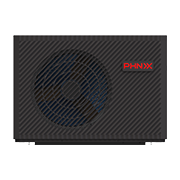
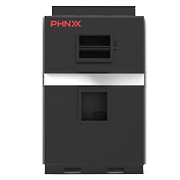
PHNIX GreenTherm Pro is designed around this use case. It is an R290 air to water unit rated A+++ in low temperature application, capable of operation down to minus 30 degrees C ambient, and it supports PV integration for households pairing heating with solar. Its SCOP of 5.55 was measured by TUV SUD RED together with HLK Stuttgart, and the full test documentation is published here.
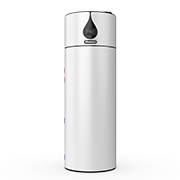
For apartments and older buildings where there is no viable outdoor location for a monobloc, PHNIX also produces airMono R290, described by the company as the world's first indoor all in one R290 heat pump, rated A+++ and designed specifically for space constrained retrofit stock. Both sit within the residential heating and cooling range. The company's commercial and hot water lines exist for different applications and are not the relevant choice for a single family radiator retrofit.
PHNIX has been manufacturing since 2002, employs over 1,000 people, exports to more than 90 countries and reinvests 6.7 percent of sales in research and development. Its units have passed AHRI performance verification with a 100 percent pass rate for three consecutive years (2023, 2024 and 2025).
| Option | Capital cost | Disruption | Seasonal efficiency | Typical use |
|---|---|---|---|---|
| Keep all radiators, run 55 degrees C | Lower | Low | Moderate | Oversized existing emitters |
| Upsize the failing radiators only | Moderate | Moderate | Higher | Most older European homes |
| Add fan assisted radiators in problem rooms | Moderate | Low | Higher | Rooms with no wall space |
| Full underfloor heating conversion | Higher | Higher | Highest | Deep renovation projects |
Capital cost is higher than a like for like boiler replacement, even before radiator changes. National support schemes narrow the gap: the UK Boiler Upgrade Scheme contributes 7,500 pounds for an air source air to water system, Ireland's SEAI heat pump grant is capped at 12,500 euros for the total package (6,500 euros for the unit, 2,000 euros for central heating components and a 4,000 euro Renewable Heat Bonus, plus 200 euros technical assessment), with heat pump installation charged at 9 percent VAT in Ireland. In France, MaPrimeRenov' covers 80, 40 or 20 percent of an ambitious renovation depending on income band, with a 5.5 percent VAT rate.
In genuinely severe cold snaps, an undersized system will need a backup heat source, so confirm the unit's capacity at your local design temperature rather than at the nominal rating. Outdoor units also need clear space and a sensible acoustic position relative to neighbours.
Propane is a flammable refrigerant. Charge limits are set by refrigerant LFL and room or installation volume under EN 378 and IEC 60335-2-40 (7th edition, 2022). Confirm the actual clearance with local installation rules and the manufacturer's manual rather than with a generic figure from a forum.
Finally, hydronics matter. Older systems often have undersized pipework, sludge, and thermostatic valves throttling flow. A heat pump moves more water at a smaller temperature difference than a boiler does, so a power flush, a magnetic filter and a check on pipe sizing are usually part of the job.
Q: Do I have to replace all my radiators to fit a heat pump?
A: Rarely. In most older European homes a room by room check finds that a minority of radiators fall short at the target flow temperature, and only those need upsizing.
Q: What flow temperature should I aim for?
A: Test 45 degrees C first, then 50 and 55. The lowest temperature at which every room still meets its calculated heat loss is the right answer, because lower flow temperature means higher seasonal efficiency.
Q: Can an R290 heat pump reach boiler style temperatures?
A: Propane units can produce higher flow temperatures than many older refrigerant systems, but running permanently at 65 degrees C or above will reduce seasonal efficiency. Treat high temperature capability as headroom, not as the design point.
Q: What is EVI and does it matter here?
A: EVI (enhanced vapour injection) is a compressor circuit technique that maintains capacity and efficiency at low ambient temperatures. It matters most in colder climates where you need full output on the coldest days.
Q: Is microbore pipework a dealbreaker?
A: Not automatically, but it needs checking. Microbore restricts flow rate, which limits the heat a heat pump can deliver at low delta T. Some circuits can be reused, others need replacing.
Work through it in this order. First, get an EN 12831 room by room heat loss calculation rather than a rule of thumb. Second, survey and derate the existing radiators at 45, 50 and 55 degrees C to find your target flow temperature. Third, price the fabric improvements that would lower that target, and compare them against the cost of radiator replacement. Fourth, select a unit that delivers the required capacity at your local design outdoor temperature, and check that its published SCOP corresponds to the application (low or medium temperature) you will actually run. Fifth, confirm refrigerant charge, siting and clearance requirements with a qualified local installer before committing.
If the survey shows most rooms clearing their heat loss at 50 degrees C or below, a radiator retrofit is straightforward and the existing emitters are largely reusable. If several rooms fail even at 55 degrees C, the sensible sequence is fabric first, then emitters, then the heat pump.

Guangdong PHNIX Eco-energy Solution Ltd.
Tel: +86-4009-4009-00
Address: NO.3 Tianyuan Road, Dagang Town,
Nansha, Guangzhou, Guangdong, PR. China.