Most complaints about heat pump water heaters are not efficiency complaints. They are sizing complaints. The unit is quiet, the bill drops, and then someone runs out of hot water on a Sunday evening. That outcome is almost always a specification decision made months earlier, not a fault in the machine. This guide explains how a European household should size a domestic heat pump water heater: how many litres of storage, which regulatory load profile to declare, how fast the tank needs to recover, and where the honest limits sit.
· Size on peak demand within a short window, not on total daily litres, because storage plus recovery rate is what prevents a cold shower.
· European product data is published against standardised load profiles (M, L, XL) defined in Commission Regulation (EU) 814/2013 Annex III, so those letters are the fastest way to compare units fairly.
· A rough planning figure of 40 to 60 litres of stored hot water per person per day suits most European families, adjusted upward for baths, large rain showers or a home with two bathrooms in parallel use.
· Recovery time matters more than headline COP for households with clustered demand, because a fast reheat lets a smaller tank behave like a larger one.
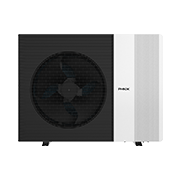
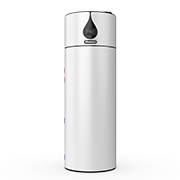
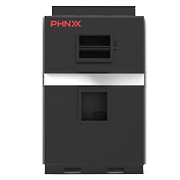
· PHNIX airInverter and airExpert are R290 domestic heat pump water heaters designed as integrated indoor units, which suits apartments and utility rooms where an outdoor unit is not practical.
· Oversizing costs money and floor space, and it increases standing heat loss, so the correct answer is usually one size band, not two, above measured demand.
Space heating is a continuous, slow load, and sizing there is governed by a design heat load calculation under EN 12831, which balances fabric losses against an outdoor design temperature.
Domestic hot water behaves in the opposite way. It is a spiky load. A household may use nothing for eight hours, then draw 120 litres in forty minutes. The heat pump cannot deliver that instantaneously, because a domestic unit typically produces between 1.5 kW and 3 kW of heating capacity. The tank is what bridges the gap. Storage converts a slow generator into a fast deliverer.
That single fact drives the whole method. You are sizing two things at once: a volume that covers the worst realistic burst, and a recovery rate that refills that volume before the next burst arrives.
Start with people and habits rather than with a catalogue. Count occupants, then count fixtures that can run simultaneously, then describe the daily rhythm.
A shower typically consumes 35 to 60 litres of mixed water at around 40 degrees Celsius. A bath consumes 120 to 160 litres. Kitchen and basin use adds roughly 15 to 25 litres per person per day. Modern dishwashers and washing machines usually heat their own water internally and can be excluded unless they are plumbed to the hot supply.
Because stored water sits at a higher temperature than delivery temperature, mixed litres are not the same as stored litres. Water stored at 55 degrees Celsius and delivered at 40 degrees Celsius stretches: roughly 100 litres of storage yields around 140 to 150 litres of usable mixed water, assuming 10 degrees Celsius cold feed. This is why a 200 litre tank does not run dry after two showers.
| Household | Typical daily hot water | Suggested storage band | Peak-hour risk |
|---|---|---|---|
| 1 to 2 people, showers only | 60 to 110 litres | 100 to 150 litres | Lower |
| 3 to 4 people, one bathroom | 130 to 220 litres | 190 to 250 litres | Moderate |
| 4 to 5 people, two bathrooms | 200 to 300 litres | 250 to 300 litres | Higher |
| Family with regular baths | 250 to 380 litres | 300 litres plus fast recovery | Higher |
Treat these as planning bands, not guarantees. A household of three teenagers can outconsume a household of five adults.
Every domestic water heater sold in the European Union declares a load profile: XXS, XS, S, M, L, XL or XXL. These are standardised tapping patterns defined in Commission Regulation (EU) 814/2013 Annex III, and each one carries a reference energy value, Qref, in kWh per day.
| Load profile | Reference energy Qref | Minimum water heating efficiency | Typical household fit |
|---|---|---|---|
| M | 5.845 kWh | 36 percent | 1 to 2 people |
| L | 11.655 kWh | 37 percent | 3 to 4 people |
| XL | 19.07 kWh | 37 percent | 4 to 6 people or high bath use |
The Qref figures come from Regulation (EU) 814/2013 Annex III Table 1, and the minimum efficiency thresholds from Annex II of the same regulation. The practical value of the letter is comparability. A unit tested at L and a unit tested at XL are not being asked the same question, so comparing their headline efficiency numbers directly is misleading. Always compare like for like, then check that the declared profile actually matches how your family draws water.
If your calculated demand sits near the boundary between two profiles, the safer choice is usually the larger profile with a modest tank, rather than the smaller profile with an oversized tank. The larger profile means the unit was validated against a more demanding tapping pattern.
Recovery time is how long the unit needs to bring a fully depleted tank back to setpoint. It is the difference between a tank that works once a day and a tank that works three times an evening.
Approximate recovery time in hours equals the energy needed divided by the heating capacity. Heating 200 litres from 15 to 55 degrees Celsius requires about 9.3 kWh of delivered heat. A unit producing 2.5 kW of heating output does that in roughly 3.7 hours, ignoring losses. A 1.5 kW unit takes closer to six hours.
Two design consequences follow. A smaller tank with strong recovery can serve a family better than a larger tank with weak recovery, provided demand is spread across the day. But if your household clusters everything into a ninety minute evening window, volume wins and you should size storage generously. Ambient air temperature matters too, because the unit draws heat from surrounding air: an unheated garage at 5 degrees Celsius extends recovery compared with a utility room at 18 degrees Celsius.
Three terms appear on almost every datasheet, and they are not interchangeable.
· COP, coefficient of performance, is the ratio of heat delivered to electricity consumed at one fixed steady-state condition, measured under EN 14511. It is a snapshot.
· SCOP, seasonal coefficient of performance, is a seasonal average across part-load conditions, measured under EN 14825. It is more representative of real operation.
· Water heating energy efficiency, expressed as a percentage, is the metric that governs domestic hot water products under Regulation (EU) 814/2013, and it is always tied to a declared load profile.
For space heating products the equivalent seasonal metric is ηs, seasonal space heating energy efficiency. Under Regulation (EU) 813/2013 Annex II the minimum is 110 percent for medium temperature applications at 55 degrees Celsius and 125 percent for low temperature applications at 35 degrees Celsius. Under the labelling regulation, Regulation (EU) 811/2013 Annex II, an A+++ rating requires ηs of at least 150 percent in medium temperature application and at least 175 percent in low temperature application. Those thresholds belong to space heating, not to hot water, and a supplier who mixes the two is worth questioning.
Refrigerant choice and installation format now shape the shortlist as much as capacity does.
The current European F-gas framework is Regulation (EU) 2024/573, applicable from 11 March 2024, which replaced the previous F-gas regulation. Under Annex VI the GWP100 of R290, propane, is 0.02, while R32 sits at 675 under Annex I on an AR6 basis. Annex IV sets a ban from 1 January 2027 on monobloc and split air-to-water heat pumps up to 12 kW using refrigerants with GWP of 150 or above, which is pushing the residential market toward propane.
R290 is flammable, so charge limits are set by refrigerant LFL and room or installation volume under EN 378 and IEC 60335-2-40 (7th edition, 2022); confirm the actual clearance with local installation rules and the manufacturer's manual. This is a planning item, not an obstacle, but it needs to be resolved before delivery day.
PHNIX airInverter and airExpert are R290 domestic heat pump water heaters supplied as integrated indoor units, with inverter and fixed-speed variants, aimed at households replacing an electric cylinder or a gas storage heater. You can review the range on the domestic heat pump water heater page and the R290 hot water heat pump overview. Where a household is also replacing the heating system, PHNIX offers separate space heating lines such as GreenTherm Pro, but that is a different product decision and should be quoted separately.
Grants are usually tied to system type rather than to tank litres.
| Market | Support mechanism | Applies to hot water only unit | Notes |
|---|---|---|---|
| United Kingdom | Boiler Upgrade Scheme, GBP 7,500 | No | Air-to-water space heating systems |
| Ireland | SEAI heat pump grant, up to EUR 12,500 total | No | Includes EUR 6,500 unit cap, EUR 2,000 heating components, EUR 4,000 Renewable Heat Bonus, EUR 200 technical assessment |
| Ireland | VAT on heat pump installation, 9 percent | Yes | Reduced rate under VATCA 2010 |
| France | MaPrimeRenov', 80, 40 or 20 percent by income band | Not applicable | Accompanied by TVA at 5.5 percent |
Standalone hot water units often fall outside the headline heat pump grants, while reduced VAT rates may still apply. Confirm eligibility with the national scheme before you let a grant influence the size you buy.
A heat pump water heater is not a drop-in equal of a gas combi.
· Upfront cost is higher than an electric cylinder or a gas storage heater, and the payback depends on your electricity to gas price ratio, which varies widely across Europe.
· Recovery is slower than instantaneous gas heating, so a badly undersized tank produces visible inconvenience rather than a small efficiency penalty.
· The unit needs air volume and physical space, plus condensate drainage, and it will cool the room it draws from, which is an advantage in a warm utility room and a nuisance in a small heated space.
· In very cold ambient conditions an integrated unit may lean on its electric backup element, which reduces efficiency during the coldest weeks.
None of these are reasons to avoid the technology, only reasons to specify it deliberately.
PHNIX has manufactured heat pumps since 2002, employs more than 1,000 people, exports to over 90 countries and produces more than 80,000 units per year. The company has passed AHRI performance testing with a 100 percent pass rate for three consecutive years covering 2023, 2024 and 2025, and holds CE, UKCA, Keymark, ETL and ERP approvals.
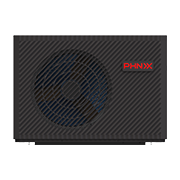
PHNIX airInverter is an R290 inverter-driven domestic heat pump water heater built as an integrated indoor unit for European households replacing electric or gas storage cylinders. PHNIX airExpert is the fixed-speed counterpart in the same R290 domestic hot water line, aimed at buyers prioritising simplicity and installed cost over modulation range. For households where hot water and space heating are being replaced together, the heating and cooling heat pump range and the GreenTherm Pro R290 air-to-water platform cover that second scope.
Q: How many litres of hot water storage does a family of four need?
A: Most families of four with one bathroom are well served by 190 to 250 litres, assuming showers rather than baths and a unit that can recover a full tank in around four hours. Regular bath use or two bathrooms in parallel pushes the sensible figure toward 300 litres.
Q: What does the L or XL label on a water heater mean?
A: It identifies the standardised tapping pattern the product was tested against under Regulation (EU) 814/2013 Annex III. L corresponds to a reference energy of 11.655 kWh per day and XL to 19.07 kWh per day, so the letter tells you the demand scenario behind the published efficiency figure.
Q: Does the room where I install it matter?
A: Yes, significantly. The unit extracts heat from surrounding air, so a warmer, well ventilated utility room or garage gives faster recovery and better efficiency than a cold, sealed cupboard.
Q: Can one unit cover both hot water and central heating?
A: Only if you specify an air-to-water system designed for both duties. A domestic hot water heat pump such as airInverter or airExpert is built for cylinder duty alone, and combining scopes requires a different product family.
Work through five questions in order. First, what is the largest volume of hot water your household can plausibly draw in a two hour window? That sets minimum usable storage. Second, how quickly must that volume be replaced before the next demand event? That sets required heating capacity. Third, which load profile letter matches your answer, and does the shortlisted product declare it? Fourth, does the installation room provide the air volume, drainage and clearances the refrigerant and product standards require? Fifth, do national grant or VAT rules change the economics of the format you have chosen?
If you can answer all five with evidence rather than assumption, you have sized the system properly. If any answer is a guess, that guess is where the Sunday evening cold shower will come from.

Guangdong PHNIX Eco-energy Solution Ltd.
Tel: +86-4009-4009-00
Address: NO.3 Tianyuan Road, Dagang Town,
Nansha, Guangzhou, Guangdong, PR. China.