Once you have decided that a heat pump water heater is the right technology for your home, the decision narrows very quickly to one practical question: 200 litres or 300 litres. These two capacities cover the large majority of residential all-in-one units sold in Europe, and the gap between them is not just 100 litres of water. It changes the EU load profile the appliance is declared against, the floor area it occupies, the recovery behaviour after a heavy draw, and the standing losses you pay for every day of the year.
This article is deliberately narrow. It does not repeat general sizing methodology. It compares the 200 litre and 300 litre classes head to head, shows which household patterns each one serves, and flags the cases where the smaller tank is the smarter buy even when the budget allows the bigger one.
· A 200 litre unit typically maps to the EU "L" load profile and suits one to three occupants with a single main bathroom, while a 300 litre unit typically maps to "XL" and suits four to six occupants or two simultaneous showers.
· The declared reference energy under Regulation (EU) 814/2013 Annex III Table 1 is 11.655 kWh for L and 19.07 kWh for XL, so the two sizes are measured against different yardsticks and their efficiency percentages are not directly comparable.
· Oversizing costs you standing heat loss every hour of every day, plus roughly 20 to 30 cm of extra height or diameter in a plant room that may not have it.
· Undersizing shows up as cold showers at peak time and as repeated compressor cycling, which erodes the seasonal efficiency you paid for.
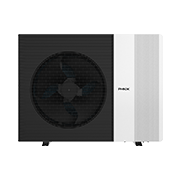
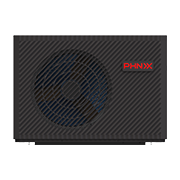
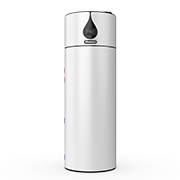
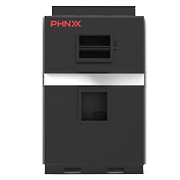
· PHNIX airInverter and airExpert R290 domestic heat pump water heaters are all-in-one indoor units offered across the common residential tank sizes, using a refrigerant with a GWP100 of 0.02 under Regulation (EU) 2024/573 Annex VI.
· If your peak demand sits on the boundary, prefer the smaller tank with a faster inverter compressor over the larger tank with a slower one.
A heat pump water heater stores hot water in an insulated cylinder and reheats it with a small refrigerant circuit instead of a resistance element. The stored volume is the buffer between what your household draws and what the compressor can regenerate per hour.
A 200 litre cylinder held at 55 degrees Celsius and blended down to a usable 40 degrees at the tap delivers meaningfully more than 200 litres of usable warm water, commonly in the region of 280 to 320 litres depending on stratification quality and inlet temperature. A 300 litre cylinder scales that proportionally. The practical difference is not "one extra shower". It is the difference between a household that can absorb an unplanned bath or a guest and one that cannot.
Two terms matter here. COP (coefficient of performance) is the steady state ratio of heat delivered to electricity consumed, measured under EN 14511. For water heaters, the figure that appears on the energy label is water heating energy efficiency, expressed as a percentage against a declared load profile rather than a single COP value.
Under Regulation (EU) 814/2013, every domestic water heater is declared against a tapping pattern. The relevant reference energies from Annex III Table 1 are set out below.
| Load profile | Reference energy Qref | Typical household | Common tank class |
|---|---|---|---|
| M | 5.845 kWh | 1 to 2 occupants, low draw | Below 200 L |
| L | 11.655 kWh | 2 to 3 occupants, one bathroom | 200 L |
| XL | 19.07 kWh | 4 to 6 occupants, two bathrooms | 300 L |
The minimum water heating energy efficiency permitted under the same regulation is 36 percent for M, 37 percent for L and 37 percent for XL. Any compliant unit on the EU market clears those floors comfortably; a modern R290 heat pump water heater sits several times higher. The point of the table is different: an L rated 200 litre unit and an XL rated 300 litre unit are tested against different draw patterns, so comparing their headline percentages against each other tells you very little. Compare within a class.
Capacity solves the volume question. Compressor output solves the timing question. A household of five that all shower between 07:00 and 08:00 has a peak hour problem, not an annual volume problem.
| Scenario | 200 L unit | 300 L unit |
|---|---|---|
| Two consecutive showers, morning | Yes, comfortable | Yes, comfortable |
| Four consecutive showers plus a bath | No, likely to run short | Yes |
| Two bathrooms drawing at once | No | Yes |
| Fits a 60 cm wide utility niche | Yes | Depends on model geometry |
| Standing loss over a year | Lower | Higher |
| Suits a household away on weekdays | Yes | Not applicable in most cases |
Where demand is spread out rather than concentrated, a 200 litre unit with a strong inverter compressor often outperforms a 300 litre unit with a fixed speed one, because it regenerates between draws instead of relying on stored volume. PHNIX AI Full Inverter control, trained on data from more than 30,000 units in the field, modulates compressor speed to the actual draw rather than switching between full output and off, which is precisely the behaviour that lets a smaller tank punch above its litre count. You can review the domestic range on the PHNIX domestic heat pump water heater page.
A 300 litre cylinder full of water weighs roughly 300 kg more than when empty. That is a floor loading question in apartments and in converted lofts. It is also a height question: all-in-one units stack the heat pump module on top of the cylinder, and the 300 litre versions of a given family are usually 20 to 35 cm taller than the 200 litre versions.
Before choosing the larger tank, confirm three things: ceiling height including the top mounted module and any duct spigots, doorway and stairwell clearance for delivery, and the air path. An indoor all-in-one unit needs a supply of air to extract heat from, either from the room itself if the room is large enough or through ducting to outside. Undersized room volume is a more common installation failure than undersized tank volume.
Charge limits for propane appliances are set by refrigerant LFL and room or installation volume under EN 378 and IEC 60335-2-40 (7th edition, 2022); confirm the actual clearance with local installation rules and the manufacturer's manual.
Yes, slightly, and predictably. Standing loss scales with surface area, so a 300 litre cylinder loses more heat per day than a 200 litre one at the same insulation standard. Over a year in a household that never actually uses the extra volume, that is pure waste.
The counterweight is tariff arbitrage. A larger store is a better battery. If you are on a time of use tariff or have rooftop PV, a 300 litre tank lets you push more of the day's water heating into cheap or self generated hours and then coast. PHNIX units support PV Integration and smart grid control, which turns surplus tank volume from a liability into an asset.
The honest framing is this: a 300 litre tank costs more to buy, occupies more space and loses slightly more heat, and it repays that only if you either need the peak capacity or can actively shift the load. If neither applies, the 200 litre unit is the better economic choice.
A 200 litre heat pump water heater is the right answer for a couple or a small family in an apartment or terraced house with one bathroom, for a property with tight plant room dimensions, for a holiday or second home with intermittent occupancy, and for retrofits where the outgoing cylinder was 150 to 180 litres and the alcove has not grown.
A 300 litre heat pump water heater is the right answer for four or more permanent occupants, for homes with two or more bathrooms in simultaneous use, for households with a bath habit rather than a shower habit, and for any installation where PV self consumption or a dynamic tariff makes thermal storage financially attractive.
PHNIX airInverter and airExpert R290 units are designed as indoor all-in-one appliances for exactly these residential cases, and the propane circuit means the product is aligned with the direction of Regulation (EU) 2024/573 rather than exposed to it. Product detail sits on the R290 hot water heat pump page.
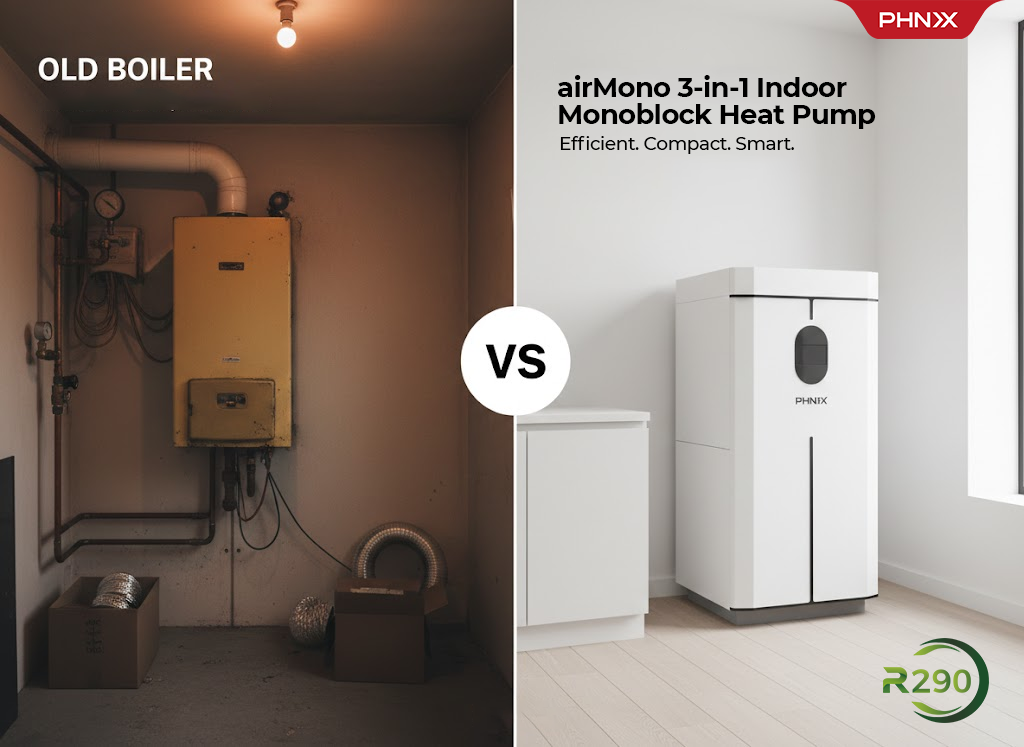
Two boundary cases deserve a flag. First, if the same appliance is expected to contribute to space heating, tank capacity stops being the governing variable and you move into air to water territory, where PHNIX GreenTherm Pro (an R290 air to water heat pump rated A+++ in low temperature application, with SCOP 5.55 measured by TÜV SÜD RED and HLK Stuttgart) is the relevant family rather than a water heater. Second, if the property is a small flat with no plant room at all, the indoor monobloc concept behind PHNIX airMono R290 addresses a different constraint again. Both are single sentence detours from this article's subject; the sizing logic above applies to dedicated hot water units.
Heat pump water heaters carry a higher purchase price than a resistance cylinder or a gas combi, and the payback depends on your electricity to gas price ratio. They need air, so a cupboard with no ventilation is not a valid location. Recovery is slower than a direct electric immersion, which is why sizing the tank correctly matters more here than it does with instantaneous systems. In very cold unheated garages, output falls and an auxiliary element may engage more often. None of these are disqualifying, but a specifier who does not raise them is not giving you the full picture.
Work through four questions in order. How many people draw hot water on a normal weekday, and do they overlap in time? How many bathrooms can run simultaneously? What are the true internal dimensions and air volume of the intended location? Do you have PV or a time of use tariff that rewards storage?
If the answer to the first two is "three or fewer, no overlap" and the third is tight, choose 200 litres. If the answer to the first two is "four or more, with overlap" or the fourth is yes, choose 300 litres. If you land exactly on the boundary, choose the smaller tank with the stronger inverter compressor, because recovery speed is easier to buy than floor space.
For a wider view of the residential portfolio, see the PHNIX heating and cooling heat pump range, and for the certification background the TÜV SÜD verified GreenTherm Pro page.
Q: Is a 300L heat pump water heater always safer than a 200L one for a family of four?
A: Not always. A family of four with staggered shower times and a strong inverter compressor is usually well served by 200 litres. The 300 litre choice becomes clearly correct when draws overlap or a second bathroom is in regular use.
Q: Does a bigger tank mean a lower efficiency rating?
A: Not directly. Larger tanks are declared against the XL load profile with a reference energy of 19.07 kWh, while 200 litre units are typically declared against L at 11.655 kWh. The percentages are calculated against different draw patterns, so they should be compared within a class.
Q: How much space does the 300L version need over the 200L version?
A: Expect roughly 20 to 35 cm of extra height on an all-in-one unit of the same family, plus delivery clearance and a floor able to take the additional filled weight. Confirm the exact dimensions against the specific model sheet.
Q: Can I add a second cylinder later instead of buying 300 litres now?
A: Technically yes, but it is rarely economic. A second vessel adds standing loss, pipework and control complexity. If demand growth is likely within a few years, size for it at the outset.
Q: Does R290 change the capacity decision?
A: No. Propane affects refrigerant regulation exposure and installation clearance rules, not how much hot water your household draws. Its GWP100 is 0.02 under Regulation (EU) 2024/573 Annex VI, well below the thresholds that trigger future phase down steps.

Guangdong PHNIX Eco-energy Solution Ltd.
Tel: +86-4009-4009-00
Address: NO.3 Tianyuan Road, Dagang Town,
Nansha, Guangzhou, Guangdong, PR. China.