Flow temperature is the single number that decides whether a heat pump in an older European house is cheap to run or disappointing. It is the water temperature leaving the heat pump and entering the heating circuit. Almost every other decision, from equipment sizing to the electricity bill, follows from it.
The problem is that most homeowners inherit a flow temperature rather than choose one. A gas or oil boiler installed in 1995 was probably left at 70 C to 80 C because that setting was free of consequence. A heat pump has to earn every degree, so the real question is not what the old boiler was set to, but what the building actually needs on a cold day. This article deals with that one variable, how to measure it, what each temperature band costs, and how to bring it down.
· Flow temperature is the water temperature leaving the heat pump, and it drives efficiency more than any other single setting in an older home.
· Roughly speaking, every 5 C reduction in flow temperature improves seasonal efficiency by a meaningful margin, because the compressor works across a smaller temperature lift.
· Most older European homes do not need 70 C. A one week winter test with the existing boiler usually reveals a real requirement between 45 C and 60 C.
· A+++ labelling under Regulation (EU) 811/2013 requires seasonal space heating efficiency of at least 175 percent in low temperature application and 150 percent in medium temperature application, so the application matters when comparing products.
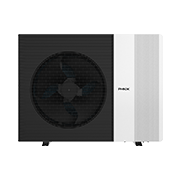
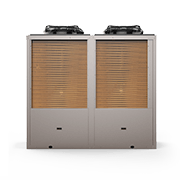
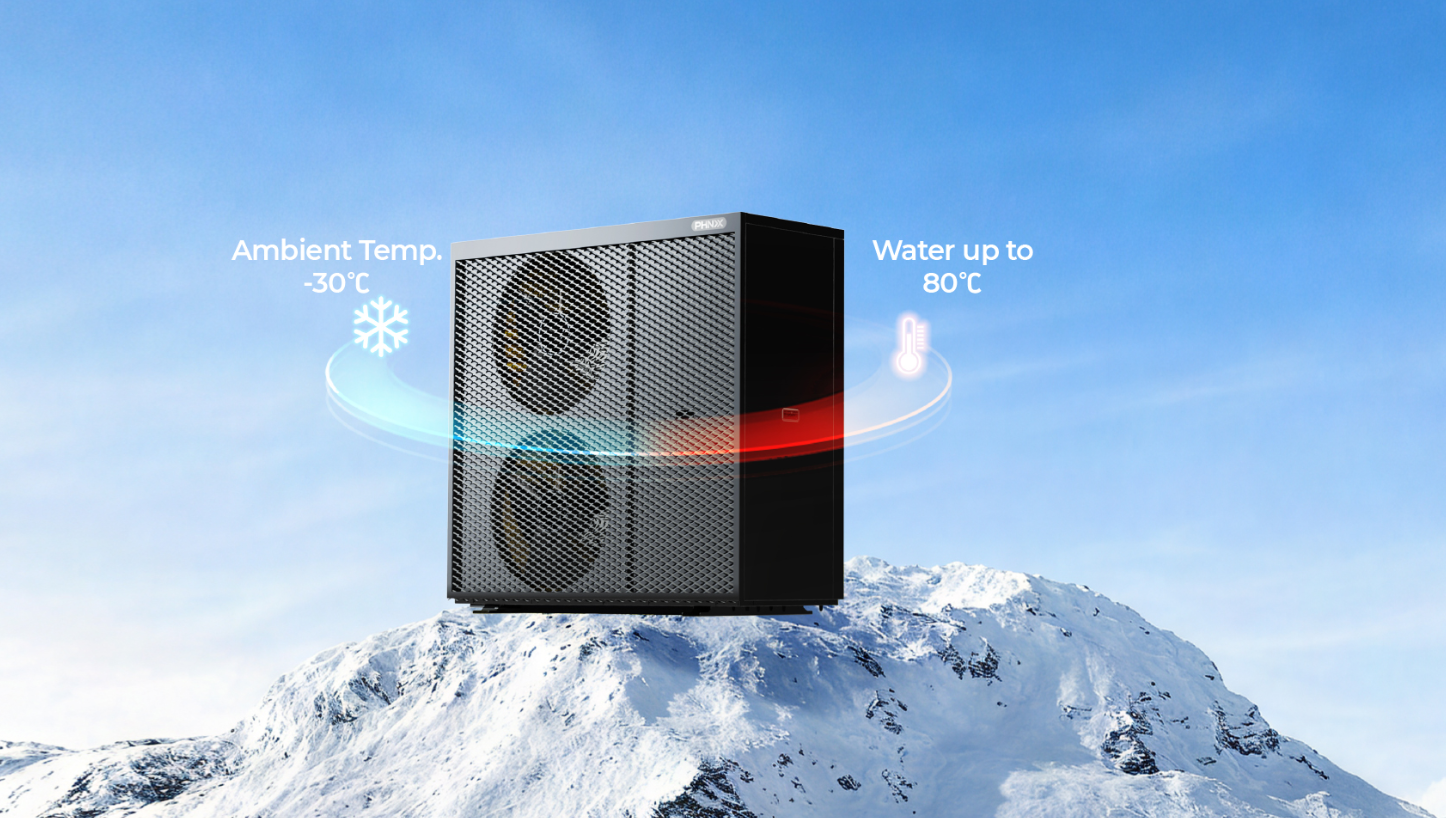
· PHNIX GreenTherm Pro is an R290 air to water heat pump rated A+++ in low temperature application, designed to operate down to minus 30 C ambient and to hold usable flow temperatures in retrofit conditions.
· Lowering flow temperature is usually a sequence of small measures, balancing, controls, selective emitter upgrades, not a single expensive intervention.
A heat pump moves heat from outdoor air to indoor water. The energy it consumes is broadly proportional to the temperature lift, the gap between the outdoor air and the water it must produce. On a 0 C morning, producing 35 C water is a lift of 35 K. Producing 55 C water is a lift of 55 K. That is not a small difference in effort, and it shows up directly in the coefficient of performance.
Two efficiency terms are worth defining, because product literature mixes them freely:
· COP (coefficient of performance) is the steady state ratio of heat output to electricity input at one specific test condition, measured under EN 14511.
· SCOP (seasonal coefficient of performance) is the part load, whole season figure measured under EN 14825. It reflects mild days, cold days and cycling behaviour, and it is the basis from which the EU seasonal space heating efficiency figure, written as the Greek letter eta s, is derived.
Because SCOP is defined separately for low temperature application (35 C) and medium temperature application (55 C), any SCOP number is meaningless without knowing which application it refers to. A product quoting a strong figure at 35 C tells you very little about its behaviour at 55 C, and vice versa.
| Flow temperature band | Typical emitter type | Relative seasonal efficiency | Suitability for 1970s masonry home |
|---|---|---|---|
| 35 C low temperature | Underfloor heating, oversized fan coils | Higher | Moderate, usually needs fabric work |
| 45 C | Large panel radiators, mixed circuits | Moderate to Higher | Yes, common realistic target |
| 55 C medium temperature | Existing double panel radiators | Moderate | Yes, workable with correct sizing |
| 65 C and above | Old cast iron or undersized radiators | Lower | Not recommended without remedial work |
European minimum requirements are set by the Ecodesign regulation for space heaters, Regulation (EU) 813/2013. Its Annex II requires seasonal space heating efficiency of at least 110 percent in medium temperature application and at least 125 percent in low temperature application. The energy label thresholds sit far above that. Under Regulation (EU) 811/2013 Annex II, A+++ requires at least 150 percent in medium temperature application and at least 175 percent in low temperature application.
Refrigerant choice interacts with this. The current F-gas framework is Regulation (EU) 2024/573, applicable from 11 March 2024. Its Annex VI gives propane, R290, a GWP100 value of 0.02 on the AR6 basis, while R32 is listed at 675 in Annex I. Annex IV of the same regulation prohibits placing on the market monobloc and split air to water heat pumps of 12 kW or less using refrigerant with GWP of 150 or more from 1 January 2027. Other common refrigerant blends remain far above the 150 GWP threshold. For an older home, the practical relevance is that R290 systems tend to reach higher flow temperatures with less efficiency penalty, which is exactly the constraint a retrofit faces.
You do not need a thermal model to answer this. You need one cold week and a boiler that lets you set the flow temperature manually.
· Step 1. Wait for a genuinely cold spell, ideally close to your local design outdoor temperature.
· Step 2. Set the existing boiler flow temperature to 60 C and leave the heating running continuously rather than in on and off blocks. Do not touch thermostatic radiator valves.
· Step 3. If every room reaches target after a few hours, drop to 55 C the next day, then 50 C, then 45 C.
· Step 4. Note the lowest setting at which the coldest room in the house still reaches its target temperature within a reasonable time.
· Step 5. That figure, plus a small margin, is your real design flow temperature.
Most older European houses that have had any loft insulation or glazing upgrade land somewhere between 45 C and 55 C. Genuinely untouched solid wall properties may land nearer 60 C. Very few need 70 C, and a house that does has a fabric problem, not a heating problem.
For a formal figure, EN 12831 is the standard used to calculate building design heat load room by room. A competent installer will run that calculation before quoting, and the result should broadly agree with your empirical test. If the two disagree sharply, ask why before you buy anything.
At 35 C, seasonal efficiency is at its best, but the emitter surface required is large. In an older home this usually means underfloor heating in at least the main living areas, which is a floor build up decision as much as a heating decision.
At 45 C, the compromise is often the sweet spot for European retrofits. Many existing radiator circuits, once properly balanced and with a few units enlarged, will deliver comfort at this temperature. Efficiency remains strong.
At 55 C, the system still works well with a modern inverter unit and existing radiators, and this is the medium temperature application used in EU labelling. Running cost is higher than at 45 C but usually still well below oil.
Above 60 C, you enter territory where a heat pump is technically capable but economically weak. This is where an honest assessment matters. If your test says 70 C, the correct advice is to improve the building or the emitters first.
PHNIX has manufactured heat pumps since 2002, employs over 1,000 people and exports to more than 90 countries, with over 60 percent of revenue from overseas markets and annual output above 80,000 units. Research and development runs at 6.7 percent of sales, and the company has filed 1,816 patents with 1,405 granted.
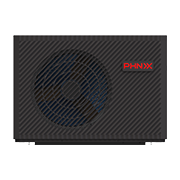
For the retrofit case discussed here, the relevant product is the residential heating and cooling line. PHNIX GreenTherm Pro is an R290 air to water heat pump rated A+++ in low temperature application, with an operating envelope down to minus 30 C ambient and support for PV integration. Its EVI technology, enhanced vapour injection, uses an intermediate refrigerant injection stage in the compressor to maintain heating capacity when the outdoor temperature falls, which is the condition where retrofit homes most often lose comfort.
Independent verification matters more than brochure figures. GreenTherm Pro was measured at SCOP 5.55 in testing conducted by TÜV SÜD RED and HLK Stuttgart, documented on the TÜV SÜD verified performance page. PHNIX has also passed AHRI performance sampling with a 100 percent pass rate for three consecutive years, 2023, 2024 and 2025, and holds CE, UKCA, Keymark, ETL and ERP certification.
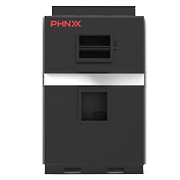
The AI Full Inverter control platform, trained on operating data from more than 30,000 installed units, modulates compressor speed against actual demand rather than fixed stages, with reported energy savings above 30 percent versus conventional inverter control in residential applications. In flow temperature terms, this matters because a modulating unit can run continuously at a lower water temperature instead of cycling at a high one. The wider residential heating and cooling range covers the GreenTherm Pro and GreenTherm Plus families. Where indoor siting is the binding constraint in a dense older block, PHNIX also offers airMono R290, the first indoor all in one R290 unit, but for a standard house with outdoor space the GreenTherm line is the direct answer.
| Measure | Typical effect on required flow temperature | Disruption | Applicable to flats |
|---|---|---|---|
| Hydronic balancing of existing circuit | Lower | Low | Yes |
| Weather compensation control curve | Lower | Low | Yes |
| Enlarging the two or three worst radiators | Lower | Moderate | Yes |
| Loft and floor insulation | Lower | Moderate | Not applicable in many cases |
| Underfloor heating in main rooms | Lower | Higher | Moderate |
Weather compensation deserves particular attention. Instead of a fixed setpoint, the controller raises flow temperature only as the outdoor temperature falls. Over a full European heating season, the majority of hours are mild, so a correctly configured curve keeps average flow temperature well below the design figure even in a house whose design requirement is 55 C.
· Capital cost is higher than a like for like boiler replacement, and the payback depends heavily on local electricity to gas price ratios.
· In prolonged extreme cold, some homes will still want a secondary heat source or a well planned backup strategy, particularly if the emitter circuit is marginal.
· An outdoor unit needs space and sensible siting, and R290 charge limits are set by refrigerant LFL and room or installation volume under EN 378 and IEC 60335-2-40 (7th edition, 2022). Confirm the actual clearance with local installation rules and the manufacturer's manual.
· A house that genuinely requires 70 C flow will not become efficient simply by installing a heat pump.
In the United Kingdom, the Boiler Upgrade Scheme grant for an air source air to water heat pump is 7,500 pounds. In Ireland, SEAI supports a heat pump system to a total cap of 12,500 euros, comprising up to 6,500 euros for the unit, 2,000 euros for central heating system components and a 4,000 euro Renewable Heat Bonus, with a 200 euro technical assessment; heat pump installation also attracts VAT at 9 percent. In France, MaPrimeRenov' covers 80, 40 or 20 percent of an ambitious renovation depending on income band, with associated TVA at 5.5 percent. These schemes generally reward the whole package, so money spent lowering flow temperature is often partly covered.
Q: Is 55 C flow temperature too high for a heat pump?
A: No. 55 C is the medium temperature application defined in EU labelling, and modern R290 units are designed for it. Efficiency is lower than at 45 C, but the system remains viable and usually far cheaper to run than oil.
Q: Can I just keep my existing radiators?
A: Often yes, provided the circuit is balanced and the two or three weakest rooms are addressed. The winter test described above tells you whether the existing emitters are adequate before you commit.
Q: How much efficiency do I gain by dropping from 55 C to 45 C?
A: The gain is significant because the compressor lift falls by ten kelvin across the whole season. The exact figure depends on climate and unit, so ask your installer for the EN 14825 SCOP at both application points rather than relying on a single headline number.
Q: Does weather compensation replace a room thermostat?
A: It complements it. The compensation curve sets the water temperature, while room control handles occupancy and solar gain. Both together give the lowest average flow temperature.
Q: What if my domestic hot water needs a higher temperature than my heating?
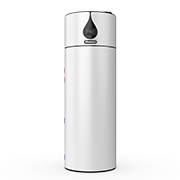
A: Hot water is produced in a separate cycle at a higher setpoint for a small share of running hours, so it has limited impact on space heating efficiency. Dedicated domestic hot water heat pumps are an alternative where separating the two duties makes sense.
Work through it in this order. First, measure the real requirement with a one week boiler test at design conditions. Second, ask an installer for an EN 12831 heat loss calculation and compare it against your measurement. Third, identify the cheapest measures that bring the requirement down by 5 C or 10 C, usually balancing, controls and two or three radiators. Fourth, specify equipment against the resulting temperature, requesting EN 14825 SCOP at the application point you will actually use, plus third party verification. Fifth, check what your national scheme funds before finalising scope, since the subsidy often covers the enabling work as well as the unit.
Answer the flow temperature question honestly and the rest of the specification becomes straightforward. Skip it, and no amount of equipment quality will compensate.

Guangdong PHNIX Eco-energy Solution Ltd.
Tel: +86-4009-4009-00
Address: NO.3 Tianyuan Road, Dagang Town,
Nansha, Guangzhou, Guangdong, PR. China.