Turning a storage setpoint from 55°C to 60°C looks like a trivial change on a controller screen. It is not. Those five degrees move three things at once: the compressor works against a higher condensing temperature so the COP falls, the tank stores more usable energy so you get more mixed hot water out of the same volume, and the stored water sits in a range that hygiene guidance treats very differently. This article is a decision analysis of that single choice. It is not a buying guide and it is not a recovery-time explainer.
· Raising the setpoint from 55°C to 60°C moves the COP in one direction only, downwards, because the refrigerant must condense at a higher temperature against the same air source.
· The same tank delivers more usable mixed water at 60°C, because you draw more energy per litre before the useful volume runs out at the mixed delivery temperature.
· There is no single EU-wide mandatory storage temperature. Directive (EU) 2020/2184 is risk based and sets a parameter value of Legionella < 1 000 CFU/l, with no temperature figure anywhere in the text.
· In the UK, HSE HSG274 Part 2 §2.6 is explicit: store hot water at at least 60°C, reach 50°C at the outlet within 1 minute (55°C in healthcare premises), keep cold water below 20°C and return water at no less than 50°C.
· A common compromise is a lower daily setpoint with a scheduled higher-temperature disinfection cycle, which keeps most of the heat pump running hours in the efficient band.
· For single-dwelling units with short pipe runs the risk profile differs from a large circulated system, so the right answer is site specific, not universal.
A heat pump water heater moves heat from ambient air into stored water. The efficiency of that transfer depends on the temperature lift between the evaporating side (air) and the condensing side (water). Push the target water temperature up and the lift grows, the compressor pressure ratio grows with it, and the coefficient of performance falls. That direction is thermodynamic, not a product characteristic, and it applies to every air-to-water machine regardless of brand or refrigerant.
Two things follow. First, the penalty is not fixed. It depends on ambient air temperature, on tank stratification, and on whether the last few degrees come from the heat pump or from a built-in electric element. Second, the penalty is concentrated at the top of the cycle: heating from cold mains to roughly 45°C happens at a low lift and a high COP, so the last five degrees are the most expensive in the whole cycle.
Measurement of these effects is standardised. EN 14511 defines steady-state rated COP and EER. EN 14825 defines part-load SCOP and SEER, and the ErP seasonal space heating efficiency is derived from it. EN 12831 covers design heat load. Water heater efficiency is tested under a declared load profile using the applicable European test standards, which is why an efficiency claim is only meaningful alongside its profile.
For water heating, Regulation 814/2013 Annex II 1.1(b) sets the minimum water heating efficiency ηwh that has applied since 26 September 2017: 32% for 3XS, XXS, XS and S profiles, 36% for M, 37% for L, XL, XXL and 3XL, and 38% for 4XL. Regulation 812/2013 Annex II Table 1 sets the A+++ label thresholds, and those thresholds move with the profile: S needs ηwh of at least 90%, M at least 163%, L at least 188%, XL at least 200% and XXL at least 213%. Any efficiency class quoted without its declared load profile is incomplete.
The reference energy Qref in Regulation 814/2013 Annex III Table 1 is the sum of the useful heat of each tapping in the profile: 5.845 kWh for M, 11.655 kWh for L and 19.07 kWh for XL. That number is worth holding on to, because it gives you a defensible way to size the daily energy question rather than guessing.
On refrigerants, the current framework is Regulation (EU) 2024/573, which has applied since 11 March 2024 and repealed 517/2014. GWP values follow IPCC AR6. R290 has a GWP100 of 0.02 under Annex VI, and R32 has a GWP100 of 675 under Annex I §1 and sits under the HFC quota. Annex IV restricts self-contained heat pumps of 12 kW or less containing refrigerant with GWP of 150 or more from 1 January 2027, with the same date for split air-to-water units of 12 kW or less, and a full fluorinated-gas restriction for 12 kW or less self-contained units from 1 January 2032. Where site safety requirements do not allow a GWP below 150, the ceiling relaxes to 750. Separately, Article 13(4) bans fluorinated gases with GWP of 2500 or more in servicing of air conditioning and heat pumps from 1 January 2026. There is no 750 servicing tier for heat pumps, so R32 equipment remains serviceable.
This is the part that decides the argument more often than the energy bill. At EU level there is no harmonised mandatory storage temperature. Directive (EU) 2020/2184 sets a parameter value of Legionella < 1 000 CFU/l in Annex I Part D for use with Articles 10 and 14, and Article 10(3)(e) requires Member States to ensure effective control and management measures proportionate to the risk. The Directive text contains no temperature requirement at all. Temperature rules therefore come from national codes and industry technical rules, not from a single European number.
In the UK the position is specific. HSE HSG274 Part 2 §2.6 states that hot water should be stored at at least 60°C, that water should reach 50°C at the outlet within one minute (55°C in healthcare premises), that cold water should stay below 20°C, and that circulating return temperature should not fall below 50°C. If you operate under that guidance, 55°C storage is not a free choice.
In Germany, central domestic hot water systems are governed by DVGW technical rules; check the current edition and the local requirements before fixing a setpoint. France sets its own requirements for domestic hot water temperature and Legionella control; confirm the current national rules with a local specifier. For every other market, the honest instruction is the same: national rules differ, follow local requirements.
The usable output of a storage tank is not its volume, it is the energy it holds above the delivery temperature you blend down to. If a thermostatic mixing valve delivers water at 40°C and cold mains sits near 10°C, then each stored litre at 55°C carries 45 K of usable lift above mains and each stored litre at 60°C carries 50 K. The ratio is 50/45, which is roughly 11% more delivered energy from the same tank before it is exhausted. That is a transparent arithmetic result from stated assumptions, not a product claim, and it shifts if your mains temperature or blend temperature differs.
That gain is why 60°C is attractive for households with clustered demand, for example two showers back to back in the morning. If your constraint is not capacity but the time before the tank is ready again, the relevant variable is different, and we cover that separately in how recovery time works on a heat pump water heater.
| Factor | 55°C setpoint | 60°C setpoint |
|---|---|---|
| Compressor temperature lift | Lower | Higher |
| Expected COP over the cycle | Higher | Lower |
| Usable mixed water from one tank | Lower | Higher |
| Standing losses from the tank | Lower | Higher |
| Likelihood of electric element assistance for the top degrees | Lower | Higher |
| Alignment with UK HSG274 storage guidance | No | Yes |
| Suitable for a large circulated multi-outlet system | Not applicable without a documented risk assessment | Yes |
| Scale and deposit risk in hard water | Lower | Higher |
Consider a representative European scenario, not a real customer, of a four-person household with a declared M load profile, so daily useful heat is the Qref value of 5.845 kWh. At an assumed seasonal water heating efficiency of 150% the daily electricity input is about 3.9 kWh; at 135% it is about 4.3 kWh. Using the Eurostat second-half-2025 tax-inclusive EU27 household electricity price of 0.2896 EUR/kWh for the 2 500 to 5 000 kWh consumption band, that is roughly 0.11 EUR per day of difference, or in the order of 40 EUR per year. The two efficiency figures here are illustrative endpoints chosen to show the method, not measured values for a specific machine; substitute the declared ηwh of the unit you are actually comparing, at its declared load profile, to get a number you can defend.
The point of the arithmetic is the order of magnitude. For a single dwelling, the annual cost gap between the two setpoints is usually modest, and it should not outrank a hygiene requirement. For a large building with a long circulation loop, both the energy gap and the risk consequence scale up, and the analysis has to be done properly rather than by analogy with a house.
The common middle path is to run a lower daily setpoint and schedule a periodic higher-temperature cycle. Most of the operating hours then sit in the efficient part of the envelope, while the tank still receives regular thermal treatment. Three conditions decide whether this is legitimate on your site.
· The whole stored volume, including the coldest zone near the bottom of the tank, must actually reach the intended temperature, not just the sensor position.
· The distribution system must be included in the reasoning, because a dead leg or a poorly circulated branch is not disinfected by tank temperature alone.
· The approach must be compatible with the national rules and any applicable risk assessment for the building; it is not a substitute for one.
Where the top-up to disinfection temperature is delivered by a built-in electric element rather than by the compressor, the energy for that cycle is resistive and carries a COP of 1. Keeping those cycles infrequent and short is the whole point.
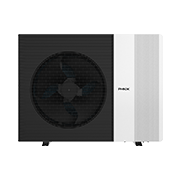
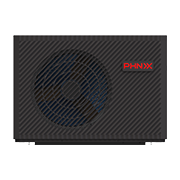
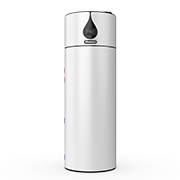
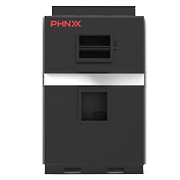
PHNIX airInverter is an R290 heat pump water heater designed for indoor installation in European and Australian homes, and airExpert R290 sits in the same domestic water heating line. R290 has a GWP100 of 0.02 under Annex VI of Regulation (EU) 2024/573, which places these units outside the 2027 Annex IV restrictions that apply to equipment at or above a GWP of 150. Refrigerant charge limits are set by refrigerant LFL and room or installation volume under EN 378 and IEC 60335-2-40 (7th edition, 2022); confirm the actual clearance with local installation rules and the manufacturer's manual. Maximum achievable outlet temperature, tank volume and element rating vary by model, so use the model technical manual rather than a generic figure when you set a schedule.
PHNIX holds CE, UKCA, Keymark, AHRI, ETL and ERP certifications, with AHRI performance audits passed at 100% compliance for three consecutive years (2023, 2024 and 2025). Guangdong PHNIX Eco-energy Solution Ltd was founded in 2002, employs more than 1,000 people, exports to over 90 countries and has filed 1,816 patent applications, of which 1,405 are granted. Its AI Full Inverter control is trained on data from more than 30,000 operating units and targets 30%+ savings against conventional inverter control in residential and commercial applications. If you are still at the selection stage rather than the setpoint stage, the trade-offs between unit types are set out in how to choose a heat pump water heater for a European home, and the full domestic range is listed on the domestic heat pump water heater category page.
On the space heating side, the R290 GreenTherm Pro air-to-water heat pump was measured at SCOP 5.55 by TÜV SÜD RED and HLK Stuttgart. For context on space heating labelling, Regulation 811/2013 Annex II requires ηs of at least 175% for A+++ in low-temperature applications (Table 2) and at least 150% in medium-temperature applications (Table 1), and those are separate scales from water heating classes.
Q: Is 55°C always cheaper to run than 60°C?
A: On energy input per unit of stored heat, yes, because the temperature lift is smaller and the COP is higher. The total bill difference depends on your draw pattern, standing losses and how much of the top of the cycle is covered by an electric element rather than the compressor. Run the arithmetic with your unit's declared ηwh at its declared load profile before deciding.
Q: Can I legally run a domestic tank at 55°C in Europe?
A: There is no EU-wide mandatory storage temperature. Directive (EU) 2020/2184 sets a Legionella parameter value of less than 1 000 CFU/l and requires risk-proportionate control measures, with no temperature figure. National rules and industry technical rules decide the answer, and in the UK HSE HSG274 Part 2 §2.6 specifies storage at at least 60°C.
Q: Does a weekly high-temperature cycle cancel out the savings of a lower daily setpoint?
A: Not usually, because the cycle is short relative to total annual operation, but it is resistive energy if the element does the work, so its cost is real. Log how often the cycle runs and at what duration, then price it at your tariff rather than assuming it is negligible.
Between 55°C and 60°C there is no universally correct answer, only a correctly ordered decision. Check the hygiene requirement that applies to your site first, because in some jurisdictions and in most circulated systems it removes the choice. If the requirement leaves room, then weigh roughly 11% more usable mixed water at 60°C under the assumptions above against a lower COP and higher standing losses, and consider a lower daily setpoint with a scheduled disinfection cycle as the middle path. Then verify the numbers with the declared efficiency of the actual unit, at its declared load profile, and with a local specifier who knows the national rules.

Guangdong PHNIX Eco-energy Solution Ltd.
Tel: +86-4009-4009-00
Address: NO.3 Tianyuan Road, Dagang Town,
Nansha, Guangzhou, Guangdong, PR. China.