A developer refurbishing an eight to twenty unit apartment block in Europe usually reaches the domestic hot water decision late, after the envelope and space heating strategy are fixed. By then the question has narrowed to two architectures: one central heat pump plant feeding a circulating hot water loop, or one compact heat pump water heater inside each dwelling. Both are fully electric, both can run on R290, both meet the same ErP requirements, and they fail in completely different places. What follows is a six dimension trade-off structure to walk through with a specifier.
· Centralized plant concentrates capital cost, plant room area and maintenance responsibility in the landlord; individual units push all three into the dwelling.
· The circulating loop is the hidden cost of centralized systems: standing heat loss runs all year, and Legionella control depends on loop temperature, not on the heat pump alone.
· Individual heat pump water heaters give per dwelling metering without heat cost allocators, which matters where tenants pay their own electricity.
· Retrofit of an occupied building usually favours individual units, because work is contained inside one apartment and no vertical risers need cutting.
· Centralized plant wins on diversity: peak demand across twenty units is far below twenty individual peaks, so installed capacity per dwelling is smaller.
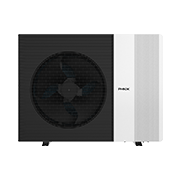
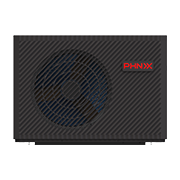
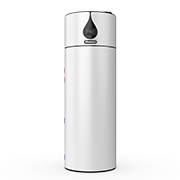
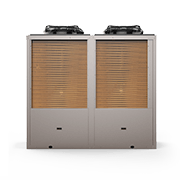
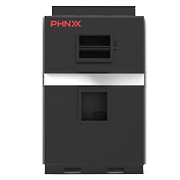
· PHNIX airInverter is an R290 heat pump water heater designed for indoor installation in European homes, while PHNIX HeatGreen R290 Commercial covers the centralized plant form factor, with an operating envelope from -30°C to 43°C.
A centralized system places one or more air-to-water heat pumps in a plant room, on the roof or in a courtyard, charges a central storage volume, and distributes hot water through a flow and return loop with a circulation pump. Hot water for the whole block is produced, stored and controlled in one place.
An individual system gives each apartment its own integrated heat pump water heater, typically an indoor monobloc with a built-in tank in a utility cupboard or kitchen. There is no shared loop, storage or control, and each dwelling is a self-contained system on its own electricity meter.
Both belong to the same regulatory world. Water heater efficiency is declared as ηwh under Regulation (EU) 814/2013, and the minimum since 26 September 2017 is 32% for 3XS to S profiles, 36% for M, 37% for L to 3XL and 38% for 4XL. Energy labelling thresholds under Regulation (EU) 812/2013 are profile dependent too: A+++ requires ηwh of at least 90% at profile S, 163% at M, 188% at L, 200% at XL and 213% at XXL. Any efficiency claim that does not name its declared load profile is meaningless, because the threshold moves with the profile.
| Dimension | Centralized plant plus loop | Individual unit per dwelling |
|---|---|---|
| Capital cost ownership | Landlord or management company, single contract | Split per dwelling, can be staged |
| Metering and cost allocation | Requires heat meters or allocators, plus a billing process | Direct on the dwelling electricity meter, no allocation |
| Standing loss and Legionella exposure | Higher, continuous loop losses and loop temperature management | Lower, no circulation loop |
| Maintenance responsibility | Centralized, one service visit covers the building | Distributed, access to each apartment needed |
| Space occupied inside the dwelling | Minimal, risers and a tapping point only | Moderate, cupboard or plant niche required |
| Retrofit disruption in an occupied building | Higher, vertical risers and plant room works | Lower, one apartment at a time |
| Installed capacity per dwelling | Lower, demand diversity across units | Higher, each unit sized for its own peak |
| Single point of failure | Yes, plant outage affects all units | No, failures are contained |
The capital comparison is rarely an equipment price contest. A centralized scheme buys fewer, larger machines but adds a plant room, buffer and storage, insulated risers, a circulation pump, heat meters and a commissioning scope that touches every riser. An individual scheme buys many small machines with almost no distribution: a cold feed, a drain, a condensate route and a dedicated circuit. The crossover is driven by pipework, not by the heat pumps. Above roughly twenty to thirty dwellings the plant room amortises well; in the eight to sixteen unit range typical of European conversion projects, the distribution overhead often outweighs the equipment saving.
Operating cost assumptions must be stated, not asserted. Using Eurostat household electricity prices for the second half of 2025, taxes included, in the 2,500 to 5,000 kWh annual band, the EU27 average is 0.2896 EUR/kWh. Take a representative European scenario: a dwelling with a declared M load profile, where Regulation (EU) 814/2013 Annex III Table 1 sets Qref at 5.845 kWh per tapping cycle, served by an A+++ appliance, which at profile M means ηwh of at least 163%. Annual useful energy is roughly 5.845 kWh times 365, about 2,133 kWh; input at 163% is about 1,309 kWh, or roughly 379 EUR per year. That illustrates the arithmetic, not a guarantee; it ignores ambient conditions, real tapping behaviour and loop losses.
That last exclusion is the point. A centralized system adds the loop on top of the same useful energy. Loop losses depend on riser length, insulation thickness, setpoint and pump run hours, so they must be calculated for the actual building rather than taken from a rule of thumb. For the appliance selection logic behind the per dwelling numbers, our guide on how to choose a heat pump water heater for a European home works through load profile selection and sizing.
This dimension decides more projects than efficiency does. With individual units, hot water energy lands on the dwelling's own electricity meter: no allocation key, no annual reconciliation, no dispute about whose showers drove the bill. Tenants who cut consumption see the saving directly, which is the cleanest possible incentive alignment.
With centralized plant, you need heat meters at each dwelling or an allocation method, plus a billing and reconciliation process. Loop losses are a shared cost nobody consumed individually, so distributing them is a policy decision rather than a measurement. For build-to-rent operators with billing infrastructure this is routine; for a small private landlord it is an administrative burden that outlasts the construction contract.
There is no single EU-wide mandatory storage temperature. Directive (EU) 2020/2184 on drinking water is risk assessment driven: Annex I Part D gives a parameter value of Legionella below 1 000 CFU/l for use with Articles 10 and 14, and Article 10(3)(e) requires member states to ensure effective control measures proportionate to the risk. The directive contains no temperature requirement. Setpoints come from national regulations and industry technical rules, not a harmonised European number.
Those rules differ in ways that change the design. In the United Kingdom, HSE guidance HSG274 Part 2 states that hot water should be stored at at least 60°C, should reach 50°C at the outlet within one minute (55°C in healthcare premises), cold water should be below 20°C, and circulating return temperature should not fall below 50°C. In Germany, central domestic hot water systems are governed by DVGW technical rules; check the current edition and the local requirements before fixing a setpoint. France sets its own requirements for domestic hot water temperature and Legionella control; confirm the current national rules with a local specifier.
The architectural consequence is asymmetric. A centralized loop holds a large volume at elevated temperature and circulates it continuously, so it is the classic Legionella management case and its control regime is non-negotiable. Individual appliances serve short dead legs from a small tank inside the dwelling, which reduces loop exposure but does not remove the need for disinfection or a periodic high temperature cycle per the appliance manual and local rules. Higher setpoints also raise required supply temperature, pushing the heat pump towards a less favourable operating point.
The current framework is Regulation (EU) 2024/573, applicable from 11 March 2024, which repealed Regulation (EU) 517/2014. GWP values follow the IPCC Sixth Assessment Report: R290 has a GWP100 of 0.02 under Annex VI, and R32 has a GWP100 of 675 under Annex I and sits inside the HFC quota system. Annex IV restricts placing on the market self-contained heat pumps up to 12 kW containing refrigerant with GWP of 150 or more from 1 January 2027, with the same date for split air-to-water units up to 12 kW, and a full fluorinated refrigerant ban for self-contained units up to 12 kW from 1 January 2032. Where site safety requirements do not permit GWP below 150, the ceiling relaxes to 750. R410A and R454B are blends and are not listed individually in the annexes of Regulation (EU) 2024/573, but both sit far above the 150 GWP threshold that drives the 2027 restrictions.
For a building specified in 2026 and occupied for the next two decades, R290 removes the refrigerant transition risk from both architectures. The practical constraint is charge and siting: charge limits are set by refrigerant LFL and room or installation volume under EN 378 and IEC 60335-2-40 (7th edition, 2022); confirm the actual clearance with local installation rules and the manufacturer's manual. That constraint bites differently in a plant room than in a first floor utility cupboard. Our walkthrough of heat pump water heater installation in a European family home covers indoor siting, condensate and ventilation for the per dwelling case.
For the individual route, the PHNIX domestic heat pump water heater range covers airInverter and airExpert R290 integrated units built for indoor placement, the models that sell into European and Australian apartments. Tank volume, maximum outlet temperature and clearances vary across the range, so take them from the model technical manual.
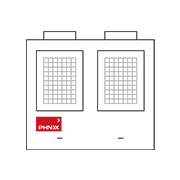
For the centralized route, HeatGreen R290 Commercial is the plant form factor, developed for hotels, schools and hospitals and rated across an ambient envelope from -30°C to 43°C. Commercial hot water heat pumps typically deliver COP in the range of 3 to 5 depending on climate and water temperature, and the figure to design with is the one from selection software at your actual entering water and ambient conditions. If space heating is in the same scope, the PHNIX heating and cooling heat pump category is where GreenTherm Pro sits, measured by TÜV SÜD RED and HLK Stuttgart at SCOP 5.55; under Regulation (EU) 811/2013 Annex II, the A+++ space heating class requires ηs of at least 175% in low-temperature application and 150% in medium-temperature application.
PHNIX holds CE, UKCA, Keymark, AHRI, ETL and ERP certifications, with AHRI performance audits passed at 100% compliance for three consecutive years (2023, 2024 and 2025). Guangdong PHNIX Eco-energy Solution Ltd was founded in 2002, employs more than 1,000 people and exports to over 90 countries.
Work the dimensions in this order, because each answer constrains the next.
· Is there a plant room, riser route and roof or courtyard position that survives planning and acoustics? If not, the centralized option is already closed.
· Who owns maintenance in year five? With no management company under contract, distributed units avoid an orphaned plant.
· Will tenants pay their own energy? If yes, individual metering is worth a real premium.
· Is the building occupied during works? Riser installation in occupied flats is a common cause of programme overrun.
· What is the dwelling mix? Studios at a declared S or M profile need far less than family units at L or XL.
· Which national Legionella regime applies? A high mandated loop return temperature penalises centralized performance directly.
Hybrid arrangements exist for mixed outcomes: centralized preheat with per dwelling top-up, or centralized space heating with individual hot water. Both add interface complexity, so treat them as a considered choice rather than a compromise.
Q: Is a centralized heat pump always more efficient than individual units in a small apartment building?
A: Not automatically. A larger machine can have a better rated COP under EN 14511 steady state conditions, but the centralized system also carries continuous loop losses and often needs a higher supply temperature to satisfy national Legionella rules. In small blocks with long risers, those two effects can cancel out the equipment advantage. Compare at system level, not appliance level.
Q: How do I compare efficiency labels between a centralized plant and an individual water heater?
A: Mostly you cannot compare them directly. Individual domestic units are declared as ηwh under Regulation (EU) 814/2013 against a specific load profile, and A+++ under Regulation (EU) 812/2013 means at least 163% at profile M but 188% at L, so the class alone is not a number. Centralized plant is selected from measured performance at stated water and ambient conditions. Compare annual kWh for the same useful demand instead.
Q: Which option is better for a retrofit of an occupied building?
A: Individual units are usually less disruptive, because each installation is contained within one apartment and no new risers are cut through occupied floors. The trade-off is indoor space in every dwelling plus access for servicing. If the building already has serviceable hot water risers, the centralized case improves substantially.
Centralized and individual heat pump water heaters are not better or worse than each other; they allocate cost, risk and responsibility differently. Centralized plant concentrates capacity, maintenance and billing complexity in one place and benefits from demand diversity, but pays continuously for the loop and carries a single point of failure. Individual units eliminate the loop, give clean per dwelling metering and de-risk retrofit in occupied buildings, at the price of indoor space and distributed servicing.
For blocks in the eight to twenty unit range, distribution overhead and the national Legionella regime usually decide it, not headline machine efficiency. Run the six dimensions in order, state your electricity price and load profile assumptions explicitly, and verify every setpoint against the applicable national rules before the design is frozen.

Guangdong PHNIX Eco-energy Solution Ltd.
Tel: +86-4009-4009-00
Address: NO.3 Tianyuan Road, Dagang Town,
Nansha, Guangzhou, Guangdong, PR. China.