Every hotel retrofit reaches the same fork in the road. You have two thermal loads under one roof: domestic hot water (DHW) for guest showers, kitchens and laundry, and space heating for rooms, corridors and public areas. Both can be served by air source heat pumps. The question is whether they should be served by the same heat pumps. This article is not about which brand to buy or how fast the payback lands. It is about system architecture: what happens to efficiency, plant room space and control complexity when you merge two loads that want different temperatures at different times of day.
· DHW and space heating pull in opposite directions on temperature, so a combined plant is controlled around the hotter load, which costs efficiency on the cooler one.
· Space heating tracks outdoor temperature and runs long and flat; DHW is peaky, with a sharp morning peak and a softer evening one, and it does not disappear in summer.
· A combined system saves space and capital cost but concedes seasonal efficiency and makes Legionella control and heating comfort compete for one machine.
· Separate systems let each circuit run at its own optimal flow temperature, at the cost of more units, more space and a higher installed price.
· The hybrid route, separate generators tied together by a common controller and store strategy, is what most mid-size and large hotels choose.
· Decide from your DHW-to-heating load ratio, emitter type, plant room footprint and national hot water hygiene rules.
The core issue is flow temperature. Space heating emitters in a refurbished hotel are typically underfloor loops or fan coil units, and both are happy with relatively low water temperatures. Domestic hot water has to be stored and distributed at a temperature set by hygiene rules, not by comfort. Heat pump efficiency is governed by the lift between source and sink, so a machine that is excellent at 35°C flow into underfloor pipework is merely adequate at the temperatures a DHW cylinder needs.
The second difference is time. Space heating demand is a slow function of outdoor temperature: it ramps over hours, it is predictable, and it goes to near zero in a European summer. DHW demand is the opposite, with short violent peaks when guests shower, a second bump in the evening, kitchen and laundry draws layered on top, and a baseline that runs all twelve months. A hotel at 70 percent occupancy in July still needs the full morning shower peak covered.
On refrigerant, the current framework is Regulation (EU) 2024/573, which applied from 11 March 2024 and repealed Regulation 517/2014. GWP values follow the IPCC Sixth Assessment Report: R290 (propane) is 0.02 under Annex VI, while R32 is 675 under Annex I and remains inside the HFC quota system. R410A and R454B are blends and are not listed individually in the annexes of Regulation (EU) 2024/573, but both sit far above the 150 GWP threshold that drives the 2027 restrictions. Annex IV bans self-contained heat pumps up to 12 kW with GWP of 150 or more, and split air-to-water units up to 12 kW, from 1 January 2027. Hotel plant is normally larger, but these dates signal where refrigerant availability and servicing economics are heading.
On hygiene, there is no single EU-wide mandatory storage temperature. Directive (EU) 2020/2184 is risk based: Annex I Part D gives a parametric value of Legionella below 1 000 CFU/l for Articles 10 and 14, and Article 10(3)(e) requires Member States to ensure control measures proportionate to the risk. The directive contains no temperature figure. Temperature requirements come from national codes and industry technical rules, not from a harmonised European number.
In the United Kingdom, HSE guidance HSG274 Part 2 is explicit: store hot water at 60°C or above, deliver 50°C at the outlet within one minute (55°C in healthcare premises), keep cold water below 20°C, and keep circulation return at or above 50°C. In Germany, central domestic hot water systems are governed by DVGW technical rules; check the current edition and the local requirements before fixing a setpoint. France sets its own requirements for domestic hot water temperature and Legionella control; confirm the current national rules with a local specifier.
| Criterion | Combined (one plant, both loads) | Separate (dedicated plant each) | Hybrid (separate generators, shared control) |
|---|---|---|---|
| Plant room footprint | Lower | Higher | Moderate |
| Installed capital cost | Lower | Higher | Moderate |
| Seasonal efficiency on heating | Lower | Higher | Higher |
| DHW availability during heating peak | Lower | Higher | Higher |
| Control complexity | Moderate | Lower | Higher |
| Summer part-load operation | Poor | Good | Good |
| Redundancy if one machine fails | Lower | Higher | Higher |
| Suits small properties under roughly 40 keys | Yes | No | Not applicable |
| Suits large full-service hotels | No | Yes | Yes |
| Ease of staged retrofit | Lower | Higher | Higher |
Small properties change the maths. A boutique hotel of 30 to 40 keys with a compact plant room, no on-site laundry and a kitchen closed outside service hours has a DHW load small enough that a single well-sized plant with a priority-switching valve can cover both duties without the heating circuit noticeably suffering. The plant runs at the DHW setpoint only when the store calls, then drops back to the heating curve.
The design discipline is honest scheduling. DHW priority must be genuinely time limited, the store must be large enough that the plant is not chasing every draw-off, and the heating curve must be weather compensated. If you are still weighing whether a heat pump plant beats your existing boiler at all, equipment selection is covered separately in our guide to the best commercial heat pump options for hotels looking to cut energy costs.
Above roughly 80 to 100 keys, and in any property with on-site laundry, a spa or a high-volume kitchen, the DHW load stops being a side duty. The DHW plant wants to run near flat out at a high sink temperature much of the day; the heating plant wants to modulate gently at a low sink temperature. Asking one set of compressors to do both means one duty is always operating away from its best point.
Separation also buys resilience: if one of three modular DHW units fails you lose a third of capacity, not all of it, and space heating is untouched. It makes staged retrofit possible too. Many hotels convert DHW first, because it is a year-round load with the strongest running-cost case, then convert space heating at the next major refurbishment. The financial framing of that staged approach, including how the payback stacks up against a gas boiler baseline, is worked through in our analysis of hotel ROI when moving from a gas boiler to a heat pump.
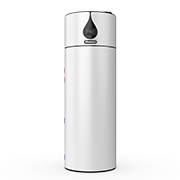
The middle path keeps the generators separate but joins them at the control layer. In practice: dedicated DHW heat pumps feeding a stratified store held at the hygiene setpoint, dedicated heating heat pumps feeding a low-temperature buffer on a weather-compensated curve, and one building management interface that sees both.
What the shared controller buys is coordination rather than hardware savings. It can stagger compressor starts so the two plants never peak together against the electrical supply, shift DHW store recharge into off-peak tariff windows or into a sunny midday when on-site PV is generating, and hold heating flow temperature down during the morning shower peak. None of that is possible when the two systems are logically independent.
PHNIX builds this coordination into the product. PHNIX AI Full Inverter control is trained on operating data from more than 30,000 installed units and delivers over 30 percent energy savings in residential and commercial applications compared with conventional inverter control. PV Integration and AI Smart Grid let the plant respond to on-site generation and tariff signals, and fault pre-warning flags degradation before it becomes a guest-facing outage.
Take a representative European scenario: a 90-key city hotel, fan coil heating, on-site laundry, annual occupancy around 72 percent. Assume a DHW demand of 55 litres per occupied room night through a 45 K rise, roughly 2.9 kWh per occupied room night, or about 68,000 kWh of useful DHW heat per year. At a seasonal DHW efficiency of 3.0, electrical input is around 22,700 kWh per year. Using the Eurostat EU27 average household electricity price for the second half of 2025 of 0.2896 EUR/kWh including taxes, that is approximately 6,600 EUR per year for DHW electricity alone. Commercial tariffs differ from the household series, so treat this as an order-of-magnitude frame.
Now change one assumption. If a combined plant also has to satisfy heating and therefore sits at a lower seasonal DHW efficiency of 2.6, input rises to roughly 26,200 kWh and the cost to around 7,600 EUR. The gap, on these stated assumptions, is about 1,000 EUR per year on DHW alone, before any effect on the heating circuit. Whether that justifies a second set of machines depends on your capital cost delta and plant room constraints.
For the heating side, design heat load should be established under EN 12831 rather than estimated from floor area. EN 14511 declares steady-state rated performance, while EN 14825 covers part-load SCOP and SEER and underpins the ErP seasonal space heating efficiency. Under Regulation 811/2013 Annex II, an A+++ space heater reaches seasonal space heating efficiency of at least 175 percent in low-temperature application (Table 2) and at least 150 percent in medium-temperature application (Table 1). Always check which application a quoted class refers to.
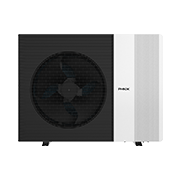
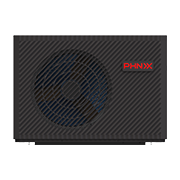
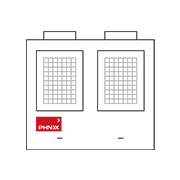
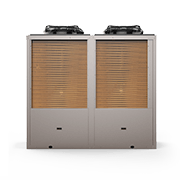
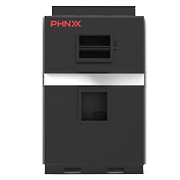
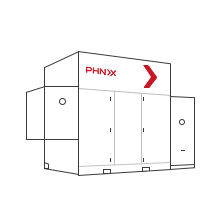
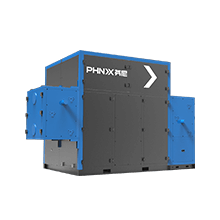
PHNIX HeatGreen R290 Commercial is an air source heat pump range designed for hotels, schools and hospitals, with an operating envelope from -30°C to 43°C ambient. Running on R290 with a GWP100 of 0.02, it sits outside HFC quota pressure. Published commercial heat pump efficiency typically falls in the COP 3 to 5 range depending on climate and flow temperature, and machine-specific figures should be taken from the technical manual for the selected model. The full range and its configuration options are set out on the PHNIX commercial heat pump category page.
Two design points matter here. First, EVI low-temperature technology allows stable operation down to -30°C, which protects DHW delivery on the coldest mornings, precisely when a combined system is most stretched. Second, charge limits are set by refrigerant LFL and room or installation volume under EN 378 and IEC 60335-2-40 (7th edition, 2022); confirm the actual clearance with local installation rules and the manufacturer's manual. For hotel plant this usually means outdoor siting or a dedicated ventilated plant area, which should be resolved at concept design, not at commissioning.
PHNIX holds CE, UKCA, Keymark, AHRI, ETL and ERP certifications, with AHRI performance audits passed at 100 percent compliance for three consecutive years (2023, 2024 and 2025). On the residential side of the portfolio, GreenTherm Pro has been measured by TÜV SÜD RED and HLK Stuttgart at a seasonal coefficient of performance of 5.55, documented on the GreenTherm Pro SCOP 5.55 test report page. Founded in 2002, Guangdong PHNIX Eco-energy Solution Ltd employs more than 1,000 people and exports to over 90 countries.
· Calculate the ratio of annual DHW heat demand to annual space heating heat demand. Above roughly 1:1, separation gets hard to argue against.
· Identify emitter flow temperature. If the heating circuit can run below 45°C, the penalty of merging it with a 60°C DHW duty is largest.
· Check for on-site laundry, a spa or a commercial kitchen. Any of the three pushes you toward dedicated DHW plant.
· Confirm the national hygiene requirement setting your store temperature, and whether secondary circulation is required.
· Decide whether the retrofit is single-phase or staged. Staged strongly favours separate or hybrid.
· Confirm whether on-site PV exists or is planned, because shared control is worth far more when there is surplus generation to absorb.
Q: Can one heat pump legally serve both domestic hot water and space heating in a hotel?
A: Yes, no regulation prevents it. The constraint is technical and hygienic. The plant must reach and hold the store temperature required by your national code, and the control strategy must guarantee that DHW priority never leaves the store below that temperature for longer than the risk assessment permits.
Q: Does a combined system always use more energy than separate systems?
A: Not always. In small properties with a modest DHW load and radiator heating that already needs a high flow temperature, the gap between the two duties is narrow and the penalty is small. It grows with the size of the DHW load and with how low the heating circuit could otherwise run.
Q: Should the DHW conversion come before or after the space heating conversion?
A: DHW is usually first. It is a year-round load, so the running cost case is strongest, and it is less disruptive because it does not touch guest rooms and can often be done between seasons.
Combining domestic hot water and space heating on one heat pump plant is a capital cost and floor area decision that you pay for in seasonal efficiency and operational flexibility. Separating them is an efficiency and resilience decision that you pay for in capital cost and plant room space. The hybrid approach, distinct generators governed by one intelligent controller, resolves most of the tension for mid-size and large hotels.
Run the load ratio, check the emitter temperature, confirm the national hygiene requirement, then choose. Whichever architecture you select, size it against a calculated design heat load rather than a rule of thumb, because an oversized plant will cycle badly on both duties and undo the efficiency you were trying to buy.

Guangdong PHNIX Eco-energy Solution Ltd.
Tel: +86-4009-4009-00
Address: NO.3 Tianyuan Road, Dagang Town,
Nansha, Guangzhou, Guangdong, PR. China.