A heat pump water heater is one of the few appliances where installation quality matters almost as much as machine quality. A unit that is certified, inverter driven and correctly sized can still deliver disappointing hot water, long recovery times and inflated running costs if it is dropped into the wrong room, if its exhaust air circles back into its own inlet, if condensate is not drained properly, if the pipework is left bare, or if nobody ever touched the commissioning parameters. These are the five failures that field service teams see over and over, across every brand and every market.
This article walks through each mistake in the order it usually appears on site, explains what happens to the machine, and gives the correction. The examples are drawn from all-in-one domestic units of the type PHNIX builds in its domestic heat pump water heater range, but the physics applies to any air source water heater.
· The most common mistake is placing an indoor all-in-one unit in a room that is too small, which starves the evaporator and cools the room until the machine falls back on its electric element.
· Exhaust air short-circuiting back to the inlet is second, and it can cut effective capacity sharply while the unit still appears to run normally.
· Condensate handling is not optional. A blocked or badly fallen drain line causes tray overflow, corrosion and nuisance shutdowns.
· Uninsulated hot water pipework and dead legs waste energy every day of the appliance's life and make recovery time look worse than it is.
· Commissioning parameters, setpoint, legionella cycle, fan speed and timer, are left at factory defaults far too often.
· Correcting all five costs almost nothing at installation time and is expensive to retrofit later.
An air source water heater does not create heat, it moves heat. An indoor all-in-one unit takes heat out of the air in the room it stands in and puts it into the tank. That means the room is part of the appliance. Put a unit in a sealed 4 cubic metre cupboard and it will cool that cupboard down within an hour, the evaporator will see progressively colder air, capacity will fall, run time will stretch, and the controller will eventually call the backup electric element to keep up with demand. The customer sees a bill that looks like a resistance heater, because functionally that is what they now own.
The correction is to treat the installation room as a design input. Either give the unit a sufficiently large open room, typically a utility room, garage or basement, or duct the inlet and outlet so the machine draws from and discharges to somewhere it cannot chill itself into a corner. Manufacturers publish a minimum room volume for exactly this reason, and it is not a legal formality, it is the operating envelope.
There is a second reason room volume matters on R290 machines. Propane is a flammable refrigerant, and permitted charge is a function of the refrigerant lower flammability limit and the room or installation volume. Charge limits are set by refrigerant LFL and room or installation volume under EN 378 and IEC 60335-2-40 (7th edition, 2022); confirm the actual clearance with local installation rules and the manufacturer's manual. Do not guess, and do not copy a clearance figure from a different model's datasheet.
The unit blows out air that is roughly 4 to 8 K colder than what it took in. If that cold discharge finds its way straight back to the inlet grille, the machine enters a self-defeating loop. Inlet temperature drops, evaporating pressure drops, COP drops, and the unit runs longer for the same litres of hot water. It rarely trips an alarm. It just performs badly, forever.
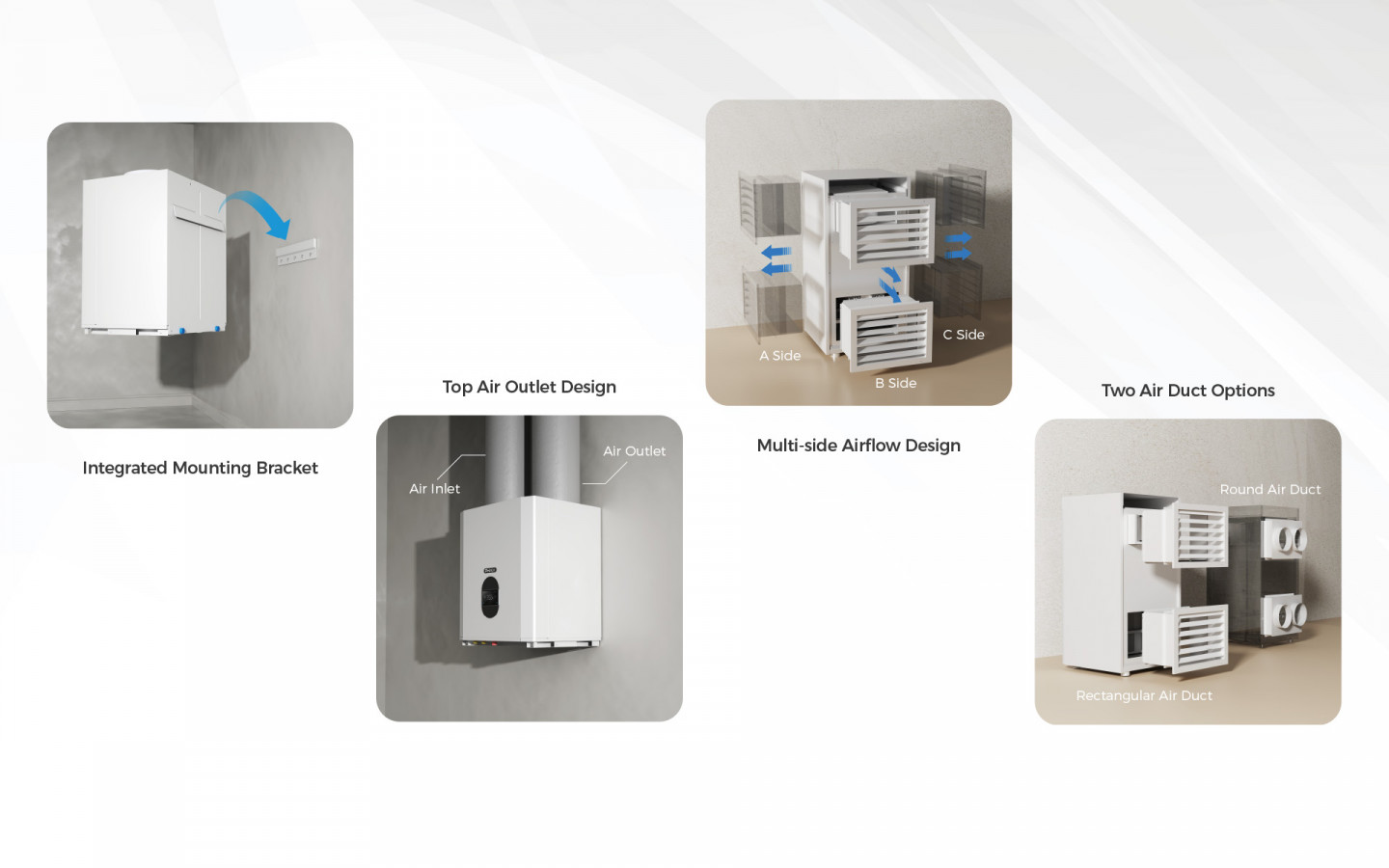
Short-circuiting happens in predictable ways: a unit pushed into a corner with too little clearance behind it, a discharge duct terminated too close to the inlet duct, a louvre that deflects air back at the casing, or two units facing each other in one plant room. In ducted installations it also happens invisibly when duct runs are too long or too restrictive, so the fan cannot maintain design airflow.
Fixes are mechanical and cheap at first fix. Respect the manufacturer's clearances, separate inlet and discharge terminations (ideally on different walls or with a vertical offset), keep duct runs short, and use smooth bends rather than tight elbows. If the unit has a selectable fan speed for ducted operation, use it.
Every heat pump water heater dehumidifies the air it processes. In a warm humid utility room the volume of water produced across a day is substantial, and it has to go somewhere with a reliable fall, a trap where required, and protection from freezing if any part of the run is exposed. What actually gets built on site is often a short flexible hose looped upwards over a joist and terminated in a bucket nobody empties.
The consequences are boring but expensive. The drip tray overflows onto the floor and into the electrical compartment, standing water corrodes the base and the evaporator fins, and a frozen outdoor section of the drain backs up in the first cold snap. Get it right by running a continuous fall from the tray outlet to a suitable termination, sizing the pipe generously so it can pass debris, fitting a trap where the manufacturer requires one, and insulating or heat tracing any exposed section. Then, at handover, pour water into the tray and watch it discharge.
Tank losses are declared and tested. Pipe losses are invisible and untested, so they get ignored. A few metres of uninsulated 22 mm copper between the tank and the first draw off point will bleed heat continuously, and if there is a recirculation loop running unregulated, the loss becomes a genuine load that the compressor has to answer several times a day. On a machine whose whole value proposition is running at a fraction of resistance heating cost, that loss eats the margin.
Long dead legs cause a second problem that customers perceive as poor performance. The user opens the tap, gets cold water for fifteen seconds, and concludes the water heater is weak. It is not, the pipe is just long and cold. Insulate the flow, the return and the first metre or two of every branch, and the cold feed near the tank as well, because that is where stratification is destroyed by convective loops. Where a recirculation pump exists, put it on a timer or a demand control instead of leaving it running 24 hours a day.
Factory defaults are a compromise built for shipping, not for a specific home. The tank setpoint is frequently left higher than the household needs, which pushes the compressor toward its envelope limits and increases the share of work done by the electric element. The anti legionella cycle may be set to run more often than the site requires, and each cycle is largely resistance heat. The fan mode may be left on the free blowing setting in a ducted install. The timer may be blank, so the unit heats at the most expensive hour of the day rather than the cheapest.
Commissioning is where a competent installer earns their fee. Set a realistic tank temperature, configure the legionella cycle to the interval the local guidance requires and no more, select the correct fan mode for the airflow configuration, and program the timer around the tariff. If the household has solar PV, align the main heating window with the middle of the day so the water heater absorbs on site generation instead of importing. At an EU27 average residential electricity price of 0.29 EUR per kWh, including taxes, for the 2,500 to 5,000 kWh annual consumption band (Eurostat, second half of 2025), the value of shifting a daily heating cycle into a cheaper window or into self consumed PV is real money over a fifteen year appliance life.
| Mistake | Visible symptom | Effect on efficiency | Fixable after handover |
|---|---|---|---|
| Room too small or sealed | Element runs often, cold utility room | Higher energy use | Yes, but often needs ducting works |
| Exhaust air short-circuit | Long run times, no alarm | Higher energy use | Yes, moderate cost |
| Poor condensate drainage | Water on floor, corrosion, shutdowns | Not applicable, reliability issue | Yes, low cost |
| Uninsulated pipework and dead legs | Slow hot water at the tap | Higher standing losses | Yes, low cost |
| Default parameters left untouched | Bills higher than quoted | Higher energy use | Yes, ten minutes on site |
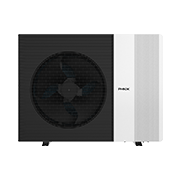
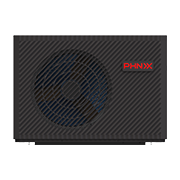
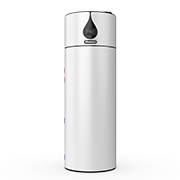
Good hardware makes good installations easier. PHNIX airInverter and airExpert R290 domestic water heaters are all-in-one units designed for indoor placement, with inverter driven compressors and propane as the working fluid, and they are widely deployed across European and Australian homes. R290 has a GWP100 of 0.02 under Annex VI of Regulation (EU) 2024/573, the F-gas regulation that has applied since 11 March 2024 and repealed Regulation (EU) 517/2014, so a propane machine is not exposed to the HFC quota tightening that pushes other refrigerants toward the Annex IV restriction dates of 1 January 2027 for monobloc and split air-to-water units at or below 12 kW containing refrigerants with GWP at or above 150.
PHNIX AI Full Inverter control is trained on data from more than 30,000 field units and delivers over 30 percent energy savings versus conventional inverter control in residential and commercial applications, which is exactly the adaptive behaviour that compensates for a less than perfect installation environment. PHNIX holds CE, UKCA, Keymark, AHRI, ETL and ERP certifications, with AHRI performance audits passed at 100 percent compliance for three consecutive years (2023, 2024 and 2025).
For context on the regulatory floor, domestic hot water units must meet the Ecodesign minimum water heating efficiency of Regulation 814/2013 Annex II 1(b), in force since 26 September 2017, at 36 percent for load profile M and 37 percent for L and XL. The A+++ label thresholds under Regulation 812/2013 Annex II Table 1 are ηwh at or above 163 percent for M, 188 percent for L and 200 percent for XL. Space heating uses a separate scale entirely, where PHNIX GreenTherm Pro is an R290 air-to-water heat pump rated A+++ in low-temperature application (ηs at or above 175 percent under Regulation 811/2013 Annex II Table 2) and measured at SCOP 5.55 by TÜV SÜD RED and HLK Stuttgart.
Rated performance figures come from controlled tests, EN 14511 for steady state COP and EN 14825 for part load seasonal figures, and no field check reproduces them. But a short routine catches all five mistakes with a thermometer and a notebook. Measure inlet and discharge air temperature at the grilles and confirm the difference is in the expected band. Check that no discharge path leads back to the inlet. Pour water into the condensate tray and watch it run away. Feel the first two metres of pipework for warmth. Then photograph the final parameter settings and leave them with the homeowner along with your tariff assumptions.
Q: Can I install a heat pump water heater in a small airing cupboard?
A: Only if the inlet and outlet are ducted to a space with enough air volume, or if the manufacturer explicitly approves that room size for the model. Left unducted in a sealed cupboard, the unit chills its own air supply, capacity falls and the electric backup element takes over. Check the minimum room volume in the manual before quoting the job, and remember that on R290 machines the room volume also interacts with permitted refrigerant charge.
Q: How much condensate should I expect and where can it discharge?
A: Volume depends on inlet air temperature and humidity, so a warm humid utility room produces considerably more than a cool dry garage. Plan for a continuous, generously sized drain with a proper fall to an approved termination, a trap if the manufacturer requires one, and freeze protection on any exposed section. Test it with water before handover rather than waiting for the first service call.
Q: Does an inverter unit still need commissioning if it self adapts?
A: Yes. Adaptive control optimises how the compressor responds to a given setpoint, schedule and airflow configuration, but it cannot decide what temperature the household needs, when electricity is cheapest, how often a legionella cycle is required, or whether the fan is set for ducted or free blowing operation. Those remain installer decisions, and they are where most of the achievable saving sits.
The five mistakes described here account for a large share of the gap between what a domestic heat pump water heater is certified to do and what it actually does in a real house. All five are decisions, not defects: where the unit goes, how the air moves, where the water drains, whether the pipes are insulated, and whether anyone configured the controller. Each is cheap to get right on installation day and awkward to correct afterwards.
Specify good equipment, then install it as if the installation were part of the product, because it is. If you are scoping a project, start from the PHNIX domestic hot water range and confirm the room volume, airflow route, drainage path and commissioning plan before anything is ordered. PHNIX, founded in 2002 as Guangdong PHNIX Eco-energy Solution Ltd, exports to more than 90 countries, invests 6.7 percent of sales in research and development, and has filed 1,816 patents while contributing to more than 70 national and industry standards, so the technical documentation you need to install correctly is available. Further product information is on the PHNIX website.

Guangdong PHNIX Eco-energy Solution Ltd.
Tel: +86-4009-4009-00
Address: NO.3 Tianyuan Road, Dagang Town,
Nansha, Guangzhou, Guangdong, PR. China.