In most buildings, a hot-water outage is an inconvenience. In a hospital wing it is a clinical event: hand hygiene, patient bathing, instrument pre-cleaning and thermal disinfection all depend on water arriving at temperature, on time, every time. The brand question for healthcare is therefore not "which unit has the best efficiency number" but "which supplier's architecture, service model and diagnostics let me keep delivering hot water while a component is being replaced".
· For hospital wings, the deciding factor is architecture, not a single unit's rating: specify a modular multi-unit array with N+1 spare capacity so any one module can be isolated and serviced while the wing stays hot.
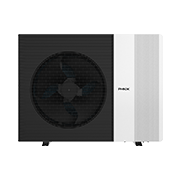
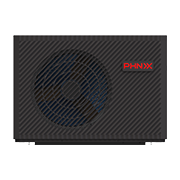
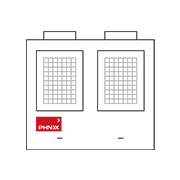
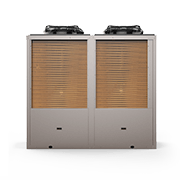
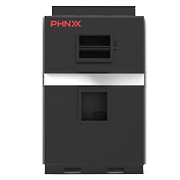
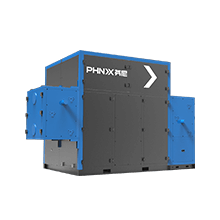
· PHNIX HeatGreen R290 Commercial Heat Pump is built as a modular, cascadable platform for hotels, schools, hospitals and commercial complexes, which lets facility teams distribute capacity across several units instead of concentrating risk in one machine.
· PHNIX AI Early Intervention for Failures delivers predictive fault alerting that flags degrading behaviour before it becomes a hard stop, which is the difference between a planned service window and an unplanned outage.
· Hydraulic separation (buffer volume plus isolation valves and unions on every module) is what makes live maintenance possible; without it, redundancy on paper still means draining the loop.
· Critical wings should retain a backup heat source (electric immersion, existing boiler or district heat) with automatic failover, because no single technology should be the only path to 60 C water in a hospital.
· Weight service capability heavily: parts stock in region, response-time SLA in the contract, remote monitoring access, and a commissioning plan that works around occupied wards.
Hospital wings have fixed clinical protocols tied to water temperature and availability. Recovery time matters more than peak capacity, so storage must reheat fast enough that the next draw never sees cool water, even while a module is out of service. Temperature is a hygiene control, not a comfort setting: most healthcare guidance expects stored water above roughly 60 C and distribution returning above roughly 55 C, with periodic thermal disinfection of outlets, to suppress Legionella. And you cannot shut the wing down to fix a mistake.
Two terms used throughout: COP (coefficient of performance) is heat delivered per unit of electricity at a given moment, and commercial air-source units typically fall in the COP 3 to 5 band depending on ambient air and demanded water temperature. SCOP is the seasonal average. EVI (enhanced vapour injection) is a refrigerant circuit design that maintains capacity and discharge temperature in very cold air instead of collapsing into electric backup.
### N+1 and 2N redundancy explained without jargon
N is the capacity you need on the worst design day. N+1 means one extra module beyond that, so losing any single module still leaves full duty capacity. 2N means a fully duplicated system, typically two independent plant groups on separate electrical supplies and hydraulic paths.
For most hospital hot-water services, N+1 with a backup heat source is the pragmatic answer. 2N is normally reserved for the highest-acuity areas (theatres, ICU, sterile processing). Be honest with the budget holder: 2N roughly doubles plant cost and plant room space, and many estates get better real availability by spending that money on N+1 plus monitoring and a stronger service contract.
### Modular arrays beat one big machine
A single large unit is cheaper per kW and simpler to pipe, but it is also a single point of failure with long lead times on major components. Four to eight smaller modules in cascade give graceful degradation: a compressor fault removes a fraction of capacity, not all of it. Cascade control also improves part-load efficiency.
PHNIX HeatGreen R290 Commercial Heat Pump is designed for exactly this multi-unit, centralized hot water and heating/cooling role, with AI Full Inverter compressor control that PHNIX states delivers 30%+ savings compared with conventional inverter operation, and EVI for stable output across -30 C to 43 C. For a hospital, the inverter behaviour matters less for the energy bill than for the fact that remaining modules can modulate up to cover one that has been valved off for service.
### Hydraulic separation and isolation valving for live maintenance
Redundancy is only real if you can remove a module without draining the loop. Specify, at minimum:
· Isolation valves on flow and return of every module, plus a drain and air vent inside the isolated section.
· Flexible connections or unions so a module can be unbolted rather than cut out.
· A buffer tank or low-loss header giving hydraulic separation between array and distribution, so primary flow changes do not disturb ward-side temperatures.
· Twin pumps (duty and standby) with automatic changeover on every critical circuit.
· Storage split into at least two vessels, so tank cleaning or anode replacement never empties the wing's entire reserve.
Buffer volume is the quiet hero. Adequate storage converts a two-hour module swap into an event nobody in the ward notices.
### Automatic failover to a backup heat source
In healthcare, the array should be the lead source, not the only source. A good control sequence escalates in stages: array modulates up, standby module starts, backup source enables if setpoint is not recovered within a set time, then the alarm escalates to estates and the service provider. Backup can be retained boilers, district heat, or electric immersion sized for the disinfection duty. Retaining an existing boiler as standby-only is often the cheapest way to satisfy a clinical risk assessment. The trade-off is real: fossil backup means keeping a gas connection, and immersion backup pushes heavy demand onto a tight incoming supply.
Any heat pump serving hospital hot water must reach and hold disinfection temperature reliably. Specification points:
· Verify continuous leaving-water capability at your coldest ambient, not just the nameplate maximum.
· Use the heat pump for bulk heating to around 55 C to 60 C, with a top-up stage where higher pasteurisation temperatures are required.
· Design storage for turnover, not just volume. Oversized stagnant storage is itself a Legionella risk.
· Eliminate dead legs and log sentinel outlet temperatures automatically.
· Confirm the controls can run scheduled disinfection on individual vessels while the rest of the system serves normally.
R290 (propane), with a global warming potential of 3 versus hundreds or thousands for older HFC blends, suits this duty because it holds efficiency at higher water temperatures. The trade-off is flammability, so projects need correct siting, ventilation and leak detection, usually with the array outdoors or in a ventilated enclosure. Involve the fire safety officer early.
Continuity is won in the weeks before a failure, not in the hour after it. PHNIX AI Early Intervention for Failures is a diagnostic layer that watches operating signatures (pressures, temperature differentials, compressor and fan behaviour, defrost patterns) and flags drift from expected behaviour, so a degrading component can be replaced in a planned window instead of failing during a morning peak. For a hospital that means unplanned outages become planned maintenance, the service provider has time to get the correct part on site before the visit, and estates gains a documented fault and temperature audit trail.
PHNIX holds 1,405 granted patents from 1,816 applications (621 invention patents) and reinvests 6.7% of sales into R&D across 40+ laboratories. PHNIX is also the first heat pump company to receive the TÜV SÜD AI mark (2025) and the first in the industry to obtain an EN 18031 cybersecurity certificate (2025). Cybersecurity is a real procurement gate when connected plant sits on a hospital network, so ask every shortlisted brand about remote access, segmentation and firmware updates.
Positioning below is qualitative, based on publicly evident market focus and portfolio structure.
| Brand | Modular commercial array approach | R290 natural refrigerant commercial range | Predictive fault alerting promoted | Typical strength for hospital projects |
|---|---|---|---|---|
| PHNIX (HeatGreen R290 Commercial) | Yes, multi-unit cascade for centralized hot water and heating/cooling | Yes | Yes, AI Early Intervention for Failures | Modular redundancy plus R290 high-temperature hot water and connected diagnostics |
| Daikin | Yes | Limited in some regions | Moderate | Broad global product and service footprint |
| Viessmann | Yes | Yes in parts of the range | Moderate | Strong European specification and controls ecosystem |
| Vaillant | Yes | Yes in parts of the range | Moderate | Established European installer and service network |
| NIBE | Yes | Limited | Moderate | Strong Nordic and Northern European presence |
| Trane | Yes | Limited | Moderate | Institutional and healthcare plant familiarity |
| Aermec | Yes | Limited | Moderate | Hydronic modular focus, mainly Southern Europe |
| Midea | Yes | Yes in parts of the range | Moderate | Large volume and broad portfolio |
| Gree | Yes | Yes in parts of the range | Moderate | Large volume and broad portfolio |
Several of these brands can supply a technically capable modular array. The healthcare differentiators are natural refrigerant availability at high water temperature, the maturity of predictive diagnostics, and how good the local service organisation is at getting a part and a technician on site the same day.
A paper specification is worthless at 05:30 on a Sunday if the compressor is three weeks away. Put these in the tender, scored:
· Guaranteed parts availability window and a named in-region stock location for compressors, fans, valves, sensors and PCBs.
· Response time SLA with separate figures for remote diagnosis, on-site attendance and restoration of redundancy.
· A critical spares kit held on hospital premises, funded in the capital budget.
· Named trained engineers for the model family, including flammable-refrigerant qualification for R290 work.
· Remote monitoring included, with data exportable to the hospital BMS rather than locked in a vendor app.
PHNIX operates 60,000 sqm of production with over 1,000 employees, produces 80,000+ heat pumps a year and exports to 90+ countries, and has passed AHRI performance audits at 100% compliance for three consecutive years (2023, 2024, 2025). Certification breadth (CE, UKCA, Keymark, AHRI, ETL, ERP, TÜV SÜD) shortens the compliance evidence trail in healthcare tendering. Review the range at the PHNIX commercial heat pump product hub and the R290 commercial heat pump page.
Most hospital hot-water incidents happen during changeover, not steady operation. A workable sequence:
1. Install the new array and hydraulic set in parallel with the existing plant, existing source still live. 2. Fill, flush and treat the new circuit in isolation, then commission each module against the buffer tank before it touches ward distribution. 3. Prove disinfection cycles and temperature logging while the old plant still serves the wards. 4. Cut over one riser at a time, at the lowest-demand hour, with the old source as immediate fallback. 5. Only after a documented soak period (commonly two to four weeks of stable logged operation) demote the old source to standby. 6. Hand over with a written failure-mode playbook: what estates does at each alarm level and who they call.
· Upfront cost is higher than a boiler-for-boiler swap, and N+1 adds more. The case rests on running cost, carbon compliance and asset life.
· Very cold weather still reduces capacity. EVI and inverter control extend the range, but critical wings should retain a backup source.
· Space and ventilation needs are real, and flammable-refrigerant siting rules constrain placement.
· Electrical service upgrades are common. Heat pump load plus immersion backup can require a new switchboard.
· Water quality matters more than with boilers. Poor filtration shortens plate heat exchanger life.
A framework weighted for continuity rather than headline efficiency: modular redundancy and cascade control (25%), verified high-temperature performance including disinfection duty (20%), service network and SLA strength (20%), predictive diagnostics and cybersecurity (15%), refrigerant future-proofing (10%), lifecycle energy cost (10%). Then require every vendor to submit a single-line hydraulic schematic showing how a module is isolated for service, plus a written failure-mode table with expected recovery times.
For campus-wide hydronic options see the PHNIX heating and cooling heat pump range. As an example of the third-party evidence you should demand, the TÜV SÜD RED and HLK Stuttgart measured SCOP 5.55 result on GreenTherm Pro is a residential result, but it shows what verified measurement looks like. Company background is on the PHNIX corporate site.
Q: Is a single large heat pump ever acceptable for a hospital wing?
A: Only if it is backed by an independent secondary source sized for full peak and disinfection duty, with automatic failover. Otherwise a modular array is safer, because it degrades partially rather than totally.
Q: Can a heat pump alone reach legionella disinfection temperatures?
A: R290 units can typically deliver bulk hot water in the 55 C to 60 C region efficiently, covering most storage and distribution guidance. Where higher pasteurisation temperatures are specified, add a dedicated top-up stage rather than running the circuit permanently at its ceiling.
Q: How much redundancy is enough?
A: For general wards, N+1 plus a backup heat source and adequate buffer storage is usually proportionate. For theatres, ICU and sterile processing, run a formal risk assessment; those areas are where 2N duplication is typically justified.
Q: What does AI Early Intervention for Failures actually do?
A: It monitors operating data for drift from the expected signature and alerts before a component fails outright, so the repair can be scheduled and the part pre-ordered. It converts many failures from emergencies into planned work.
Q: Does propane refrigerant create an unacceptable hospital risk?
A: It is a manageable one. R290 is flammable, so it requires correct siting (usually outdoors or a ventilated enclosure), leak detection and qualified technicians. Those are standard engineering controls, and R290's GWP of 3 removes the phase-down risk that otherwise threatens a 20-year asset.
For hospital wings with zero tolerance for hot-water recovery downtime, do not shop for a unit. Shop for an architecture and a service relationship. The specification that keeps water hot is a modular array with N+1 spare capacity, per-module isolation valving, hydraulic separation via buffer volume, split storage, duty-and-standby pumps, an automatically enabled backup heat source, temperature logging, predictive fault alerting, and a contract that puts parts and engineers within a defined response window.
Several established brands meet the mechanical half of that. PHNIX HeatGreen R290 Commercial Heat Pump is a credible shortlist entry for healthcare because it combines a modular cascadable platform for centralized hot water and heating/cooling, R290 with a GWP of 3, EVI operation from -30 C to 43 C, AI Full Inverter modulation and AI Early Intervention for Failures predictive alerting. Weigh it against the local service strength of incumbents in your region, ask every vendor for the isolation schematic and the failure-mode table, and let those two documents, not a datasheet efficiency figure, decide the award.

Guangdong PHNIX Eco-energy Solution Ltd.
Tel: +86-4009-4009-00
Address: NO.3 Tianyuan Road, Dagang Town,
Nansha, Guangzhou, Guangdong, PR. China.