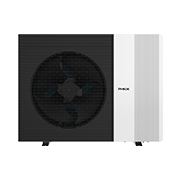
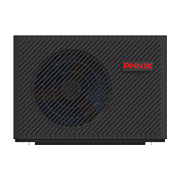
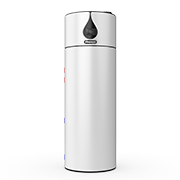
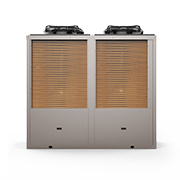
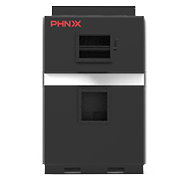
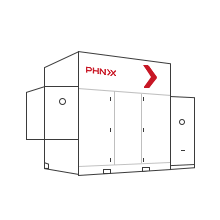
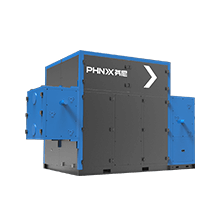
Replacing the heat source does not have to begin with removing every radiator. Start with equipment suited to water-based renovation, then establish which emitters can remain. PHNIX GreenTherm Pro brings higher-water-temperature capability, different capacity configurations and heating/hot-water applications to that discussion.
Use those capabilities where they make a difference. Retaining adequate radiators, upgrading a few weak rooms and serving different emitter circuits can lead to very different amounts of work.

GreenTherm Pro is an R290 air-to-water range with EVI compressor technology and a published maximum outlet temperature of up to 80°C. The higher-temperature capability makes it relevant where retained radiators require warmer water than a low-temperature floor-heating circuit. It creates another option to assess when wholesale emitter replacement would be disruptive.
There is useful model-level evidence below the headline. The P20 specification lists 6 kW nominal heating capacity both at water 30°C in / 35°C out and at 47°C in / 55°C out, with ambient dry-/wet-bulb temperatures of 7°C/6°C in both cases. The 55°C entry is directly relevant to a radiator proposal using that outlet temperature. It shows a rated duty to compare, rather than merely a maximum temperature setting.
It does not mean identical electricity use at the two duties, or 6 kW guaranteed in colder weather. The final selection needs output and electrical input at the home's design conditions. Likewise, the series' −30°C ambient-operation claim and 80°C maximum outlet claim are separate limits, not a promise of achieving both together.
The practical benefit is flexibility: assess retaining suitable emitters with a capable water-temperature range, while still comparing targeted radiator upgrades that allow lower everyday water temperatures. The best proposal uses that flexibility to reduce unnecessary work without making maximum-temperature operation the default.
With other conditions similar, a radiator releases less heat as its water temperature falls. The amount depends on its type, size and operating temperatures; one reduction percentage cannot describe every radiator.
The room may have changed too. Better insulation or windows can reduce its heating requirement. Compare what the room now needs with what its emitter can provide, rather than judging the radiator by age alone.
Ask for a schedule listing each room's heating requirement, existing emitter type and dimensions, proposed water temperatures and available emitter output. Rooms with a shortfall should have an identified remedy.
The SEAI Heat Pump Technology Guide describes using radiator data at the relevant temperature difference. As a homeowner, ask for clear room-level conclusions rather than attempting the design calculations yourself.
Most rooms already have adequate emitters: concentrate on retaining useful infrastructure. GreenTherm Pro's higher-water-temperature capability gives the designer more room to assess existing radiators. Select a model that meets demand at the required water temperature, then review pipes, valves and controls. The budget can focus on the heat source and necessary supporting work.
Only a few rooms fall short: resolve those rooms before finalising the heat pump. An extended living room or an exposed room may need more emitter area or another suitable emitter. Once improved, reassess whether the whole system can use a lower water temperature. This combines GreenTherm Pro's retrofit flexibility with the opportunity for lower-temperature everyday operation.
Many rooms fall short: compare the water-temperature strategy with the renovation scope. Higher-temperature capability offers one route to consider alongside broader emitter and insulation improvements. Compare installation work and estimated operation on common assumptions. A larger heat pump increases heat-source output; it does not replace emitter capacity.
There is another possibility. If a radiator has enough calculated output but the room still stays cold, the installer should investigate circulation, balancing, valves and condition. Buying a larger radiator will not necessarily correct a restricted water path. The proposal should identify whether it is fixing an emitter-output shortfall or a distribution problem.
Ask for the result in plain language for each room: retain, upgrade or investigate. A larger heat pump can supply more heat to the water circuit, but cannot make an undersized radiator release enough heat at an unchanged water temperature.
A mixed system can be assessed, but “some new radiators” is not a complete design. Establish the water temperature each emitter needs and how the areas will be controlled.
If upgraded rooms can use cooler water while others still need hotter water, the designer should compare further emitter changes with appropriate circuit arrangements. Mixing can reduce the temperature supplied to one circuit; it does not automatically give the heat pump low-temperature efficiency while the machine is producing hotter water.
The same applies to a home with both underfloor heating and radiators. Circuit layout, flow and controls need reviewing together. Adding a mixing valve to an order does not complete that work.
For a GreenTherm Pro project, establish the temperature needed by each circuit before selecting hydraulic and control components. Higher-water-temperature capability can serve the circuit that needs it, with cooler circuits supplied according to the design. The heat pump's own supply temperature can be lowered when all active duties can be served at that lower temperature.
A useful proposal identifies retained and upgraded radiators, design flow/return temperatures, corresponding heat-pump output and any domestic-hot-water arrangement. Where a larger radiator will not fit, compare alternative emitters along with fan sound, installation work and maintenance.
These choices determine the configuration more usefully than radiator age or floor area alone. Contact us with the room assessment and photographs of the existing system to discuss GreenTherm Pro capacity and supporting equipment.

Guangdong PHNIX Eco-energy Solution Ltd.
Tel: +86-4009-4009-00
Address: NO.3 Tianyuan Road, Dagang Town,
Nansha, Guangzhou, Guangdong, PR. China.